Taj Mahal: The Story, Art and Enduring Wonder Behind the White Marble
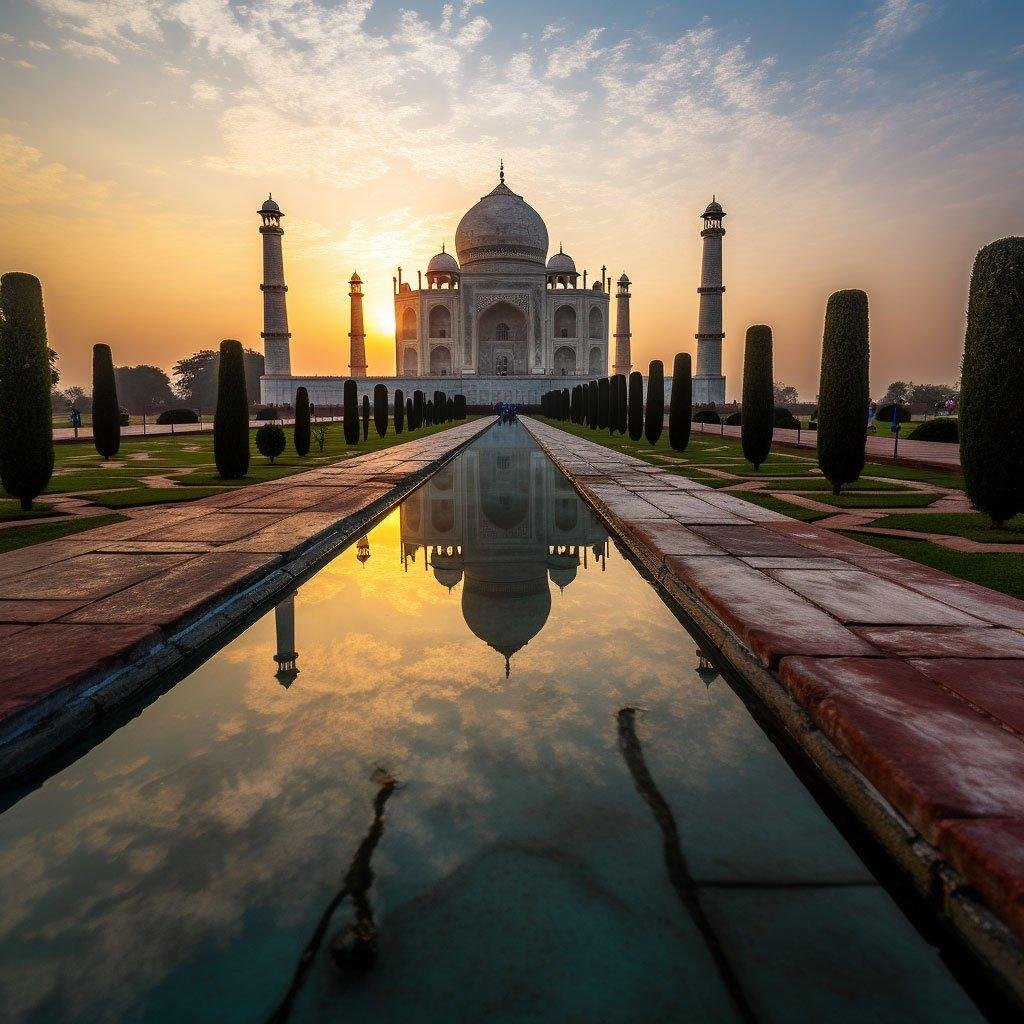
Almost everyone encounters the Taj Mahal before they ever reach Agra. It appears in schoolbooks, travel advertisements, films and photographs: a pale dome, four slender towers, a long reflection in water. Familiarity can make the building seem easy to understand. A king loved his wife, she died, and he built something beautiful in her memory.
That story gives the Taj its emotional centre. It does not explain all that surrounds it.
There are the hands that cut its stone, the calculations behind its proportions, the words inlaid around its arches, and the garden that turns the approach into a carefully measured experience. There is also the less comfortable history of imperial wealth and power. The monument holds all of these things together without announcing how difficult that achievement was.
From a distance, the composition seems remarkably simple. Move closer, and that simplicity breaks into thousands of decisions. A leaf curves across marble. A dark line sharpens an arch. A carved screen filters daylight. The Taj rewards both ways of looking: the glance that recognises it and the attention that begins to understand it
Where is the Taj Mahal, and what was it built for?
The Taj Mahal stands beside the Yamuna River in Agra, Uttar Pradesh, India. Emperor Shah Jahan commissioned it as a Mughal funerary complex in memory of Mumtaz Mahal. The famous white building is its mausoleum, but the larger composition includes a garden, a monumental gateway, a mosque and a matching building on the opposite side. [14]
Thinking of it as a complete place changes the experience. The gateway prepares the first view; the paths establish distance; the water carries the reflection; the side buildings frame the tomb. Remove any one of those relationships and the familiar photograph would lose part of its strength.
The Taj is therefore worth approaching as a sequence, rather than as a single object waiting at the end of a queue.
Shah Jahan and Mumtaz Mahal: the people behind the monument
Mumtaz Mahal was born Arjumand Banu Begum. She married Prince Khurram, the future Shah Jahan, in 1612. Their marriage became one of the most remembered relationships in Mughal history, largely because of the extraordinary memorial that followed her death. [2]
She died in Burhanpur in 1631 after giving birth to their fourteenth child. Her death, far from Agra, set in motion the project that would eventually make her resting place known worldwide. [3]
Mumtaz was initially buried in Burhanpur, and her remains were subsequently brought to Agra. Court accounts describe the emperor’s profound grief, although the picturesque details repeated in popular retellings should be treated with care. History can establish a bereavement and a monumental response more securely than it can reconstruct every private conversation between husband and wife. [4]
There is no need to invent a deathbed speech to make the story moving. A woman died, and the person who mourned her possessed the resources of an empire. The result was an attempt to give permanence to something that had disappeared from his life.
When was the Taj Mahal built?
The project developed after Mumtaz Mahal’s death in 1631. UNESCO’s detailed account dates the start of construction to 1632, the mausoleum’s completion to 1648, and completion of the remaining major works to 1653. This explains why accounts can give different dates without necessarily describing different monuments. [1]
The familiar statement that the Taj took about twenty-two years to build refers broadly to the undertaking from its inception through completion of the wider complex. It should not be read as a claim that every part was started and finished at the same time. [5]
This was an extended building programme. Design, stone supply, structural work, decoration and landscape construction demanded coordination across many years. The finished composition hides that long process unusually well. Its parts look inevitable, as though they had always belonged together.
Who designed and built it?
UNESCO identifies Ustad Ahmad Lahori as the principal architect. Yet the Taj Mahal was also the work of a large collaborative organisation, with architects, supervisors, masons, stonecutters and specialist craftspeople contributing different kinds of knowledge. [1, 5]
Uttar Pradesh Tourism describes a workforce of approximately 20,000. Such a number is best treated as a historical estimate, rather than a precise modern employment record. Its account also identifies Amanat Khan of Shiraz as the chief calligrapher. [5]
An emperor could commission the building, but he could not personally produce the precision of every joint or the delicacy of every flower. That distinction matters. Remembering the Taj only through its royal patron leaves out the skill that made the patron’s ambition possible.
The most useful question, then, is not simply who built the Taj Mahal, but how so many forms of expertise came to work toward one coherent result.
Reading the architecture: how the whole complex works
The Taj belongs to the Mughal architectural tradition, drawing on Persian and Central Asian precedents alongside building practices and decorative forms developed in India. Its design is especially associated with the refinement, controlled symmetry and naturalistic ornament of Shah Jahan’s reign. [6]
Its effects are easier to notice when you stop thinking of ornament as something added after the architecture. Here, decoration helps organise the building. Borders define surfaces. Repeated forms establish rhythm. Changes in material tell the eye which element deserves attention.
The gateway and the first view
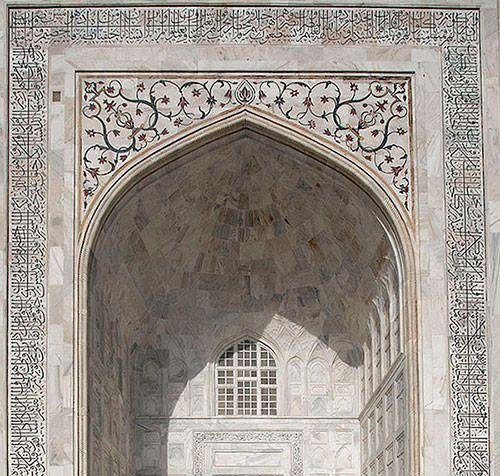
The great entrance gateway is an essential part of the approach. Its arch encloses a view of the mausoleum, making the transition into the garden feel deliberate. Its surfaces carry floral decoration and Quranic calligraphy. [7]
Pause here if visitor flow allows. First look at the white building within the darker frame, then at how much space lies between you and the tomb. A camera tends to flatten that distance; walking through it restores the scale.
The garden and water channels
The garden follows the charbagh tradition: a planned landscape divided into four principal sections by intersecting axes. At the Taj, the mausoleum stands at the riverward end rather than at the garden's centre. The riverfront setting is integral to the composition. [8]
The channels, paths and planting organise the approach into intervals. They give the eye somewhere to travel and the visitor a reason to slow down. The reflection offers another version of the building, altered by the water's movement and condition.
The garden also carries a religious meaning. The wider design has been interpreted through Islamic ideas of paradise, with the tomb imagined within a sacred, ordered landscape. [6]
That association should not make the garden feel like a puzzle with one answer. Its immediate effect is physical: distance, shade, light and the measured movement toward the mausoleum.
The dome, arches and minarets
The central dome rises above a cylindrical drum and is accompanied by smaller domed pavilions known as chhatris. Lotus ornament and a crowning finial complete the silhouette. Below, large recessed arches give depth to the façades. [9]
Four minarets mark the corners of the mausoleum platform. Each is more than 130 feet tall, and balconies divide their shafts into stages. Their slenderness keeps the central building visually dominant while giving the composition an outer boundary. [9]
Notice how differently the dome and towers behave. The dome gathers the eye toward the centre; the minarets stretch the composition outward and upward. The building’s balance comes as much from that relationship as from its left-to-right symmetry.
The mosque and its counterpart
Red sandstone buildings flank the mausoleum. The mosque stands to the west; the corresponding building to the east is commonly called the jawab, meaning “answer,” or the guest house. Their paired forms balance the composition around the white tomb. [10]
Look beyond the central façade when you reach this part of the complex. The side buildings help explain why the marble appears so luminous: colour and placement work together. The white tomb is the visual centre because the surrounding architecture makes it so.
White marble and the art of looking closely
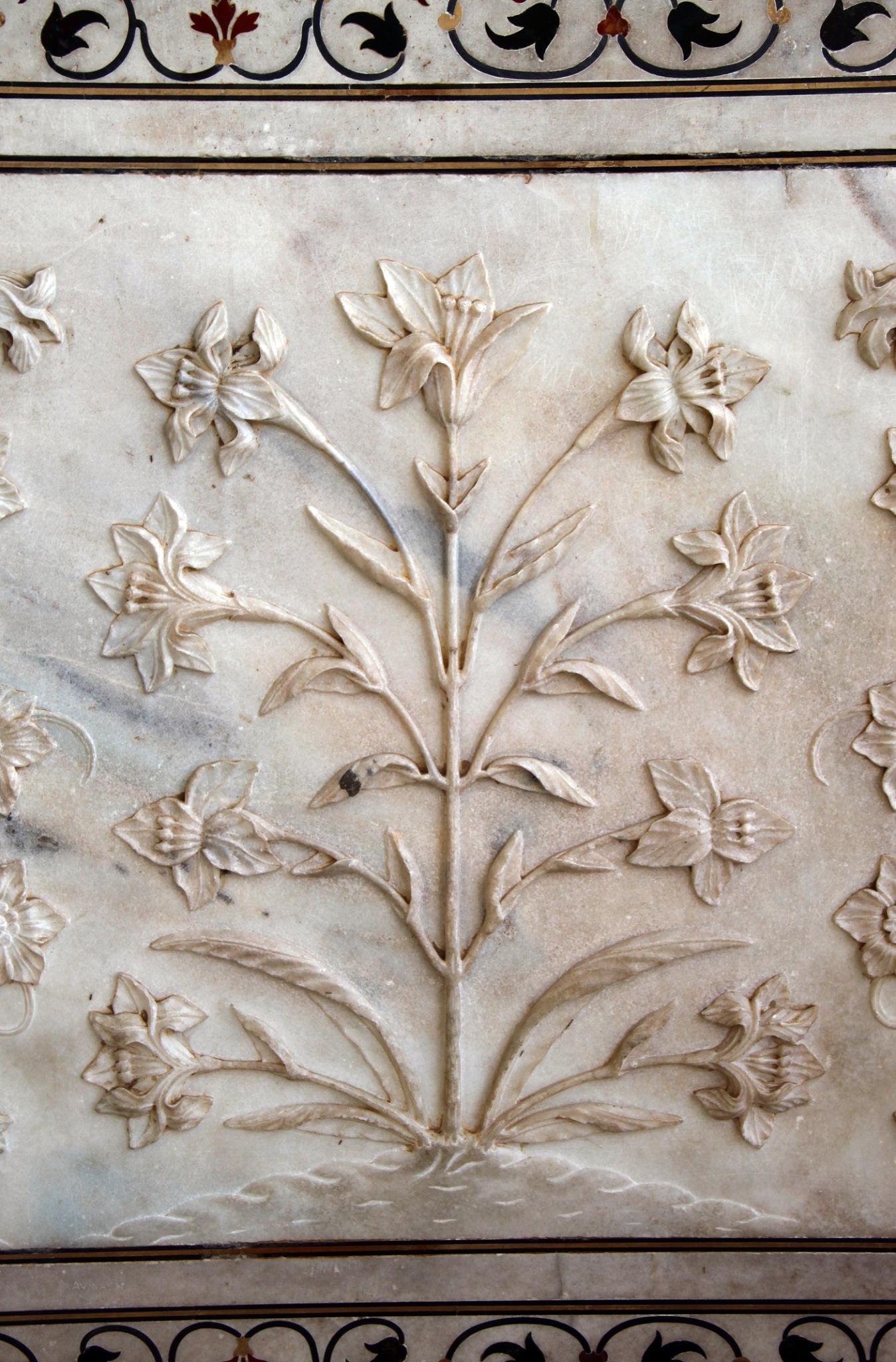
The mausoleum’s celebrated marble came from Makrana in Rajasthan. Its decoration includes stone inlay often described as pietra dura or parchin kari, in which shaped pieces of coloured stone form patterns within the marble surface. [10]
From the garden, the Taj can seem almost unadorned. Close inspection changes that impression. Floral motifs, borders and carved details bring an entirely different scale into view.
The strongest way to appreciate this work is to choose a small area and study it patiently. Follow a stem. Notice where a curve narrows. Compare the sharpness of a border with the softness of a flower. You do not need to identify every stone to recognise how difficult it is to make rigid materials appear fluid.
This is also why the Taj’s apparent changes of colour attract so much attention. Different light and atmospheric conditions change how its surfaces are perceived. The building may appear warmer, cooler, clearer or more muted at different moments; the marble is not undergoing a magical transformation. [1]
A sunrise photograph and a midday photograph can feel like portraits of different moods. Neither is the complete building. Both record a temporary meeting between stone, weather and light
Calligraphy: words built into the monument
The Taj’s calligraphy is an architectural element as well as a religious one. Quranic passages frame important openings, while inscriptions around the cenotaphs are more delicate in scale. The work is associated with Amanat Khan, whose signature survives within the inscription programme. [11]
The writing uses thuluth script. Dark lettering set against pale marble gives the text visual clarity and helps articulate the edges of the architecture. Its themes include divine mercy, judgement, and paradise. [11]
Even visitors who cannot read Arabic can see the role these inscriptions play. The letters establish movement within a border, and the border establishes order within a much larger surface. Meaning and composition reinforce each other.
What is inside the Taj Mahal?
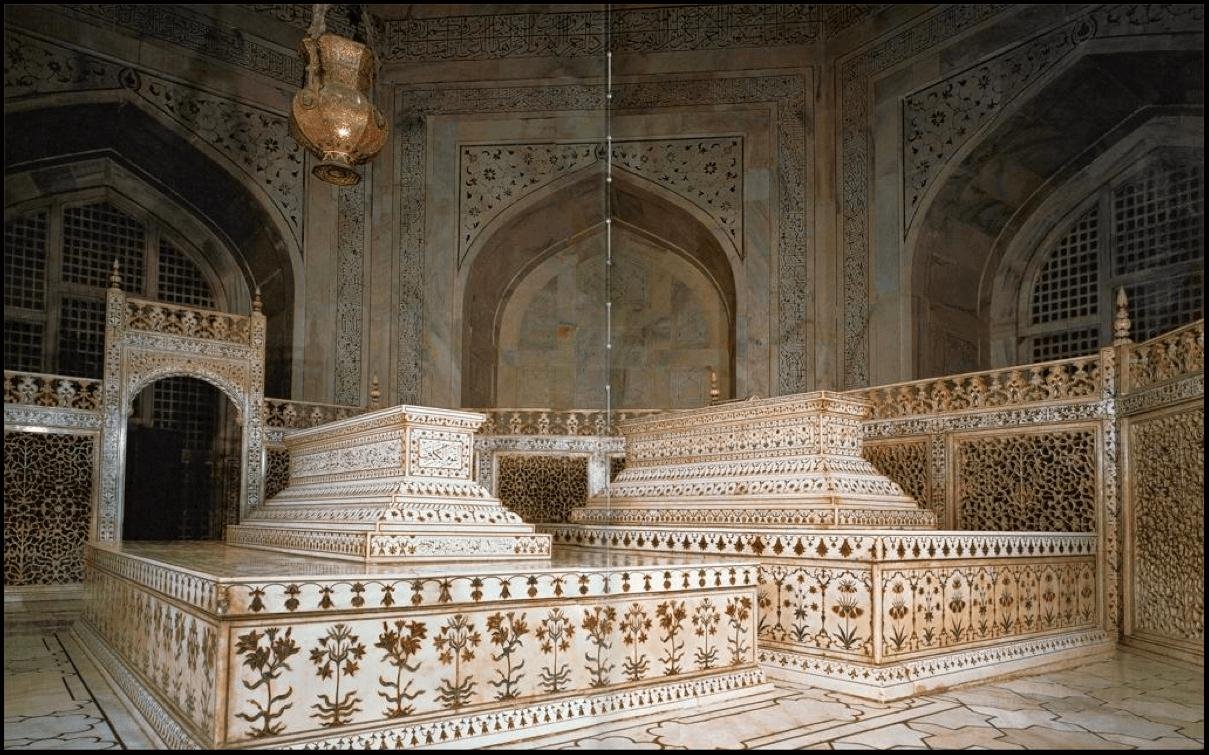
The main chamber contains the cenotaphs of Mumtaz Mahal and Shah Jahan. These are commemorative monuments; the actual graves are in a lower burial chamber. Confusing the visible cenotaphs with the graves is one of the most common misunderstandings about the interior. [12]
The central hall is octagonal. Marble screens, patterned floors, inscriptions and carefully worked floral ornament give the interior a character distinct from the open brightness outside. Mumtaz Mahal’s cenotaph occupies the central position, while Shah Jahan’s was later placed beside hers. [12]
That later addition introduces a noticeable asymmetry into the paired cenotaph arrangement. It should not be exaggerated into a claim that nothing else anywhere in the entire complex departs from perfect symmetry.
The change in atmosphere deserves attention. Outside, the building addresses a landscape and a skyline. Inside, the focus contracts to two memorials and the human loss behind the commission.
Shah Jahan’s final years
The emperor’s later life was marked by a struggle for power within his family. Aurangzeb displaced him in 1658, and Shah Jahan spent his remaining years confined at Agra Fort. He died in 1666 and was buried beside Mumtaz Mahal. [14]
Popular storytelling often dwells on the image of an ageing emperor looking toward the Taj. The emotional appeal is understandable, but the larger historical point is just as powerful: the patron’s authority proved temporary, while the building survived the political order that produced it.
The Taj is a memorial to love, but its history also contains succession, confinement and mortality. Those elements give the familiar romantic story greater depth.
Famous legends: what should readers believe?
The proposed Black Taj Mahal
A persistent legend says Shah Jahan intended to build a matching black-marble mausoleum across the Yamuna. The story has a long life in travel writing, but a confirmed building project for such a twin has not been established. The “Black Taj” is best presented as a legend, not a missing second half of the existing monument. [13]
Stories about craftsmen’s hands being cut off
Another widely repeated story claims that the builders were mutilated so they could never reproduce their work. Reliable evidence does not establish this as an event, and a responsible account should not repeat it as fact. [14]
These tales tell us something about the monument’s reputation: people have found its beauty so extraordinary that they reach for extraordinary explanations. The documented achievement of skilled workers is impressive enough without adding cruelty unsupported by evidence.
Why is the Taj Mahal a world wonder?
The Taj became a UNESCO World Heritage Site in 1983. It was also named among the New7Wonders of the World in 2007 through a separate public-voting initiative. The two recognitions are distinct; the New7Wonders result was not a UNESCO designation. [1, 15]
Its fame, however, cannot be explained by a list alone. The monument is unusually accessible to the eye. You can recognise its overall form almost immediately, yet spend a long time discovering what holds that form together.
It also allows different kinds of attention. A traveller can appreciate its proportions without knowing Mughal history. A craftsperson can study its stonework. A historian can examine its patronage. Someone grieving can recognise the impulse to preserve a memory. None of these readings has to exclude the others.
Conservation: the work behind its survival
The Archaeological Survey of India manages the Taj Mahal. Pollution, environmental conditions and the pressures of visitation make its preservation an ongoing responsibility. UNESCO describes monitoring of air quality and the monument’s structural condition as part of its protection. [1]
Calling a building timeless can conceal the effort required to keep it standing. Historic stone does not look after itself. Cleaning, maintenance and careful management are part of the monument’s present life, even when they temporarily interrupt a familiar view.
Visitors contribute through small choices: respect barriers, avoid touching decorated surfaces, and accept that access may sometimes be limited for conservation. The photograph is personal; the responsibility extends beyond any one visit.
Visiting the Taj Mahal: hours, tickets and practical advice
Visitor information below was checked against official tourism pages on 7 October 2026. Recheck the official website and booking portal before travelling, particularly for holiday arrangements, ticket categories and temporary restrictions.
Opening hours and Friday closure
The published general visiting hours run from 30 minutes before sunrise until 30 minutes before sunset. The Taj Mahal is closed to general sightseeing on Fridays. Seasonal sunrise and sunset times therefore matter more than a single fixed opening hour. [16]
Published daytime ticket prices
The official tourism page lists these base admission prices, with a separate ₹200 charge for entry to the main mausoleum: [16]
Indian visitors and OCI cardholders: ₹50 base admission; ₹250 including the main mausoleum.
Citizens of SAARC and BIMSTEC countries: ₹540 base admission; ₹740 including the main mausoleum.
Other foreign visitors: ₹1,100 base admission; ₹1,300 including the main mausoleum.
The page lists free entry for children below 15 and discounts for certain online purchases. Check the payable amount and category conditions on the official booking screen rather than assuming every ticket channel charges the same total. [16]
What to carry—and what to leave behind
Carry your ticket, government-issued identification and only what you need. The official guidance allows water bottles. It prohibits eating and smoking inside, photography within the main mausoleum, and drones inside and around the monument. Tripods and several electronic accessories are also restricted. Review the current list before packing. [17, 18]
Use an approved guide for detailed interpretation, and ask to see identification. Visitors needing mobility assistance should check current arrangements in advance; the tourism guidance notes wheelchair availability through the ASI office. [18]
Planning a comfortable visit
Give yourself enough time to experience the approach, garden and close-up detail without rushing, while respecting the duration and conditions printed on your ticket. Keep some flexibility for security queues and weather.
Early light may suit your photography plans, but it is not a guarantee of an empty site or clear skies. Decide what matters most to you: softer light, comfortable temperatures, fewer hotel changes, or enough energy for other monuments that day.
For a first visit, a modest plan is often the most rewarding. See the whole composition before concentrating on details. Spend a few minutes without a phone in your hand. Then photograph what actually caught your attention.
Can you see the Taj Mahal at night?
Special night viewing is generally scheduled around the full moon: the full-moon night and two nights on either side. The official page excludes Fridays and the month of Ramzan. These visits require separate booking and are organised in limited batches. [19]
The published arrangement gives each batch a 30-minute slot, with advance reporting for security checks. The official night-viewing page links to online ticketing. Check the date, reporting location, allowed belongings and exact slot on your booking confirmation. [19]
Approach night viewing as a different experience from daytime sightseeing. Moonlight, haze and cloud affect visibility. Expect a quieter view of the monument’s form, rather than the brightly illuminated detail that some edited photographs suggest.
What else should you see in Agra?
Agra Fort adds political and residential context to the Taj’s funerary architecture. Mehtab Bagh, across the Yamuna, offers a river-facing perspective on the mausoleum. The Tomb of Itimad-ud-Daulah rewards close attention to marble and decorative work, while Fatehpur Sikri provides a broader encounter with Mughal urban and court architecture. [20]
Choose according to your interests and available time. If the Taj’s craftsmanship holds your attention, allow room for another tomb rather than rushing through several unrelated stops. If its royal history interests you, pair it with the fort.
Seeing fewer places carefully can leave a stronger impression than collecting entrance tickets from every famous site.
Frequently asked questions
Is the Taj Mahal a palace?
Its principal purpose is funerary: it was built as Mumtaz Mahal’s mausoleum and later also became Shah Jahan’s resting place. Its palatial appearance can make that distinction easy to miss. [3]
Can visitors see the actual graves?
The familiar monuments in the main chamber are cenotaphs. The actual burials are below, in a separate lower chamber; ordinary sightseeing should not be understood as a visit to the graves themselves. [12]
Is a main-mausoleum ticket included automatically?
The published daytime structure separates base admission from the additional main-mausoleum charge. Check which option you selected before completing your purchase. [17]
Is photography allowed everywhere?
No. The official guidance prohibits photography inside the main mausoleum, and separate equipment restrictions apply elsewhere and during night viewing. Follow current signs and staff instructions. [18]
Is the Taj Mahal worth seeing if you already know its photographs?
A photograph can show the silhouette. It cannot fully reproduce the scale of the approach, the shift from bright garden to enclosed chamber, or the experience of moving from the entire building to a single worked flower. Familiarity with the image can be the starting point of a visit, rather than its substitute.
What stays with you
The Taj Mahal is often described through superlatives. After a while, they become less useful than a simple act of looking.
Notice how a dark border steadies a white surface. Notice how a tower gives space to the dome beside it. Notice how much labour is concealed inside the impression of ease. Then remember that this enormous undertaking began with the absence of one person.
The monument’s endurance lies partly in that tension. It belongs to an empire and to a marriage; to public history and private grief; to immense scale and the smallest carved detail. You do not have to choose one story and discard the others.
Give the Taj enough attention, and the famous outline begins to feel unfamiliar again. That is when the looking becomes worthwhile.
Sources and editorial notes
The article uses original prose and numbered source notes. Historical estimates are identified as estimates; popular legends are distinguished from established history. Visitor information was checked on 7 October 2026 and should be reviewed before publication and periodically afterwards.
[1] UNESCO World Heritage Centre — Taj Mahal. https://whc.unesco.org/en/list/252/
[2] Uttar Pradesh Tourism — The Cause of the Taj: Mumtaz Mahal. https://tajmahal.gov.in/the-cause-of-the-taj.aspx
[3] HISTORY — Taj Mahal: Location, Timeline & Architect. https://www.history.com/articles/taj-mahal
[4] Uttar Pradesh Tourism — Mumtaz Mahal. https://tajmahal.gov.in/about-mumtaz-mahal.aspx
[5] Uttar Pradesh Tourism — Creation History. https://tajmahal.gov.in/creation-history-of-taj-mahal.aspx
[6] Uttar Pradesh Tourism — Architecture. https://tajmahal.gov.in/architecture.aspx
[7] Uttar Pradesh Tourism — Entry to Taj Mahal. https://tajmahal.gov.in/entry-to-taj-mahal.aspx
[8] Uttar Pradesh Tourism — Taj Garden. https://tajmahal.gov.in/taj-garden.aspx
[9] Uttar Pradesh Tourism — The Taj Exteriors. https://www.tajmahal.gov.in/the-taj-exteriors.aspx
[10] Architectural Digest — The Taj Mahal: Everything You Need to Know. https://www.architecturaldigest.com/story/the-taj-mahal-everything-you-need-to-know
[11] Uttar Pradesh Tourism — Calligraphy. https://www.tajmahal.gov.in/calligraphy.aspx
[12] Uttar Pradesh Tourism — The Taj Interiors. https://www.tajmahal.gov.in/the-taj-interiors.aspx
[13] Black Taj Mahal — overview and referenced scholarship. https://en.wikipedia.org/wiki/Black_Taj_Mahal
[14] Taj Mahal — myths and referenced scholarship. https://en.wikipedia.org/wiki/Taj_Mahal
[15] New7Wonders — Taj Mahal. https://world.new7wonders.com/wonders/taj-mahal-1630-a-d-agra-india/
[16] Uttar Pradesh Tourism — Visiting Hours and Ticket Prices. https://tajmahal.gov.in/visiting-hours.aspx/ticketing.aspx
[17] Uttar Pradesh Tourism — Ticketing. https://www.tajmahal.gov.in/ticketing.aspx/visiting-hours.aspx
[18] Uttar Pradesh Tourism — Dos and Don'ts. https://tajmahal.gov.in/dos-and-donts.aspx
[19] Uttar Pradesh Tourism — Night View. https://www.tajmahal.gov.in/night-view.aspx
[20] Uttar Pradesh Tourism — Nearby Attractions. https://tajmahal.gov.in/nearby-attractions.aspx