Machu Picchu rewards a closer look. Beyond its celebrated panorama lies a carefully engineered Inca settlement shaped by water, mountains, royal authority, and people drawn from across an empire. This detailed guide explores archaeological evidence for its age and purpose, explains its terraces and ceremonial buildings, revisits its story of international recognition, and introduces the surrounding cloud forest. It also covers travel planning, ticket circuits, mountain hikes, conservation, and common misconceptions, helping readers appreciate the site as both an extraordinary historical place and a living part of Peru’s heritage.
Machu Picchu and the Inca World Behind the Famous View
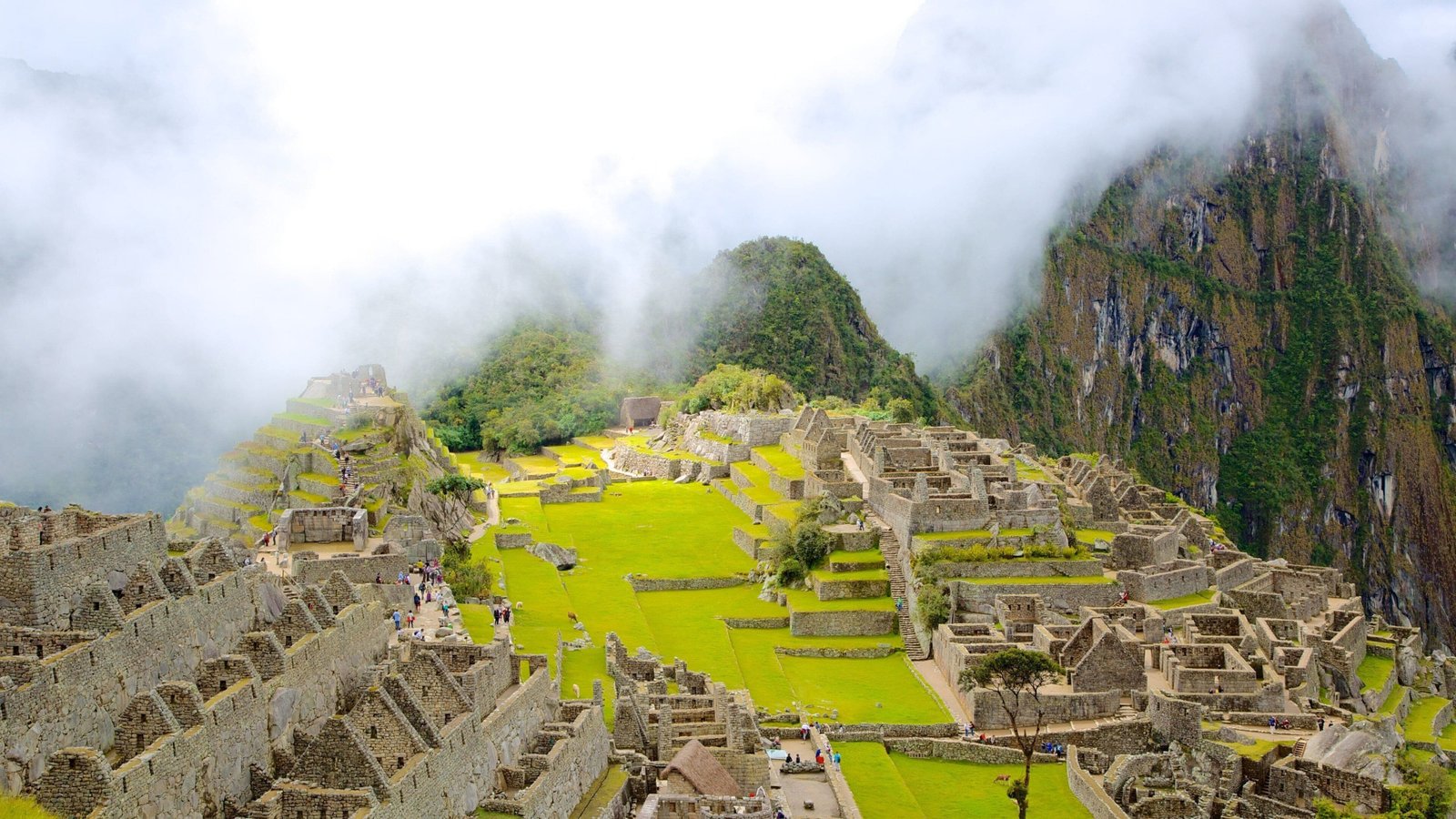
The familiar photograph makes Machu Picchu look almost inevitable: stone buildings arranged along a ridge, terraces stepping down the hillside, and a steep green peak rising behind them. Look longer, though, and the questions begin. How was a settlement made to work here? Where did its water come from? Who maintained it when the royal visitors left?
Those questions lead to a richer place than the postcard suggests. Machu Picchu is an achievement of Inca planning, a landscape of political and religious meaning, and an archaeological site whose history is still being revised. Its beauty draws the eye upward toward the mountains. Its engineering asks us to look down, into the ground beneath our feet.
Understanding both changes the experience of visiting. A retaining wall becomes more than a backdrop. A water channel becomes evidence of daily life. An empty doorway raises the question of the people who once passed through it.
Where Machu Picchu is located
Machu Picchu stands in Peru’s Cusco region, approximately 2,430 metres above sea level, on the eastern slopes of the Andes. The Urubamba River winds through the deep valley below. Here, mountain terrain meets humid tropical forest, giving the archaeological site its distinctive setting of steep ridges, dense vegetation, and shifting clouds.
UNESCO inscribed the Historic Sanctuary of Machu Picchu on the World Heritage List in 1983. It is a mixed property, recognised for both cultural and natural importance. The protected landscape extends well beyond the buildings in the famous photograph. [1]
For trip planning, distinguish three places: Cusco, the regional travel hub; Machu Picchu Pueblo, also called Aguas Calientes, the town reached by train below the site; and the archaeological settlement on the ridge. Booking accommodation in the town does not mean staying beside the ruins, and reaching the railway station does not mean arriving at the entrance.
Why the Incas built Machu Picchu
The leading interpretation identifies Machu Picchu as a royal estate associated with the Inca ruler Pachacuti and his lineage. An elite residence, ceremonial activity, and estate maintenance could coexist in the same place. Calling it simply a fortress, observatory, or holiday retreat reduces a complex settlement to a single function.
Research also helps recover the people behind the royal story. A 2023 ancient-DNA study found diverse origins among individuals buried at Machu Picchu, including connections to Andean, coastal, and Amazonian populations. Researchers interpret many of these individuals as retainers who sustained the estate while elite residents visited periodically. [3]
Their presence reflects the reach of the Inca state, including its movement of people. A royal landscape depended on service and labour as well as design. Admiring its stonework should leave room for those less visible lives.
The questions to ask are therefore broader than “What was this building for?” Who had access to it? Who supplied it? What relationships made it possible? Even where the answers remain incomplete, the questions bring the ruins closer to human scale.
A settlement designed with the mountain
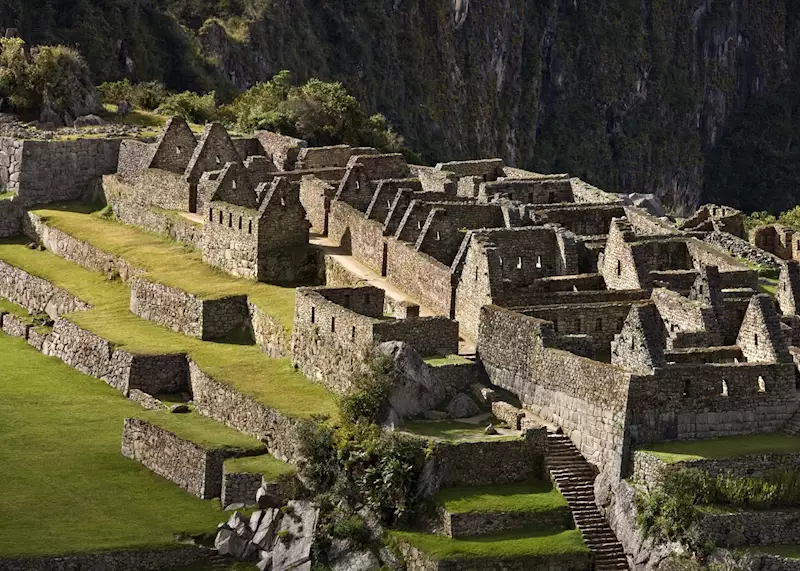
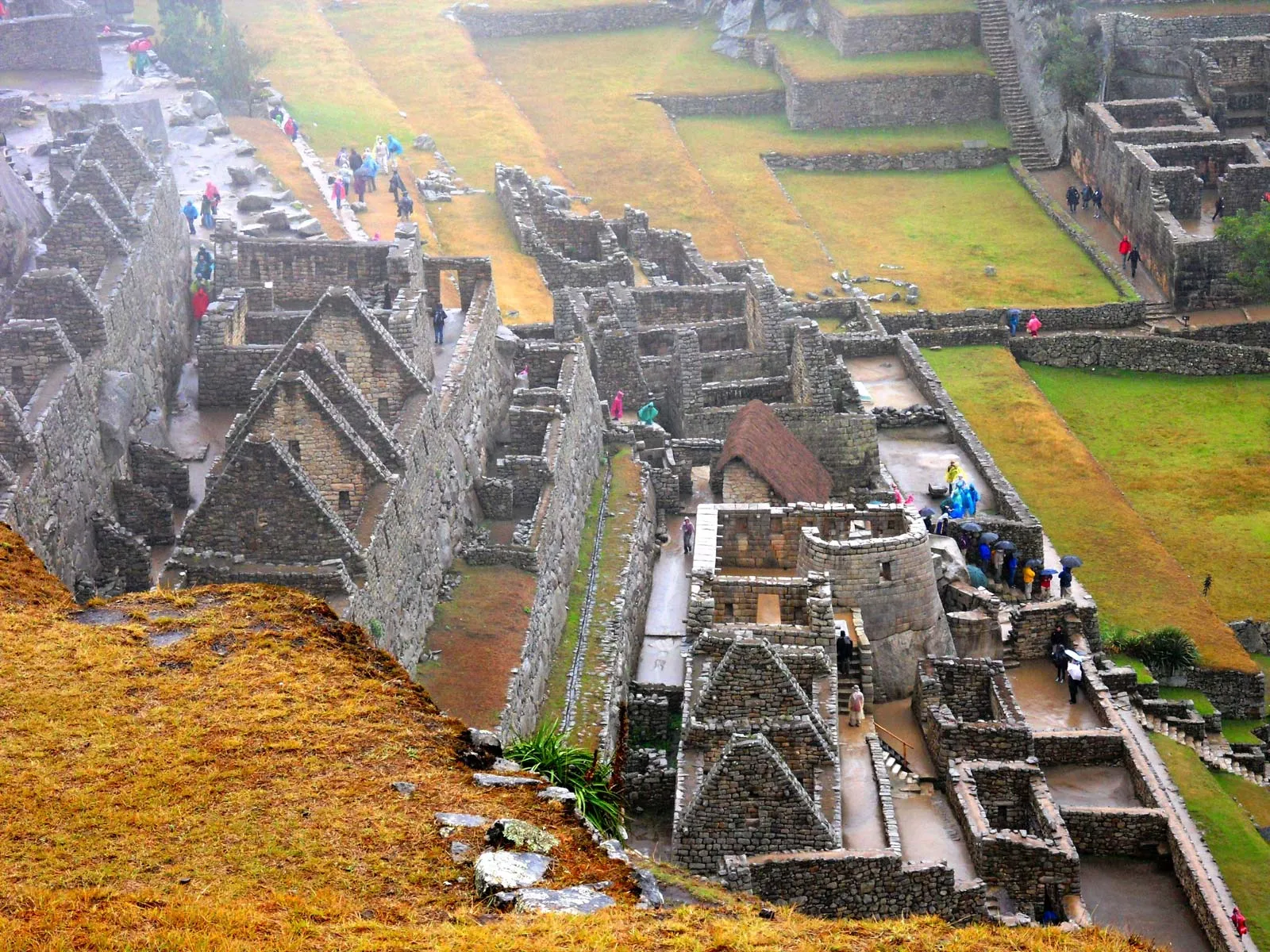
Machu Picchu’s layout makes particular sense when seen as a response to a difficult site. Broadly, the complex includes an agricultural sector with terraces and an urban sector containing ceremonial, residential, and other buildings. [4]
Open ground, stairways, slopes, and stone structures create a sequence of spaces rather than one continuous grid. From a distance, the arrangement looks compact. At walking pace, changes of level reveal how much the builders had to solve within a narrow ridge.
The surrounding mountain forms remain visible between structures. That relationship is central to the experience: even within the built settlement, the wider landscape never disappears.
It is tempting to describe every view as deliberately framed or every stone as symbolic. Some interpretations are well supported; others remain proposals. A careful visitor can appreciate the relationship between architecture and terrain without assuming that the meaning of every feature is known.
The engineering beneath the beauty
Terraces that made steep land usable
The terraces are among Machu Picchu’s most recognisable features. They created workable surfaces on steep slopes while contributing to stability and drainage. Their importance goes beyond the crops they supported.
Engineering investigations show how much depended on site preparation and subsurface construction. Water had to move through and away from the ground without carrying the settlement downhill. Retaining walls, drainage materials, and prepared foundations formed part of a coordinated response to the terrain. [5]
Seen this way, the terraces become a lesson in restraint. Instead of flattening the whole mountain, the builders worked through repeated changes in level. Each step made a small part of the slope usable while keeping it connected to the rest.
A water system built for daily life
A spring supplied a canal that carried water into the settlement and through a sequence of 16 fountains. Researchers have documented the careful design of this supply system alongside the drainage arrangements that handled rainfall. [6]
Water arriving for use and water leaving the site posed different problems. Both had to be addressed. A beautiful residence with an unreliable supply would have been difficult to inhabit; a settlement that retained too much stormwater would have been difficult to preserve.
These practical systems can be easy to overlook beside the best-known monuments. Yet a small channel often tells us more about how a place functioned than an impressive façade. It records a repeated activity: water collected, carried, used, and replaced.
Stonework that invites close attention
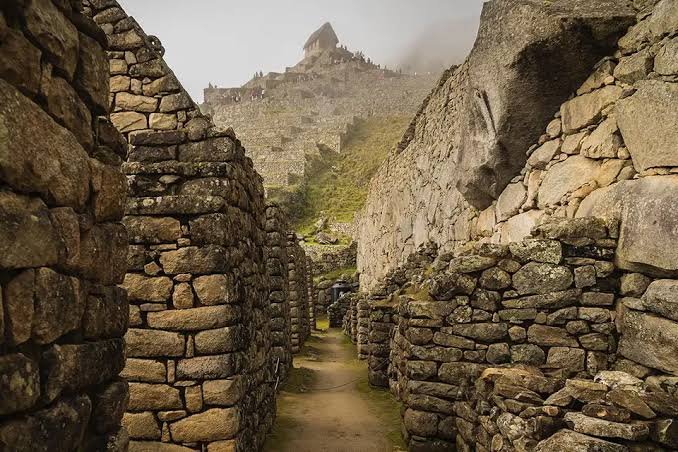
Some of Machu Picchu’s most refined masonry uses carefully shaped stones fitted closely together without mortar. The precision is particularly striking around prestigious buildings. [4]
For a visitor, the useful exercise is comparison. Notice how the finish changes from one wall to another, how openings are shaped, and how built surfaces meet exposed rock. The differences matter as much as the finest examples.
Avoid the temptation to turn craftsmanship into a supernatural puzzle. Human skill, organisation, and sustained labour are impressive enough. The enduring question is how people developed and applied that knowledge under the conditions of their own time.
Important places within Machu Picchu
Not every ticket route reaches every feature. The following descriptions explain major landmarks; they are not a promise that all are accessible on a single visit.
Temple of the Sun
The Temple of the Sun is one of the site’s best-known ceremonial structures. Its curved masonry distinguishes it from many of the surrounding buildings. It belongs among the places where the quality of construction invites attention to elite and ritual uses of space. [4]
Even when a route offers only a limited view, look at the transition between worked stone and the natural rock around it. That meeting of built and existing surfaces is one of Machu Picchu’s most compelling architectural qualities.
Sacred Plaza and Temple of the Three Windows
The Sacred Plaza includes the Main Temple and the Temple of the Three Windows. These structures are central to accounts of the settlement’s ceremonial architecture. [4]
Their open setting makes them useful for thinking about relationships between buildings. A single doorway or wall may be beautiful in isolation, but the space between structures also shaped movement, gathering, and visibility.
Intihuatana
The Intihuatana is a carved stone monument associated with solar observation and ceremonial meaning. It is frequently described as a sundial, although that familiar label should not imply a device identical to a modern clock. [7]
The more interesting question is how sky observation could connect practical timekeeping with religious life. Agricultural seasons and ceremonial occasions were not necessarily separate categories of experience.
Temple of the Condor
The Temple of the Condor takes its modern descriptive name from the bird-like form identified in its stone arrangement. Peru’s tourism authority presents it as a ceremonial feature of the complex. [4]
Here, especially, allow space between what can be seen and what has been inferred. The form is memorable; more elaborate stories about exactly what happened there need evidence of their own.
Intipunku and the mountain approaches
Intipunku, commonly called the Sun Gate, lies on an approach to Machu Picchu associated with the Inca road system. It is an important part of the experience for people arriving along the classic Inca Trail. [8]
Its significance lies partly in the arrival itself. Approaching on foot through changing terrain produces a different understanding from seeing the ruins all at once in a photograph. Access from the main site depends on the route and current arrangements; it should never be assumed to be an unrestricted extra walk.
Was Machu Picchu really a lost city
The phrase “lost city” is powerful travel writing, but it obscures local knowledge. Hiram Bingham reached Machu Picchu in July 1911 with help from local people, including Melchor Arteaga. The site was not unknown to the people living in the region. [9]
Bingham’s expeditions, photographs, and publications helped make it internationally famous. National Geographic’s extensive coverage in 1913 was particularly influential. That was a major change in global awareness, not the beginning of the place’s existence in human memory. [10]
The distinction matters because the conventional discovery story gives nearly all the agency to an outside visitor. A fuller account recognises the people who knew the landscape and enabled the encounter.
It also separates exploration from interpretation. Reaching a ruin, documenting it, and understanding its history are different achievements. The last of those remains an ongoing task.
What happened when the estate ceased to function
Machu Picchu’s principal period of Inca occupation ended around the era of the Spanish conquest, according to the dating evidence. [2] That broad context does not establish a single, fully documented reason for its decline.
Accounts that describe one dramatic final day should be treated carefully. A royal estate relied on a political and economic system extending beyond its walls. Understanding what happened to it requires considering that wider world, rather than assuming that a spectacular ruin must have had a spectacular ending.
The absence of a complete account is part of the historical record. It is more honest to explain the limits of the evidence than to fill them with a story that happens to suit the landscape.
The return of archaeological materials
Machu Picchu’s modern history includes a long debate over archaeological objects removed during Bingham’s expeditions. Agreements between Peru and Yale in 2010 and 2011 led to the return of the materials and the establishment of a research partnership with the Universidad Nacional de San Antonio Abad del Cusco.
The Museo Machu Picchu at Casa Concha in Cusco became a home for the returned collection and its interpretation. [11]
This story belongs alongside the architecture. Objects are evidence, but their location also raises questions about ownership, access, and who gets to explain the past. A museum visit can restore some of the human detail that is harder to recognise among empty stone rooms.
The living landscape around the ruins
The sanctuary protects habitats as well as archaeology. Its wildlife includes the Andean bear (often called the spectacled bear) and the Andean cock-of-the-rock. Orchids and other forest plants add to the landscape's biological richness. [12]
Wildlife should be understood as part of a functioning habitat, not a guaranteed attraction. A visit can be worthwhile without a rare sighting. The forest itself, its density and changing moisture levels, helps explain why protecting the surrounding land matters.
The same attention applies to familiar animals you may encounter near the ruins. Give them space. The desire for a close photograph is a poor reason to interrupt their movement or encourage dependence on visitors.
Planning a visit to Machu Picchu
Start with the experience you want
Before arranging a tightly timed itinerary, decide what matters most. Is your priority the broad panorama, a closer route through the settlement, or an additional mountain hike? Those choices may require different tickets.
Make a short list of priorities, then compare it with the current official maps. This is more useful than buying whatever ticket name sounds most comprehensive. Ask a booking provider to identify the precise route, entry time, and included access in writing.
Understand the circuit system
The official framework introduced in June 2024 groups ten routes into three circuits. Circuit 1 is Panorámico, Circuit 2 is Machupicchu Clásico, and Circuit 3 is Machupicchu Realeza. Routes within those families differ, and some operate seasonally. [13]
For a first visit, compare the Circuit 2 options if walking through the main settlement is your priority. Compare Circuit 1 maps if the upper panoramic perspective matters most. Circuit 3 includes lower-site routes and options associated with additional mountain or other walks. These are broad planning distinctions, not interchangeable passes.
A photograph on a ticket seller’s website doesn't show what the ticket includes. The route map does.
Book through verified channels
Peru’s official online ticket platform is Tu Boleto. Use the Ministry of Culture’s Machu Picchu website to reach the official booking page and check current requirements. [14]
Review the date, route, time, personal details, cancellation terms, and any eligibility conditions before paying. Prices, availability, entry rules, and temporary closures can change, so a durable travel plan should use the live official information rather than an old price quoted in a blog.
Keep confirmation documents available offline. Build a little margin into connections. A journey with several linked stages is more enjoyable when you don't schedule every stage to the last minute.
Get from the railway to the entrance
Rail services connect Machu Picchu Pueblo with places including Ollantaytambo, with additional services or combined bus-and-train arrangements depending on the operator and departure point. Check the actual station and service details on your reservation. [15]
From the town, visitors continue uphill by bus or on foot. Some train products do not include either archaeological admission or the bus transfer, so check each component separately. [16]
Staying overnight in Machu Picchu Pueblo can simplify the morning journey. Returning to the Sacred Valley or Cusco afterwards can also work, provided the entry slot, transfer time, and train departure fit comfortably together. Choose the arrangement that gives your visit enough room to breathe.
The Inca Trail and additional mountain hikes
Walking the Inca Trail offers a broader archaeological and mountain landscape. The classic itinerary is commonly described as a four-day journey that arrives via Intipunku. [8] It requires separate planning from an ordinary rail-based visit.
Check the operator’s permit arrangements, itinerary, included archaeological route, equipment, porter policies, and contingency plans. Trail admission should not be treated as automatic permission to explore every part of Machu Picchu afterwards.
The Inca Trail network normally closes during February for maintenance. Authorities announced it would reopen on 1 March 2026 after conservation work. That trail closure is distinct from the opening arrangements for the main archaeological site. Always check the notice for your own travel year. [17]
Huayna Picchu, also spelt Waynapicchu, and Machu Picchu Mountain are separate hiking options within the ticket framework. Compare the exact route before choosing. A mountain hike adds exertion and time; it isn't necessary for a rewarding visit to the ruins.
If steep steps or exposure make you uncomfortable, plan around that preference. You don't have to turn a historical visit into an endurance test.
Weather and the best time to go
Peru’s Andean climate has distinct wet and dry periods. The middle months of the year are generally drier, while rain is more common at the beginning and end of the year. Machu Picchu’s humid mountain setting still makes weather variable. [18]
Choose your dates around the whole journey, especially if you plan to trek. A brief shower during a site visit and prolonged rain on a multi-day trail have different implications.
Bring layers and rain protection even when the forecast looks encouraging. Allow for slippery surfaces, and avoid promising yourself a cloud-free photograph at one exact hour. Mist is part of the landscape, not evidence that a visit has failed.
For photography, make room for details as well as the panorama. A close view of masonry, a stairway, or a channel can communicate something the familiar wide shot leaves out. Follow route instructions and keep moving when others need to pass.
Visiting with care
Historic terrain can present access challenges. Anyone with limited mobility should discuss the intended route and current assistance options with the site or a qualified provider before booking. General descriptions such as “easy” don't explain the number of steps, uneven surfaces, or opportunities to rest.
Travel light, wear footwear suited to uneven stone, and check current bag and equipment restrictions. Arrange toilet and refreshment stops around the visit rather than assuming facilities will be available wherever you need them.
Follow marked routes and staff instructions. Do not climb walls for a photograph, touch vulnerable features, remove anything, or leave litter. Respect also extends to the people working around the site: guides, transport staff, porters, conservation teams, and local businesses all contribute to the experience.
UNESCO identifies visitor pressure, development, pollution, and natural hazards among the challenges affecting the sanctuary. [1] A well-managed visit is one small part of a much larger conservation task.
What Machu Picchu leaves with you
The panorama may be the reason to come. The details are the reason the place stays in the mind: a carefully fitted corner, a narrow stream of water, a staircase that makes sense of an otherwise awkward slope.
Machu Picchu rewards admiration, but it also rewards questions. Its builders solved difficult problems. Its residents came from a wider world. Its modern interpretation has changed as new evidence has appeared and old assumptions have been reconsidered.
Leave room for that complexity. The site does not need a legend attached to every stone. The surviving work, and the people it brings into view, already offer more than a single visit can absorb.
Frequently Asked Questions
Where is Machu Picchu?
Machu Picchu is in Peru’s Cusco region, above the Urubamba Valley on the eastern slopes of the Andes. The archaeological settlement stands at approximately 2,430 metres above sea level. [1]
Who built Machu Picchu?
It was built by the Incas. The leading archaeological interpretation associates the estate with the ruler Pachacuti and his lineage. Its construction and operation depended on many workers and residents whose individual names are largely unknown. [3]
When was Machu Picchu built?
It developed during the fifteenth century. A 2021 radiocarbon study indicated occupation from approximately 1420 to 1530, earlier than some traditional estimates. That evidence does not establish an exact construction date for every building. [2]
What was Machu Picchu used for?
It is widely understood as a royal estate with residential and ceremonial functions. Treating it as only a fortress or only an astronomical observatory oversimplifies the evidence. [3]
Did Hiram Bingham discover Machu Picchu?
Bingham helped bring it to international attention after his 1911 visit, but local people already knew the site. Melchor Arteaga helped him reach it. Calling this its first discovery overlooks that local knowledge. [9]
Can you visit without hiking the Inca Trail?
Yes. Travellers can take a train to Machu Picchu Pueblo and continue to the entrance by bus or on foot. Archaeological admission must be arranged separately unless explicitly included in a package. [15, 16]
Which Machu Picchu circuit should you choose?
Choose by the actual map and your priorities. The official system groups routes into panoramic, classic, and royal circuits. Compare viewpoints, settlement access, additional hikes, and seasonal availability before booking. [13]
Is Huayna Picchu included with every ticket?
No. Access depends on the specific route purchased. Do not assume that ordinary admission includes an additional mountain hike, or that one mountain ticket includes another. [13]
Is Machu Picchu closed in February?
The Inca Trail normally closes during February for maintenance, but that is not the same as a routine closure of the main archaeological settlement. Check official notices for site access, trail operations, and transport before travelling. [17]
How much time should you allow for the visit?
Let the permitted route and ticket conditions determine your time inside. Then allow separately for transport, queues, and any booked hike. An overnight stay nearby can reduce rushed connections, while a carefully coordinated day trip can suit travellers with less time.
Sources and editorial notes
Prepared for publication with sources checked in October 2026. Practical details should be rechecked before publication and periodically afterward. Numbered references identify supporting sources and may be converted into hyperlinks in the website editor. Interpretive observations and itinerary suggestions are editorial guidance. This article does not guarantee access to any individual monument or route.
SEO note: The requested meta keywords are supplied as editorial tags. Google does not use the meta-keywords tag for web ranking. Avoid repeating them unnaturally in the article. Source: https://developers.google.com/search/blog/2009/09/google-does-not-use-keywords-meta-tag
[1] UNESCO World Heritage Centre — Historic Sanctuary of Machu Picchu. Location, mixed heritage status, inscription, and conservation context.
https://whc.unesco.org/en/list/274
[2] Yale News — Machu Picchu older than expected, study reveals, 4 August 2021. Radiocarbon evidence and its chronological implications.
https://news.yale.edu/2021/08/04/machu-picchu-older-expected-study-reveals
[3] Yale News — DNA analysis offers new insights into the diverse community at Machu Picchu, 26 July 2023. Royal estate interpretation and resident origins.
https://news.yale.edu/2023/07/26/dna-analysis-offers-new-insights-diverse-community-machu-picchu
[4] PROMPERÚ — Machupicchu. Site sectors and principal architectural features.
https://www.peru.travel/attractions/machu-picchu
[5] American Society of Civil Engineers — Machu Picchu. Engineering heritage, foundations, terraces, and drainage. The article uses newer archaeological research for chronology.
https://www.asce.org/about-civil-engineering/history-and-heritage/historic-landmarks/machu-picchu
[6] Kenneth R Wright — The Masterful Water Engineers of Machu Picchu, Water 13, 3049, 2021. Water engineering research.
https://www.mdpi.com/2073-4441/13/21/3049
[7] PROMPERÚ — Intihuatana, el reloj solar de los incas ubicado en Machupicchu.
https://www.peru.travel/es/inspirate/intihuatana-el-reloj-solar-de-los-incas-ubicado-en-machupicchu
[8] PROMPERÚ — Intipunku, la entrada principal a Machupicchu en la época inca.
https://www.peru.travel/es/inspirate/intipunku-la-entrada-principal-a-machupicchu-en-la-epoca-inca
[9] National Geographic — 4 curiosidades de Machu Picchu, uno de los lugares más emblemáticos de Perú, 2023. Local knowledge and Melchor Arteaga.
https://www.nationalgeographicla.com/historia/2023/07/4-curiosidades-de-machu-picchu-uno-de-los-lugares-mas-emblematicos-de-peru
[10] National Geographic — These stunning pictures revealed Machu Picchu to the world. Bingham photographs and the 1913 publication.
https://www.nationalgeographic.com/photography/article/machu-picchu-panoramas-henry-bingham-discovery
[11] Yale News — Peru Yale partnership is the future of Machu Picchu artifacts, 4 June 2015.
https://news.yale.edu/2015/06/04/peru-yale-partnership-future-machu-picchu-artifacts
[12] SERNANP — Santuario Histórico de Machupicchu. Protected landscape and wildlife.
https://www.gob.pe/institucion/sernanp/informes-publicaciones/1793255-santuario-historico-de-machupicchu
[13] Ministry of Culture — Circuitos y Rutas de Visita. Current official circuit framework and maps.
https://www.machupicchu.gob.pe/circuitos-y-rutas-de-visita/
[14] Ministry of Culture — Official online tickets and booking platform.
https://www.machupicchu.gob.pe/online-tickets/?lang=en
https://tuboleto.cultura.pe/llaqta_machupicchu
[15] PeruRail — Train services. Departure locations and onward transport.
https://www.perurail.com/train-services/
[16] PeruRail — Frequently asked questions. Ticket inclusions and access from Machu Picchu Pueblo.
https://www.perurail.com/faq/
[17] SERNANP — Inca Trail reopening notice, 28 February 2026, and annual maintenance explanation, 2023.
https://www.gob.pe/institucion/sernanp/noticias/1359896-el-santuario-historico-de-machupicchu-reabre-su-red-de-caminos-inka-tras-temporada-de-lluvias
https://www.gob.pe/institucion/sernanp/noticias/719289-se-reinicia-temporada-de-visitas-con-reapertura-de-camino-inka-en-el-santuario-historico-de-machupicchu
[18] PROMPERÚ — Datos útiles sobre el Perú — Clima. Regional seasonal context.
https://www.peru.travel/es/datos-utiles/clima