Petra is often recognised by a single extraordinary façade, yet the Treasury is only the beginning. Beyond the narrow Siq lies an ancient city of tombs, temples, streets, meeting places, and churches, shaped by trade and sustained by remarkable water engineering. This detailed guide follows Petra from its Nabataean prosperity through Roman and Byzantine rule to its modern role as one of Jordan’s defining landmarks. It explains the major monuments, separates archaeological evidence from popular legends, introduces the region’s living cultural heritage, and offers thoughtful guidance on tickets, walking routes, seasonal conditions, and planning a rewarding visit.
Petra Beyond the Treasury and Inside Jordan’s Ancient City
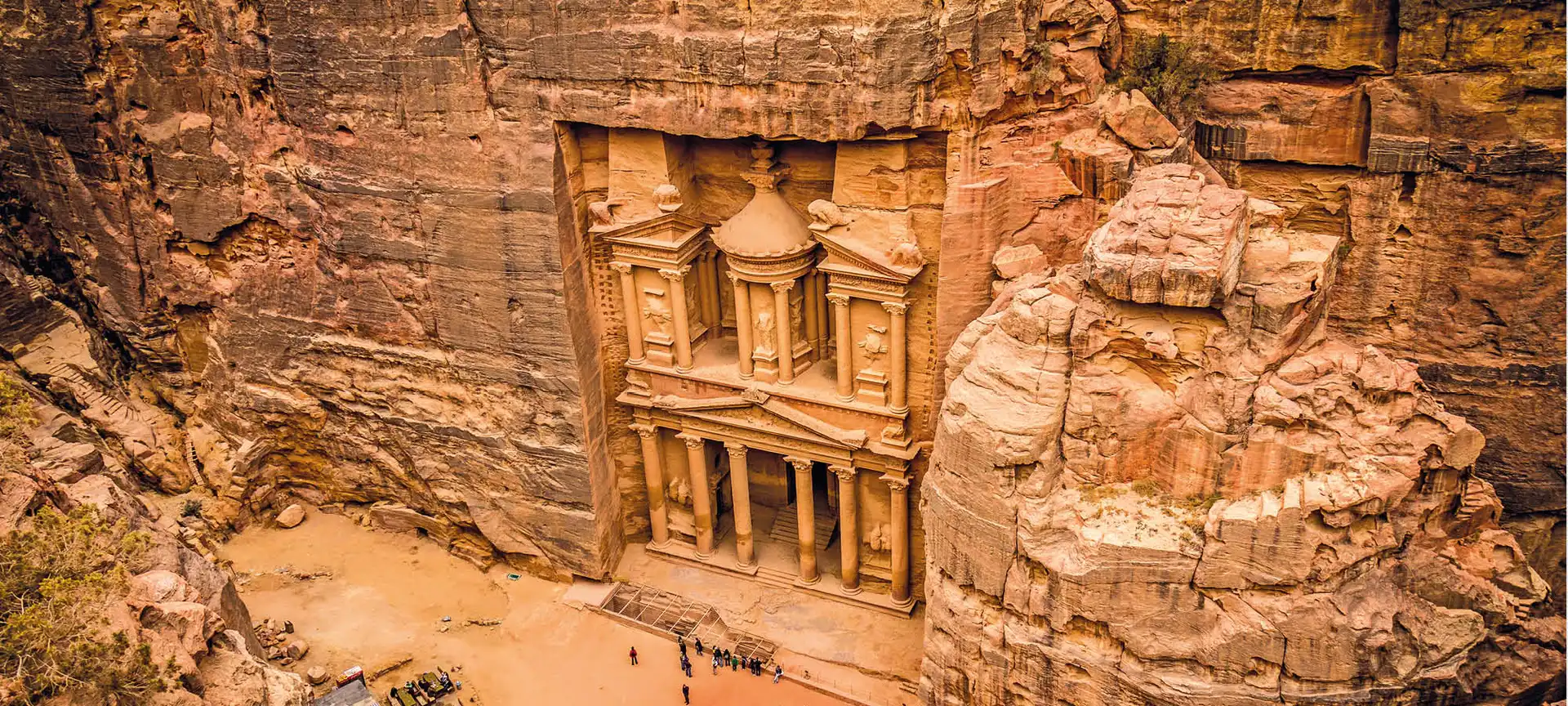
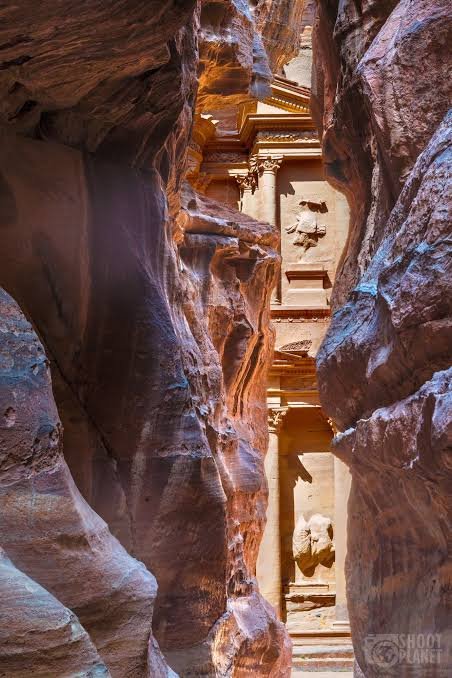
Petra begins with a passage. Sandstone walls rise on either side, the sky narrows overhead, and the route turns often enough to conceal what lies ahead. Then, through the final opening, a carved façade appears: columns, niches, and a tall central urn, all held within the face of the cliff.
The Treasury deserves its reputation. It is also an unusually persuasive distraction. Visitors who treat it as the whole of Petra miss the streets, sacred places, water channels, and later churches that explain how this ancient city worked.
Petra was a place where people traded, worshipped, built homes, buried relatives, and adapted to political change. Its grand monuments express wealth and ambition. Its less conspicuous remains reveal the practical intelligence that allowed urban life to flourish in a demanding landscape.
Follow both stories and the rose-red city becomes far more than an unforgettable view.
Where Petra is located
Petra lies in southern Jordan, beside the modern town of Wadi Musa, within a landscape of sandstone cliffs, valleys, and rocky uplands. Most visitors use Wadi Musa as their base and enter through the archaeological park’s visitor centre.
Its historical position connected routes between Arabia and the eastern Mediterranean, with links to Egypt and Syria. Petra’s setting may seem secluded when approached through the Siq, but its prosperity depended on movement through a much wider region. UNESCO recognised the site’s exceptional architectural and archaeological importance when it inscribed Petra on the World Heritage List in 1985. [1]
The practical distinction between town and site matters. Wadi Musa contains accommodation and services; the ancient city spreads across an extensive archaeological landscape beyond the entrance. A hotel described as being “in Petra” may still require a transfer or an uphill walk at the end of the day.
Who built Petra
The Nabataeans, an ancient Arab people whose kingdom grew wealthy through regional trade, built the monuments most closely associated with Petra. Petra served as their capital. Their control of caravan routes, including incense trade, helped connect southern Arabia with markets farther north and west. [2]
The Nabataeans’ achievement combined commercial knowledge with construction, water management, and a distinctive visual culture. Their architecture absorbed outside influences without becoming a simple copy of any one tradition. Familiar classical forms appear beside designs and practices rooted in the region.
Think of Petra as a meeting place, not an isolated curiosity. Goods moved through it, but so did ideas, techniques, and tastes. A column capital can be evidence of those connections just as surely as an imported object.
The people who built the city were not one anonymous group working on a single project. Generations of patrons, craftspeople, labourers, and residents shaped different parts of the landscape. Petra’s variety makes more sense when understood as accumulated urban history.
How old is Petra
There is no single construction date for Petra. Human settlement in the surrounding region long predates the monumental Nabataean city. Neolithic sites near Petra preserve evidence of communities thousands of years earlier, while the city’s celebrated architectural development belongs chiefly to the later centuries BCE and early centuries CE. [3]
This distinction prevents a common misunderstanding. Evidence that people lived in the region in prehistoric times does not make the Treasury equally ancient. Different layers of Petra’s history belong to different periods.
Nor should its famous buildings be imagined as a coordinated set completed at once. People built, altered, reused, and sometimes replaced monuments. The city visitors encounter is the surviving record of those changes.
Trade and the foundations of prosperity
Frankincense, myrrh, and other valuable goods helped sustain the commerce associated with Petra. Caravan routes required more than a track across the desert: travellers needed dependable water, provisions, places to stop, and knowledge of the terrain. Nabataean influence over these networks gave Petra an important economic role. [2]
This makes water management part of the trade story. A settlement could occupy a favourable position on a map and still fail if people and animals could not be supplied. Petra’s builders addressed both geography and infrastructure.
The grandeur of the tombs offers another perspective on prosperity. Wealth had a public expression. A prominent façade could announce a family’s status and preserve its presence in the city long after its members had died.
The result is a landscape where commerce, memory, and religious life repeatedly meet. Petra’s monuments are beautiful objects, but they also belonged to social relationships.
Roman rule and a city that kept changing
In 106 CE, the Roman Empire annexed the Nabataean kingdom. Petra continued to function under Roman administration; annexation did not instantly empty its streets or end its urban life. A destructive earthquake in 363 CE later damaged buildings and water infrastructure. [2]
Even that disaster should not be treated as a final curtain. The Petra Church and its sixth-century documentary evidence demonstrate activity well after the earthquake. [4] Political change, altered trade patterns, damage, repair, and shifting settlement patterns belong to a longer history of transformation.
The region also contains remains from later Islamic periods. Petra’s past is therefore poorly served by a story in which a thriving Nabataean city suddenly vanished and then remained untouched until a European traveller arrived. [3]
Some buildings declined, some spaces acquired new uses, and local knowledge persisted. Archaeology works through those differences rather than compressing them into a single abandonment date.
The Siq and the art of arrival
The Siq is the narrow natural passage that forms Petra’s best-known approach. It extends for roughly a kilometre through the rock before opening toward the Treasury. Its shape is natural, but the route also preserves traces of human intervention, including water channels and sections of paving. [5]
As you walk here, look beyond the final reveal. Channels along the sides show that this dramatic corridor also served practical purposes. The approach was part of an engineered landscape, not merely an attractive gateway.
The alternation between shade and light changes how the sandstone appears. In places, the walls feel close enough to compress the whole journey into a narrow strip; elsewhere, the passage briefly widens. That sequence explains why the first view of the Treasury carries such force.
There is no need to rush through it. The approach is one of Petra’s major experiences in its own right.
The Treasury and the legend behind its name
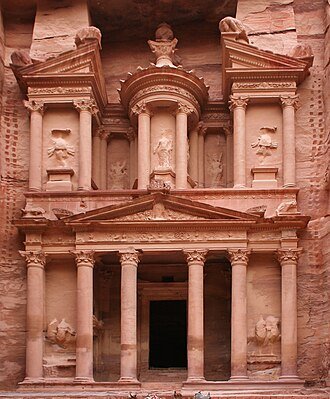
Al Khazneh, also written Al Khazna, is approximately 39.5 metres high. Its elaborate rock-cut façade is generally interpreted as funerary architecture, often associated with the reign of Aretas IV, who ruled from 9 BCE to 40 CE. Its exact date and intended occupant remain debated. [6]
The name “Treasury” comes from a later story about treasure concealed in the urn above the façade. This does not prove the building served as a royal bank. Classical architectural forms and sculptural decoration contribute to its richly composed exterior.
Its visual effect depends partly on contrast. A highly ordered façade emerges from an irregular cliff, and its sheltered position allows the carved surface to dominate the space before it.
Admire the exterior without assuming that a similarly elaborate palace stretches behind it. Rock-cut façades and interior chambers often create very different impressions. At Petra, what faces the city can be as important as what lies within.
The Street of Facades and the theatre
Beyond the Treasury, the route opens into a broader archaeological landscape. The Street of Facades introduces rows of rock-cut tombs, making clear that monumental burial architecture was a repeated feature of Petra rather than an isolated achievement. [7]
Nearby, the theatre provides a different kind of public space. Much of its seating was cut directly into the rock. The site authority dates it to the early first century CE, before Roman annexation, and identifies later Roman additions. Remains of older tombs in the cliff show that the auditorium altered an already-used landscape. [8]
Its familiar semicircular form can tempt visitors to call it simply a Roman theatre. That overlooks the Nabataean work beneath the later changes.
The precise range of activities held there is not fully documented. What survives clearly demonstrates the capacity to bring a substantial audience together. In a city often remembered for its tombs, the theatre reminds a of collective life.
The Royal Tombs
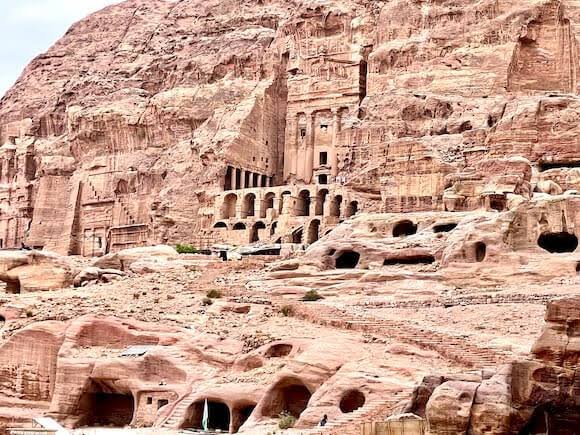
The group commonly called the Royal Tombs occupies a commanding position on Khubtha Mountain. It includes the Urn Tomb, Silk Tomb, Corinthian Tomb, and Palace Tomb. Their scale and prominence suggest elite patrons, but the conventional group name does not securely identify the person buried in every monument. [9]
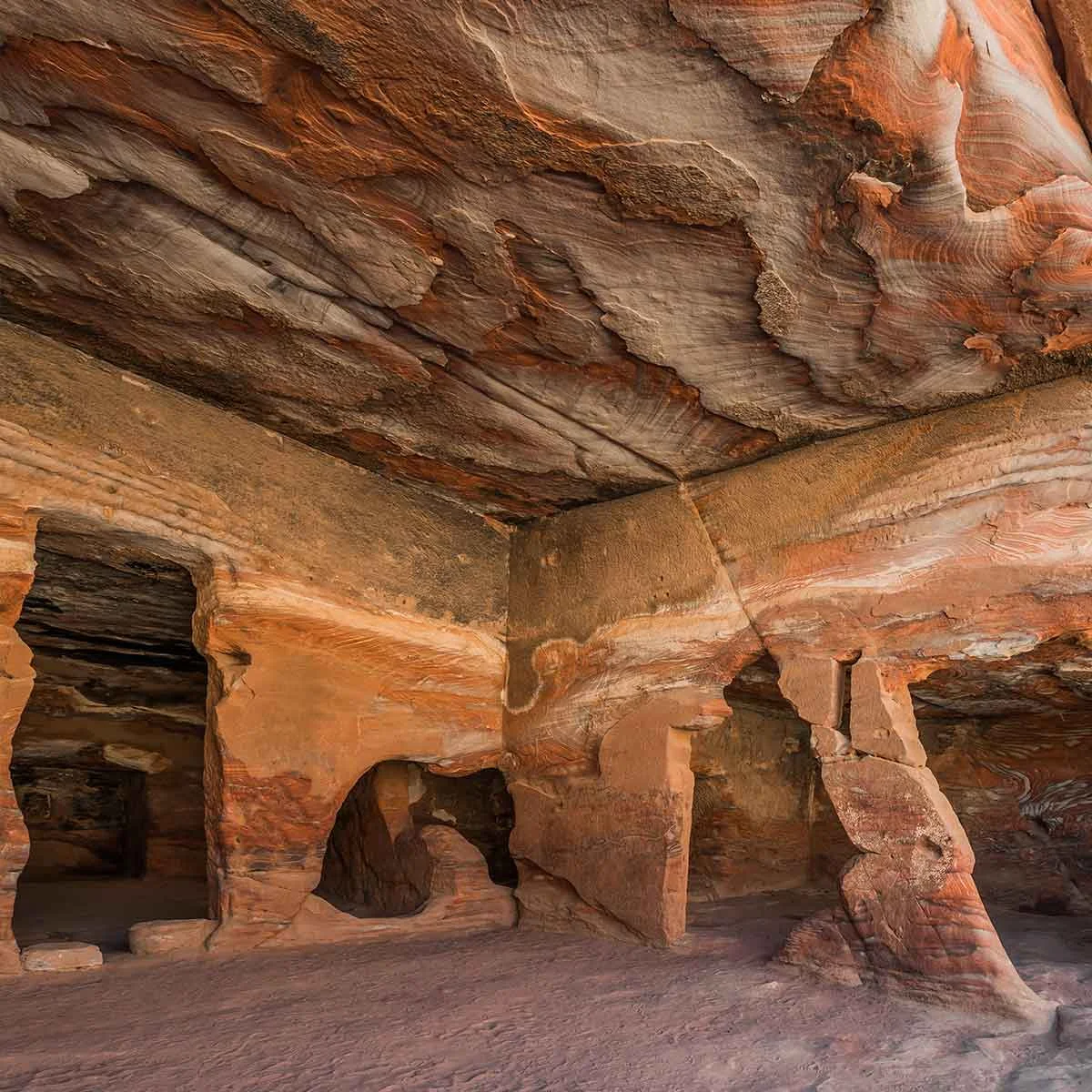
The Urn Tomb is recognised by its elevated frontage and crowning urn. The smaller Silk Tomb draws attention to the striking coloured bands within the sandstone. The Corinthian Tomb echoes elements associated with the Treasury, while the Palace Tomb presents a broad, elaborate architectural face.
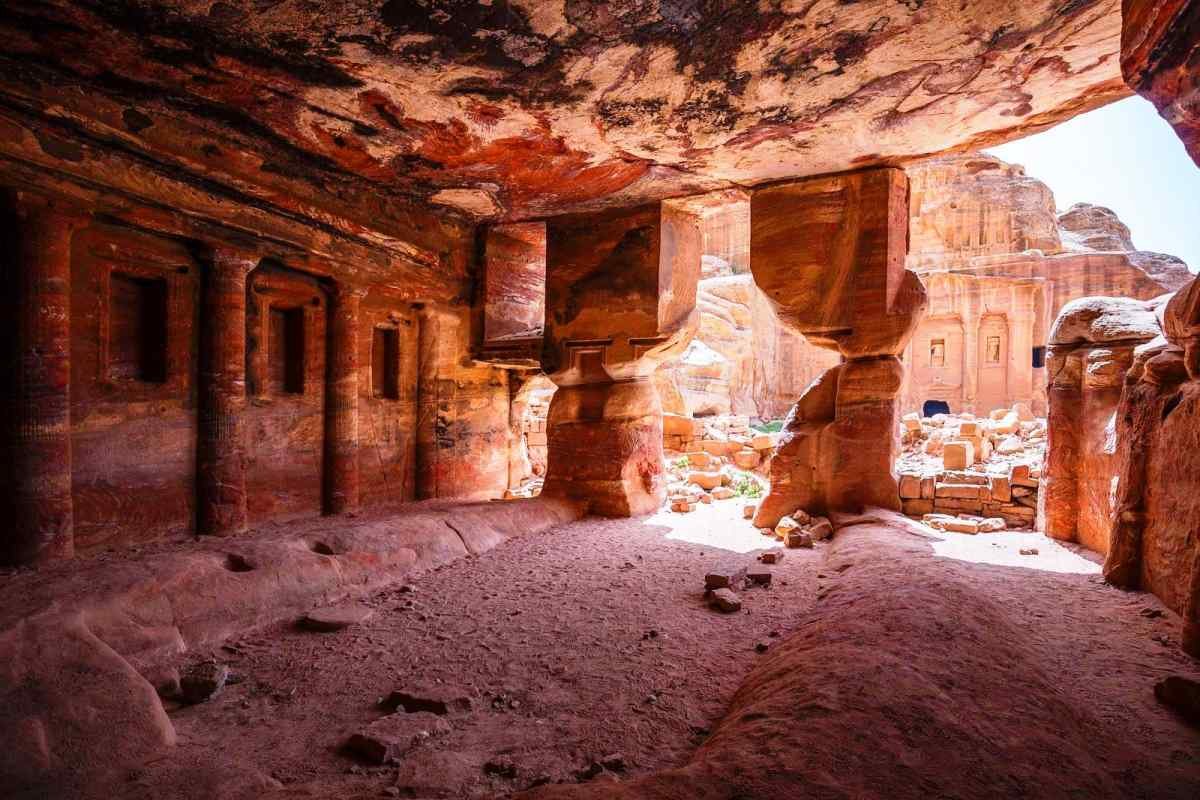
These differences make the group especially rewarding to compare. Look first at the whole façade, then at its relationship to the rock around it. Some of the strongest colour comes from the stone itself; carved order and natural variation share the same surface.
The tombs also change the city's scale. Seen across the valley, they are public landmarks. Up close, they become individual works of cutting, shaping, and composition.
The city centre and its standing buildings
Petra was not entirely carved into cliffs. The central area contains streets, freestanding structures, and large complexes that help recover its urban character.
The Collonaded Street
The Colonnaded Street forms part of the main visitor route through the city centre toward Qasr al-Bint. [7] Here the experience becomes less about confronting one façade and more about moving through linked spaces.
Allow time to look sideways. A broad street has meaning because of the buildings and activities around it. The remains can be fragmented, but they offer the framework for imagining a working urban district.
The Great Temple complex
The conventional name “Great Temple” conceals an important interpretive question. Excavation revealed a complex with collonaded spaces, monumental stairs, and a small theatre-like assembly area. The site authority discusses a substantial civic role, potentially involving council or judicial activity, while allowing for religious uses. [10]
This is a good example of why archaeologists should not mistake names for final answers. A label may survive even as research changes how we understand a building.
Brown University’s excavations also documented elaborate decoration, including elephant-head capitals and painted stucco fragments. [11] Those discoveries help counter the modern impression of Petra as a city made only of bare stone. Its architecture once carried finishes and decorative effects that survive unevenly.
Qasr al-Bint
Qasr al-Bint is one of Petra’s most prominent standing temple buildings. Its traditional name refers to a pharaoh’s daughter, but that belongs to later legend rather than a demonstrated royal residence.
The building stands on a podium and is generally associated with the worship of Dushara, a principal Nabataean deity. Its surviving walls, sanctuary arrangement, and surrounding sacred precinct provide a different architectural experience from the rock-cut tombs. [12]
Pause here to compare the two methods of building. Cutting into a cliff and constructing a freestanding structure required different decisions about form, support, and movement. Petra’s builders worked with both.
The Monastery and the climb to Ad Deir
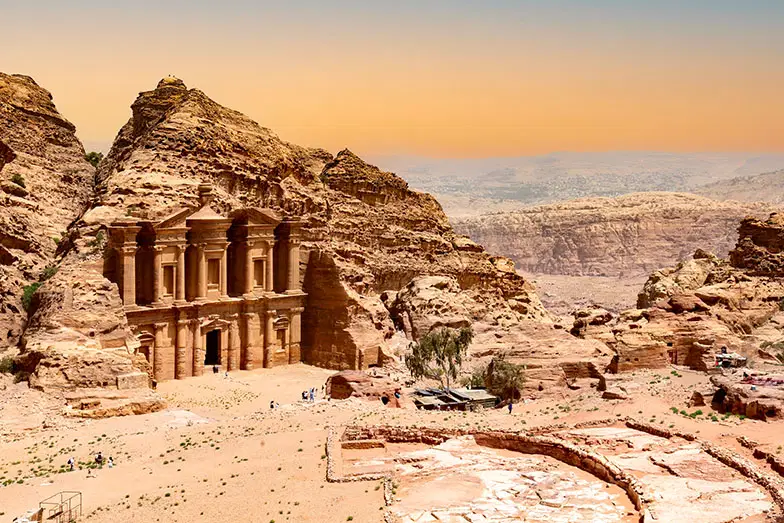
Ad Deir, often written Ad Dayr, is known as the Monastery. Its façade is roughly 47 metres wide and 48 metres high, making it one of Petra’s largest monuments. Its original function is usually discussed in connection with Nabataean religious or ceremonial activity. Later Christian reuse explains the name by which it is now widely known. [13]
The proportions are broader and the setting more open than those of the Treasury. Comparing them is more rewarding than deciding which is “better.” Each reflects a different approach and a different relationship to the surrounding rock.
The conventional route from the basin involves a substantial ascent. The official Al Dayr Trail description gives approximately 800 steps over about 1.6 kilometres from the Qasr al-Bint area. [14] That climb comes after the distance already covered inside Petra and still leaves the return journey to consider.
Plan it as a significant part of the day. If heat, fatigue, or mobility makes the route unsuitable, a visit focused on the lower city can still be deeply rewarding.
The Petra Church and evidence of everyday life
The Petra Church highlights the city’s Byzantine history. Probably built in the late fifth century, it preserves mosaic imagery of animals, plants, people, and personifications. In 1993, excavators discovered carbonised papyrus documents in an adjoining room. [4]
The sixth-century texts concern matters such as property, agreements, and inheritance. Their importance is easy to underestimate beside the great façades. A document about ownership can reveal a living society with obligations, disputes, and family interests.
The church therefore changes the story in two ways. Its mosaics introduce another visual language, and its documents help establish continuity after the better-known Nabataean period. Petra’s history continued long after many of its famous tombs were carved.
How Petra managed water
In this landscape, water could be scarce one moment and dangerously abundant the next. Petra’s engineers built channels, cisterns, reservoirs, dams, and diversion works to collect, store, distribute, and control it. UNESCO identifies this system as fundamental to the city’s development. [1]
Near the entrance to the Siq, a diversion tunnel and dam were part of the floodwater response. Water channels through the approach served a different purpose: conveying supplies into the city. [5]
These are related but distinct tasks. Keeping water available for use and preventing a sudden flow from damaging buildings required an understanding of both supply and terrain.
For visitors, a channel can look modest beside an ornate tomb. In practice, it can be just as revealing. The spectacular city depended on maintaining systems rarely designed to be spectacular.
Little Petra and the wider landscape
Siq al-Barid, commonly called Little Petra, lies north of the main city. Its smaller rock passage, carved façades, dining spaces, and water installations offer another view of Nabataean activity. The site served traders and caravans outside Petra’s central area. [15]
The dining rooms are especially useful reminders that exchange involved hospitality and social interaction. People who needed to eat, rest, and negotiate conducted trade, not goods travelling between dots on a map.
Little Petra can complement a visit to the main site. It should not be confused with an automatic shortcut to every monument. A back-route approach toward the Monastery requires its own planning, current access information, and ticket verification.
Was Petra ever truly lost
Swiss traveller Johann Ludwig Burckhardt visited Petra in 1812 and helped bring it to renewed European attention. Local people already knew the place. [3]
Calling him its discoverer without that qualification erases the knowledge that made his visit possible. “Rediscovery” is useful only when the audience doing the rediscovering is made clear.
This distinction shapes how Petra is presented today. Local communities belong in its history, not at the edge of an account focused only on ancient builders and foreign explorers.
Petra and living Bedouin heritage
UNESCO’s recognition of the Bedouin cultural space in Petra and Wadi Rum highlights traditions that include oral storytelling, poetry, songs, and environmental knowledge. [16]
This living heritage cannot be reduced to a costume, a souvenir, or a picturesque addition to the ruins. People who work and live in the region have contemporary lives as well as cultural traditions.
A thoughtful visitor asks before photographing someone, agrees clearly on prices and services, and makes room for conversation without treating every encounter as a performance. Hiring a knowledgeable local guide can add context while supporting work rooted in the region.
Planning a rewarding visit
Give the city enough time
For many first-time visitors, two days offer a more comfortable balance than trying to see every major monument in one long march. This is a planning suggestion, not a site requirement.
On the first day, take the main approach through the Siq to the Treasury, then continue through the lower city and choose stops based on your pace. On a second day, consider the Monastery or another approved route, leaving time for places you passed too quickly before.
If only one day is available, decide what matters most. A Treasury-focused visit and a day including the Monastery are different undertakings. Build the return walk into the plan from the beginning.
Tickets and the Jordan Pass
Check Petra’s official fee page before booking. Admission categories depend on visitor status and other conditions. Multi-day tickets have specific validity rules; the official page states that two- and three-day tickets are used on consecutive days. [17]
The Jordan Pass combines attraction admissions and offers different durations for Petra. Compare the package with your complete Jordan itinerary rather than assuming it is automatically the best choice. Any visa-related benefit has eligibility conditions that should be checked on the official website for your circumstances. [18]
Use official booking links, check personal details, and keep confirmations accessible offline. Daytime admission and Petra by Night are separate products.
Opening hours and seasonal conditions
Opening times vary by season. Check the official opening-hours page close to your visit, especially when arranging transport or a late return from a long route. [19]
Plan for walking around the forecast rather than a photograph of perfect weather. Strong sun increases the effort of exposed climbs; rain can change access conditions. Follow official closure and evacuation instructions, particularly when heavy rain creates a flash-flood risk. [20]
Take comfortable walking shoes, sun protection, drinking water, and layers appropriate to the season. Leave enough flexibility to shorten a route without feeling that the trip has failed.
Accessibility and transport inside the site
Distances, uneven ground, and steps make accessibility a route-specific question. Ask the visitor centre about the exact places you want to reach and the assistance available. General claims that Petra is either entirely accessible or entirely inaccessible are not useful.
The official site lists paid cart services on selected sections. [17] These do not remove the physical demands of every trail. Confirm boarding arrangements, availability, and the return journey before relying on them.
Petra by Night
Petra by Night offers an organised evening experience around the Siq and Treasury area. It has separate ticketing and operating arrangements. The dedicated event page should be checked for current nights, times, and presentation details. [21]
Treat it as an optional addition to a daytime visit. It doesn't offer the same opportunity to explore the wider archaeological site.
Whether it suits you depends on expectations. If you want a quiet, self-directed exploration of architecture, daytime walking will remain the core experience. If an organised evening atmosphere appeals to you, leave enough energy for the walk after a day in the park.
Protecting the city you came to see
Petra’s stone surfaces are vulnerable, and conservation extends beyond repairing the most famous façades. UNESCO-supported work on the Royal Tombs has linked preservation with research into the historic water-management system. [22]
Stay on authorised routes, respect barriers, and avoid touching, scratching, or climbing carved monuments. Do not remove stones or archaeological material. A fragment on the ground may still be part of the site's historical evidence.
For photographs, use permitted viewpoints and give other visitors space. A dramatic angle isn't worth damaging a fragile surface or risking an unofficial climb.
Choose your pace carefully, too. A visit that leaves time to notice a channel, compare two tombs, or study a mosaic offers more than one spent racing between landmarks.
What makes Petra unforgettable
The Treasury may supply the image that first brings you to Jordan. The city beyond it supplies the reasons to stay curious.
A theatre cut across earlier tombs, a temple with a misleading modern name, a church archive recording ordinary transactions, and a channel carrying water through stone all complicate the familiar picture. Petra becomes a place of decisions and adaptations, built and rebuilt by people whose lives were connected to a much larger world.
Its scale takes time to understand. So does its history. The best visit allows for both.
Frequently Asked Questions
Where is Petra?
Petra is in southern Jordan, beside Wadi Musa. Most travellers stay in the modern town and enter the archaeological park through its visitor centre.
Who built Petra?
The Nabataeans made Petra their capital and built many of its best-known monuments. Roman, Byzantine, and later periods also contributed to the history visible across the site. [2, 4]
How old is Petra?
Petra developed over centuries. Its famous Nabataean monuments are roughly two thousand years old, while settlement in the surrounding region dates back much farther into prehistory. No single date marks the city's construction. [3]
Was the Treasury used to store treasure?
The name comes from a later legend. The monument is generally interpreted as a mausoleum or funerary structure, although details of its date and intended occupant remain debated. [6]
Are the Treasury and the Monastery the same monument?
No. The Treasury stands near the end of the Siq approach. The Monastery is a separate, larger monument reached by a substantial uphill route from the lower city or an appropriately planned alternative approach. [6, 13, 14]
How many days should you spend in Petra?
Two days is a useful option for visitors who want both the main city and a longer hike without rushing. One day can cover selected highlights, but trying to include every major route can make the visit unnecessarily tiring.
Is the Monastery walk difficult?
It involves a sustained climb. The official route description lists about 800 steps from the basin area. Consider the walk already completed, the weather, and the return distance when deciding whether to include it. [14]
Does the Jordan Pass include Petra by Night?
No. Petra by Night requires separate admission. Check current event requirements as well as the daytime ticket conditions before purchasing. [17, 21]
Can you visit Petra without a guide?
Many visitors explore the main visitor route independently. A qualified guide can help explain the archaeology and plan a suitable itinerary. For more remote or demanding routes, confirm current guidance and access requirements with the visitor centre before setting out.
Is Little Petra worth including?
Yes, if your schedule allows and you want a broader understanding of the Nabataean landscape. Its smaller scale, dining spaces, façades, and water installations complement the main city's monuments. [15]
Sources and editorial notes
Sources checked in October 2026. Historical interpretations are distinguished from established dates and later legends. Itinerary suggestions are editorial recommendations. Recheck visitor rules, transport, opening hours, ticket eligibility, and event details before publication and travel. Numbered references can be converted into website hyperlinks.
SEO note: Meta keywords are supplied as requested, but Google does not use the meta-keywords tag for web ranking. Use these phrases naturally as editorial topics, not as repeated keyword lists within the article.
https://developers.google.com/search/blog/2009/09/google-does-not-use-keywords-meta-tag
[1] UNESCO World Heritage Centre — Petra. World Heritage status, regional setting, architecture, and water engineering.
https://whc.unesco.org/en/list/326
[2] American Museum of Natural History — The Ancient City of Petra. Nabataean trade, Roman annexation, and the earthquake of 363 CE.
https://www.amnh.org/explore/ology/archaeology/the-ancient-city-of-petra2
[3] Petra Development and Tourism Region Authority — Overview of Petra. Regional chronology and Burckhardt’s visit. Individual monument pages take precedence where broad historical summaries simplify the evidence.
https://www.visitpetra.jo/en/page/12/History-of-Petra
[4] PDTRA — The Petra Church. Byzantine architecture, mosaics, and sixth-century papyri.
https://www.visitpetra.jo/en/Location/114
[5] PDTRA — The Siq. Natural passage, paving, channels, and diversion works.
https://visitpetra.jo/ar/Location/39
[6] PDTRA — Al Khazna. Treasury dimensions, funerary interpretation, and naming legend.
https://visitpetra.jo/en/Location/2
[7] Jordan Tourism Board — Petra. Main route, Street of Facades, and city-centre landmarks.
https://international.visitjordan.com/wheretogo/petra/
[8] PDTRA — The Theater. Nabataean origins and later changes.
https://www.visitpetra.jo/en/Location/8
[9] PDTRA — Royal Tombs. Names, architecture, and social interpretation.
https://www.visitpetra.jo/en/Location/105
[10] PDTRA — The Great Temple Complex. Architecture and discussion of civic functions.
https://visitpetra.jo/en/Location/110
[11] Brown University — Petra Great Temple 1998 Field Campaign. Excavation evidence for decoration.
https://webhelper.brown.edu/joukowsky/Petra/excavations/1998-excavations.html
[12] PDTRA — Qasr al-Bint Temple Complex. Architecture, legend, and religious interpretation.
https://visitpetra.jo/en/Location/84
[13] PDTRA — Ad Dayr. Dimensions, proposed ceremonial use, and Christian reuse.
https://www.visitpetra.jo/en/Location/90
[14] PDTRA — Al Dayr Trail 1. Approximate route length and steps.
https://www.visitpetra.jo/en/Trail/22
[15] PDTRA — Siq Al-Barid, Bayda. Caravan activity, water installations, and dining spaces.
https://www.visitpetra.jo/en/Location/137
[16] UNESCO — Cultural space of the Bedu in Petra and Wadi Rum. Living cultural heritage.
https://ich.unesco.org/en/RL/cultural-space-of-the-bedu-in-petra-and-wadi-rum-00122?RL=00122
[17] PDTRA — Petra Fees. Admission categories, validity, services, and event exclusions.
https://www.visitpetra.jo/en/Petrafees
Official ticketing: https://petrapass.pdtra.gov.jo/
[18] Jordan Pass — Official packages and conditions.
https://www.jordanpass.jo/Contents/jordanpass_prices.aspx
[19] PDTRA — Opening Hours. Dedicated seasonal schedule.
https://www.visitpetra.jo/en/Openinghours
[20] Jordan Tourism Board — Is It Safe to Visit Petra Jordan, 7 February 2026. Site rules and weather-related closures. This article does not make a general assurance about regional travel conditions.
https://international.visitjordan.com/blog/external/7646/is-it-safe-to-visit-petra-jordan/
[21] PDTRA — Petra By Night. Dedicated event details; use this page rather than older FAQ descriptions.
https://www.visitpetra.jo/en/Thingstodo/75
[22] UNESCO — Preserving Petra’s Nabatean architectural heritage. Conservation and water-management research.
https://www.unesco.org/en/articles/preserving-petras-nabatean-architectural-heritage