Three towers and a sweeping rooftop have made Marina Bay Sands one of Singapore’s most recognizable landmarks. This detailed guide looks beyond the familiar photograph to explore the resort’s history, architectural ideas, engineering, hotel, cultural attractions, waterfront spaces, and future development. It explains which experiences are open to day visitors, how the infinity pool differs from the observation deck, and how to plan a rewarding visit, followed by ten FAQs and useful booking guidance.
Marina Bay Sands and the Making of Singapore’s Waterfront Icon
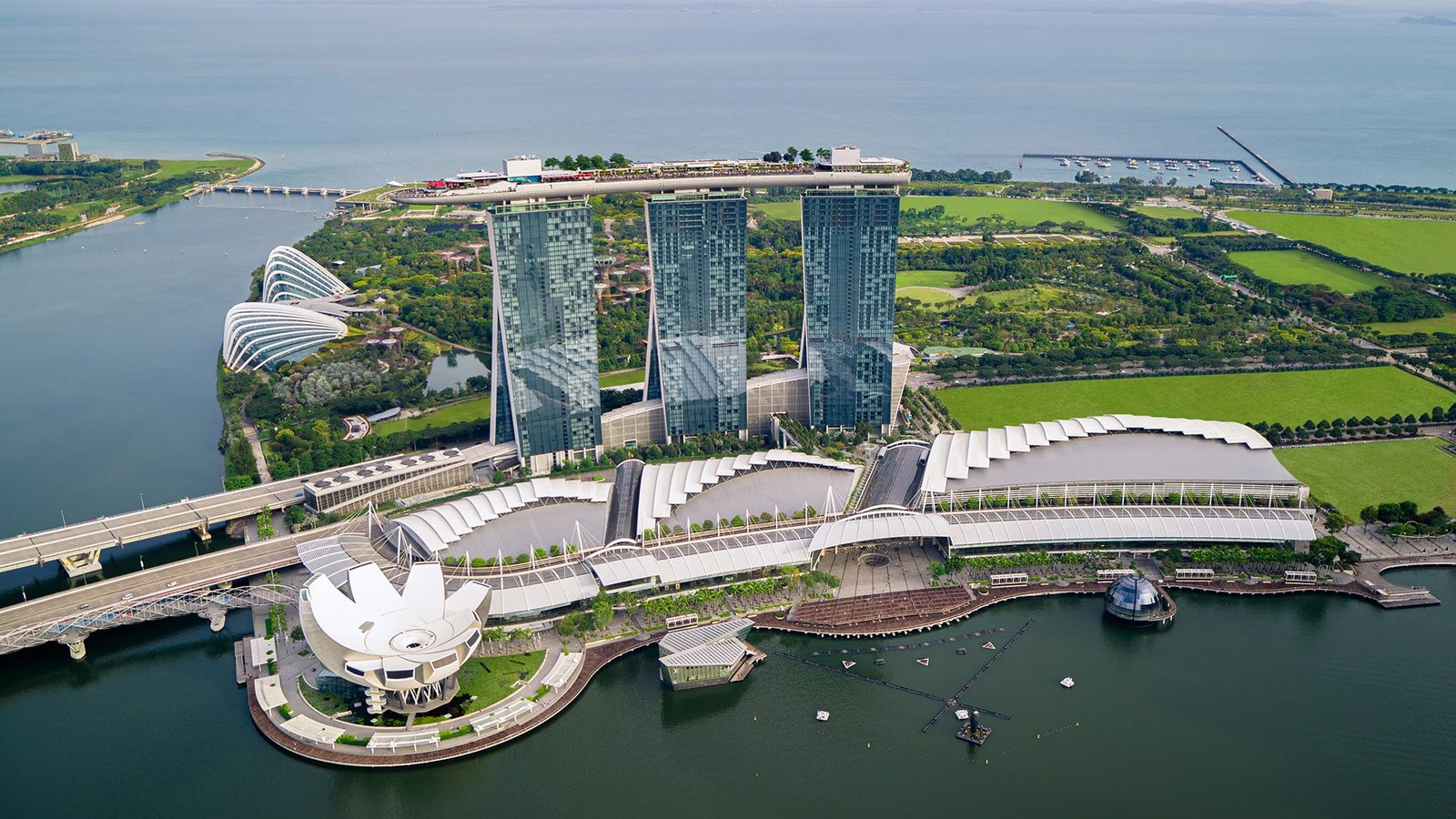
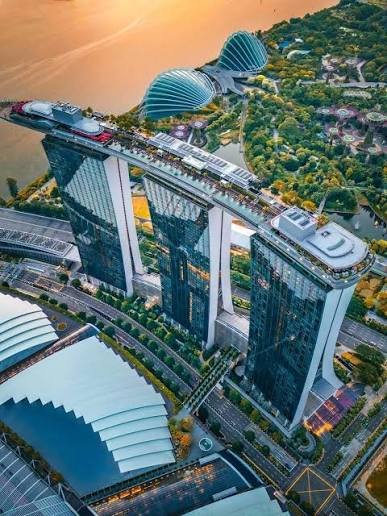
Across Marina Bay, three hotel towers rise beneath a single sweeping rooftop. The outline is so familiar you can recognise it before any sign comes into view. By day, the towers catch the changing light over the water. After dark, their windows become part of a much larger composition of reflections, promenades, and illuminated buildings.
Marina Bay Sands makes an immediate impression, but a photograph reveals only part of its character. Below the SkyPark are galleries, restaurants, shops, performance spaces, and places where people gather beside the bay. The development works at several scales: a skyline landmark from a distance, a major destination within the city, and a series of individual experiences once you arrive.
The best way to understand it is to move between those scales. Look at the whole structure from across the water. Spend time along the promenade. Then choose the interior or rooftop experience that interests you most. Its appeal becomes clearer when you connect the famous silhouette with the life beneath it.
What Marina Bay Sands is
Marina Bay Sands is an integrated resort on Singapore’s Marina Bay waterfront. Its facilities include a hotel, shopping, restaurants, entertainment, a casino, convention spaces, and the ArtScience Museum. The operator currently describes approximately 1,850 rooms and suites across the three hotel towers. [1]
The term “integrated resort” explains why the place can feel different depending on the purpose of a visit. A conference delegate, a family visiting an exhibition, and a couple arriving for dinner may share part of the same route before heading toward entirely different destinations.
It also explains a practical point: no single admission ticket automatically opens every part of Marina Bay Sands. Public circulation areas, separately ticketed attractions, hotel facilities, and private venues operate under different arrangements. Start a choosing an experience, rather than assuming access to the entire complex.
Where it is located
The resort’s main address is 10 Bayfront Avenue, Singapore 018956. Bayfront MRT station, coded CE1/DT16, serves it through the Circle and Downtown lines. [2]
Its waterfront setting is central to the experience. The bay provides enough distance to take in the three towers together, while the promenade lets visitors approach the lower buildings at a walking pace. From the opposite side of the water, the rooftop becomes a strong horizontal line against the vertical city.
The surrounding district offers opportunities to combine a visit with other attractions. Gardens by the Bay is accessible from Bayfront station’s Exit B, while the resort’s transport guide identifies Exits C and D for The Shoppes and connections to several resort venues. [2] Keep the name of your actual destination handy: a large complex can add more walking to a journey than the map initially suggests.
History and the 2010 opening
Marina Bay Sands began welcoming the public on April 27, 2010. [3] Las Vegas Sands’ portfolio includes the development, which was conceived as a major business and leisure destination. [4]
The resort opened in stages, and its components have their own histories. For example, the Art Science Museum opened in 2011. [5] This helps explain why descriptions of the complex can include more than one opening year without necessarily contradicting one another.
Large developments are rarely delivered as a single finished experience. Building work, fit-out, attraction launches, and operational changes can occur at different times. Marina Bay Sands visitors know today has also evolved since its opening through investment and changes to its hospitality offering.
That evolution matters when comparing sources. Early architectural descriptions refer to roughly 2,600 hotel rooms, while the operator’s current overview states approximately 1,850 rooms and suites. [1, 6] For booking decisions, current room categories and facilities are more useful than an opening-era inventory copied into an old travel guide.
The architect and the main design idea
Moshe Safdie and Safdie Architects designed Marina Bay Sands, with Aedas serving as executive architect and Arup contributing multidisciplinary engineering. [6, 7]
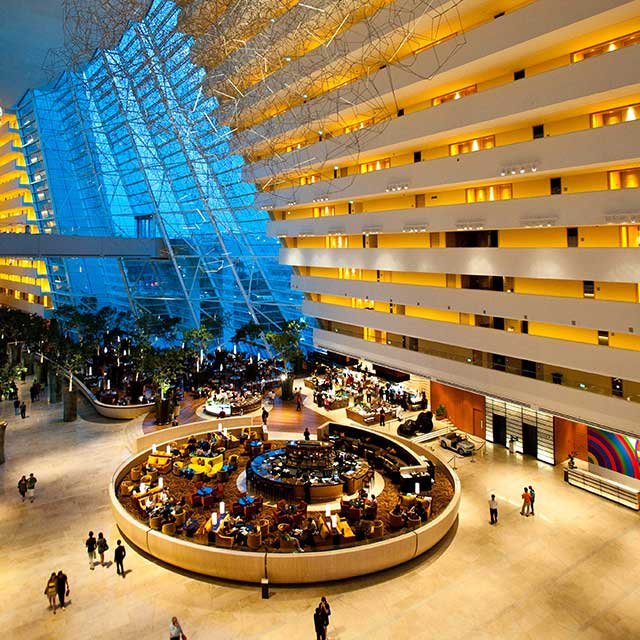
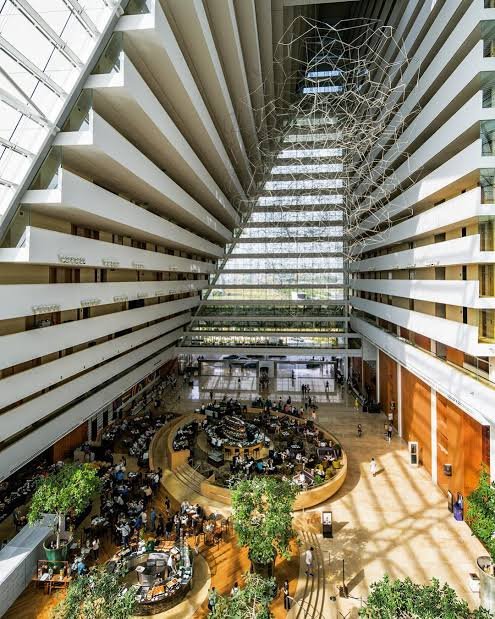
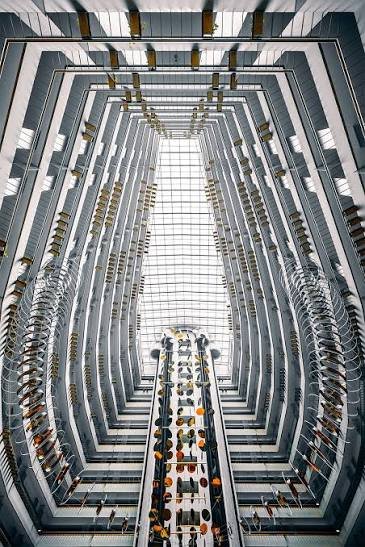
The three towers are the most obvious architectural elements, but the spaces between them are important too. Safdie Architects describes a scheme intended to maintain views through the development and connect with Singapore’s pedestrian network. At ground level, the hotel atrium operates as a linking space; above, the SkyPark brings the towers together. [6]
This creates a distinctive relationship between separation and connection. The towers retain their individual outlines, yet the rooftop makes them read as one composition. Below, routes connect the hotel with the wider resort and waterfront.
The design is especially effective from across the bay. The gaps keep the towers legible rather than letting them merge into a single wall. The rooftop then completes the image with a form that is easy to remember and difficult to mistake for another building.
Is there really a ship on the roof
The rooftop is often described as ship-like because of its long, curved profile. It is the Sands SkyPark, a purpose-built structure accommodating leisure spaces and hospitality venues above the towers.
Arup gives its dimensions as approximately 340 meters long and 38 meters wide, positioned around 200 meters above ground. [7] Safdie Architects describes a cantilever extending 66.5 meters beyond the supporting tower at the northern end. [6]
Those dimensions help explain the rooftop's dramatic effect. Its overhang makes the structure appear to reach beyond its support. From below, the eye naturally follows that projecting end. From above, the city and water become part of the setting for everyday activities such as dining, relaxing, and walking.
The ship comparison is a visual shorthand, not a technical description. Understanding the SkyPark as an elevated landscape is more useful: it places a collection of outdoor experiences in a location where most buildings would simply end.
Engineering a rooftop across three towers
The SkyPark had to accommodate the towers' individual movement. Arup also identifies deep marine clay beneath the site and vibration from wind and human activity as significant engineering challenges. Its team used three-dimensional modelling, structural testing, and tuned mass dampers to improve comfort in the elevated structure. [7]
These details make the skyline's apparent simplicity more interesting. Three tall buildings cannot be assumed to remain perfectly motionless relative to one another. A connecting structure must account for how its supports behave and the loads it carries.
Comfort is another part of the problem. People on an occupied rooftop sit, walk, swim, and look outward. Engineering therefore concerns how a structure feels in use, alongside its ability to carry weight.
The finished appearance conceals most of that work. Visitors see a continuous destination overhead. Behind that impression are coordinated decisions about structure, movement, construction, and everyday operation.
The SkyPark Observation Deck
The public SkyPark Observation Deck is accessed through Hotel Tower 3. The operator identifies it with Level 56 and a mezzanine reaching part of Level 57. It is a ticketed viewing area, distinct from the hotel’s infinity pool and rooftop restaurants. [8]
A visit offers a chance to understand the waterfront's geography. Look for the relationship between the bay, the business district, and the gardens before concentrating on individual buildings. The view becomes more meaningful when you can place familiar landmarks within the larger city.
The deck is outdoors, so weather is part of the experience. The operator notes that heavy rain or lightning can cause temporary closure. [8] A clear day offers detail and distance; evening emphasises lights and reflections. Neither guarantees a better visit, and the day's conditions matter more than a photograph used to advertise the attraction.
For planning, allow roughly an hour for the viewing experience, with additional time for entry and queues. This is a suggested allowance rather than an official duration. If you enjoy photography, leave enough flexibility to wait for changes in light.
Observation deck tickets and hours
As of October 12, 2026, standard adult admission is S$35 during non-peak hours and S$39 during peak hours. The published non-peak period is 9:30 a.m.–4:30 p.m., with last entry at 4 p.m.; peak access is 5 p.m.–10 p.m., with last entry at 9:30 p.m. [8]
Check the live calendar for your date. Special events, member offers, packages, and temporary closures can change what's available. Read the selected ticket’s conditions rather than assuming that an advertised discount applies to every visitor or time slot.
A sensible booking decision starts with your priority. If the skyline is the main attraction, choose a suitable viewing period. If you are planning dinner elsewhere, leave enough time between the two reservations. Avoid turning a relaxed visit into a sequence of rushed transfers.
The infinity pool and who can use it
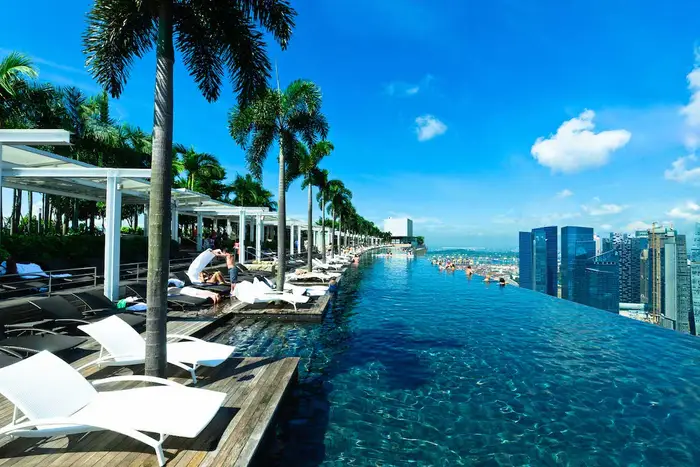
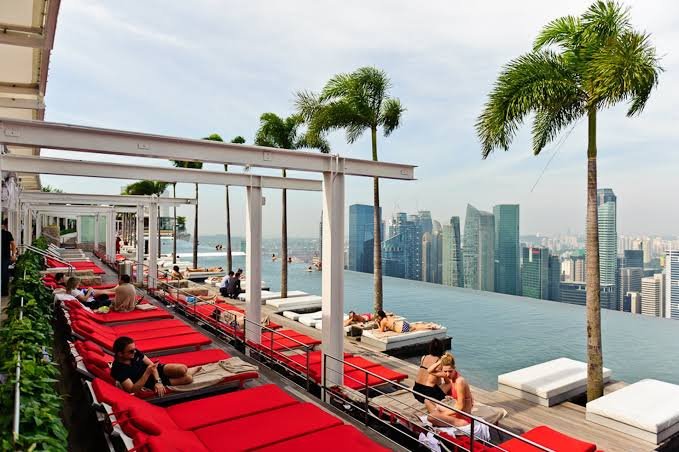
The SkyPark Infinity Pool is approximately 150 meters long and is located on Level 57. Access is reserved for registered Marina Bay Sands hotel guests, who must present their hotel keycards. The operator does not sell a separate swimming ticket to non-guests. [9]
This is the most important distinction for many first-time visitors. An observation-deck ticket provides a skyline experience, but it does not include a swim. A restaurant reservation is also a separate arrangement.
The pool’s disappearing edge creates the impression that the water meets the city beyond. The resort says a physical safety barrier supports this visual effect. Its published facilities include areas for adults, families, and children, and it is open daily from 6 a.m. to midnight. [9]
For guests, the pool's value is partly the chance to take in the skyline slowly. Morning, afternoon, and evening can produce very different surroundings. If swimming is the main reason for booking a stay, leave real time for it instead of treating it as a brief stop between other attractions.
Staying at the hotel
An overnight stay changes the relationship with Marina Bay Sands. Day visitors select a few experiences and move on. Hotel guests can return to their room, revisit the rooftop later, and use the property as a base for exploring Singapore.
Room selection deserves as much attention as the hotel’s name. Compare the room or suite category, the stated outlook, occupancy, breakfast arrangements, cancellation terms, and other inclusions. A large hotel can offer substantially different experiences within the same address.
The price is best checked for the exact travel dates and guest count. Weekend demand, major events, room categories, and booking conditions can make a single quoted nightly rate misleading. Also consider the amount paid against how much time you intend to spend at the property.
A stay can make sense for travellers who specifically want the pool and hotel experience. Someone primarily interested in architecture, exhibitions, or the waterfront can build a satisfying visit without booking a room. The better choice is the one that matches the trip rather than the photograph.
ArtScience Museum
The white, sculptural building beside the water is the Ar tScience Museum. It opened in 2011 and has 21 galleries that explore the relationship between art, science, and related fields. [5]
Its form is frequently compared to a lotus. Safdie Architects describes upper exhibition spaces within the sculptural volume and further galleries beneath the water-lily garden. The roof collects rainwater and channels it through a central opening, creating a waterfall in the open-air atrium. [10]
The museum provides a strong counterpoint to the hotel towers. Its low, spreading shape makes it visible as an individual object along the waterfront. The surrounding water and open space give visitors room to appreciate the form before entering.
Do not judge the museum only by its exterior. Review the exhibition program before buying a ticket, especially if your interests are specific. Different shows offer different kinds of engagement, from reflective gallery visits to interactive digital environments.
teamLab Future World
One of the museum’s continuing attractions is teamLab Future World, created with the international art collective teamLab. Its interactive installations focus on nature, movement, drawing, and light. The current exhibition page identifies two broad areas, City in Nature and Exploring New Frontiers. [11]
For example, Sketch Aquarium: Connected World allows visitors’ drawings of sea creatures to become part of a digital aquatic environment. Crystal Universe uses points of light to create an immersive spatial experience. [11]
The appeal lies in participation. Looking, moving, and making can become part of the artwork, giving families and visitors with little gallery experience an accessible entry point.
Check the practical conditions as well as the images. Future World uses timed admission, does not allow strollers inside, and applies height and footwear requirements to a particular climbing artwork. [11] Reviewing those details beforehand helps avoid disappointment, especially with younger children.
The Shoppes and the waterfront interior
The Shoppes at Marina Bay Sands is the resort’s retail destination, but its architecture is worth noticing even on a short walk-through. Safdie Architects describes galleries arranged as interior streets, with daylight, water features, and visual connections toward the bay. [12]
The intention is to make movement through a large development understandable. Shops and restaurants line circulation routes while openings and views provide orientation. The experience differs sharply from the rooftop, where distance and panorama dominate.
Notice the transition from inside to outside. The waterfront promenade provides a change in pace after the enclosed shopping environment. A visit that alternates between the two gives a better sense of how the resort connects with its surroundings.
You don't need to build the entire day around shopping. Treat the retail area as one possible component of a larger visit, with time for the museum, a meal, or the bay according to your interests.
Rain Oculus and art beyond the galleries
Ned Kahn’s Rain Oculus is a large acrylic bowl in which water forms a whirlpool before falling to the level below. The artist describes the work, created with Moshe Safdie, as both a skylight and a rain collector; recycled water also supplies the canal in the atrium. [13]
It is an effective example of art integrated into a busy public setting. The movement of water gives people a reason to pause in a place they might otherwise pass through quickly. The changing vortex makes the installation interesting beyond its size.
The resort also offers sampan rides along its indoor canal. [14] These are a separate attraction, so check the current operating information and admission conditions if a ride is part of your plan.
Dining and rooftop restaurants
The resort’s dining directory includes venues such as CUT by Wolfgang Puck, Spago, KOMA, and LAVO. LAVO’s official listing places its Italian restaurant and rooftop bar at Hotel Tower 1 on Level 57. [15, 16]
Choose a restaurant for the meal you actually want. Cuisine, atmosphere, dietary requirements, and the expected bill matter just as much as the address. A rooftop view can be memorable, but it should complement the dining experience rather than replace it.
For a special occasion, check reservations and any seating conditions in advance. A table near a window or outside may not be guaranteed by a general booking. Dress requirements, age policies, minimum spending rules, and opening days can also vary by venue.
Keep restaurant access separate from sightseeing access. A dining reservation is not a general pass to the SkyPark’s other facilities. Follow the arrival directions for the specific restaurant, particularly when the property is busy.
Spectra and the evening waterfront
Spectra is the resort’s free outdoor light-and-water show at the Event Plaza. The operator describes a performance lasting about 15 minutes, combining fountains, projections, lasers, mist effects, and music. [17]
It provides a natural way to end a waterfront visit. The bay becomes a performance setting, and the surrounding buildings add a second layer of light beyond the show itself. You can enjoy the atmosphere without staying at the hotel or booking a premium attraction.
Check the official schedule close to your visit and arrive with time to find a comfortable viewing position. A show seen from ground level is different from one viewed from a distant building: proximity helps the water, sound, and projections work together.
Afterwards, it's worth staying a little longer. As people begin to disperse, the promenade returns to its ordinary rhythm, and the resort can be appreciated as part of the wider nighttime waterfront.
Conventions and entertainment
The resort’s business facilities are central a its identity. Safdie Architects lists approximately 121,000 square meters for the convention and exhibition component in its project account. [12] The operator’s current overview also identifies a theatre and extensive facilities for meetings and events. [1]
These uses explain some of the activity visitors encounter. A holiday destination may also host a trade exhibition, business gathering, or performance. The lobby and surrounding routes can feel very different according to the event calendar.
If attending a show or conference, use the venue name and entrance information on the ticket. “Marina Bay Sands” is a useful district-level destination, but a precise meeting point is better once you arrive.
The casino
A casino is part of the resort, with admission restricted to patrons aged 21 and above under the operator’s published guidance. Singapore citizens and permanent residents are subject to an entry levy. [18, 19]
Visitors considering entry should check the current identification and admission requirements directly. Casino access is separate from walking around the resort, shopping, dining, or visiting the museum.
There is plenty to see without including it in an itinerary. For many travellers, the architecture, public waterfront, and cultural attractions are the main reasons to visit.
Sustainability and the work behind daily operations
The resort organises its environmental initiatives through Sands ECO360. Its 2025 responsible-business account describes engineering retrofits, water-saving measures, waste diversion, and responsible sourcing. It also reports BCA Green Mark Platinum recognition for the Expo & Convention Centre. [20]
These operational details matter in a property of this scale. A hotel, restaurants, exhibition halls, retail spaces, and outdoor facilities create different patterns of resource use. Improvements can involve both building systems and routine decisions across many departments.
Environmental certifications should be understood in their specific scope. An award attached to a particular venue does not automatically describe every building in the complex. Likewise, efficiency measures do not mean a large resort has no environmental footprint.
The useful question is how performance develops over time. Examining reported improvements, baselines, and boundaries provides a more meaningful picture than relying on a general description of the property as sustainable.
Expansion and what comes next
Las Vegas Sands held a groundbreaking ceremony for a new adjacent development on July 15, 2025. The announced US$8 billion project includes a 570-suite hotel tower, additional meeting facilities, and a planned 15,000-seat arena. Safdie Architects is designing the new property, with Populous responsible for the arena design. [4]
The proposed rooftop, called Skyloop, is distinct from the existing Sands SkyPark. Published plans include a combination of public and private experiences, with an observatory, restaurants, gardens, and hotel facilities. [4]
The resort’s published development timetable has identified January 2031 as an estimated opening, subject to government approval. [21] Treat this as a forward-looking target rather than an available attraction or a guaranteed completion date.
For today’s visitor, the distinction is straightforward: the familiar three-tower resort is operating, while the new project represents a separate future phase. A rendering of the expanded skyline should not be mistaken for a photograph of facilities already open.
Planning a rewarding visit
For a first visit without a hotel stay, choose two or three main experiences. One workable approach is an afternoon exhibition, time along the waterfront, and either a rooftop visit or dinner, followed by Spectra if the schedule fits.
An architecture-focused visit can be simpler. Begin with a distant view across the bay, walk toward the resort, examine ArtScience Museum’s exterior, and spend time inside the retail galleries. Add the observation deck if an elevated view is important to you.
Families may prefer the museum and a relaxed meal over several timed reservations. Hotel guests should leave space in the itinerary to enjoy the pool and the property itself. Booking a room and then spending almost every waking hour elsewhere may not deliver the experience that motivated the stay.
As an editorial planning allowance, reserve half a day for a few selected attractions and longer if you want exhibitions, shopping, dining, and an evening show. Travel speed, queues, and individual interests will determine the actual duration.
Weather and photography
A clear late afternoon is a good time for a first rooftop visit because it lets you see the city transition into evening. Keep the plan flexible: clouds, rainfall, and visibility can matter more than a particular time on the clock.
For photographs of the whole resort, look for space across the bay. From nearby, the towers are harder to fit in one frame, but the atrium, façades, and museum details become more interesting. Both approaches tell a different part of the story.
Avoid treating every stop as a photograph to collect. The rooftop's scale, the movement of water, and the changing relationship between the buildings become clearer when you take time to look. The strongest memory may be a view you did not immediately try to capture.
Why Marina Bay Sands remains distinctive
Marina Bay Sands brings an unusually broad range of experiences into a single waterfront development. Its recognisable silhouette draws people in; its cultural spaces, restaurants, public routes, and evening activity give them reasons to stay.
The architecture is most rewarding when seen from more than one position. Across the water, it is an image of the city. At the promenade, it becomes part of a walk. From the SkyPark, the rest of Singapore becomes the setting. These shifts in perspective turn a familiar landmark into a memorable visit.
Frequently Asked Questions
What is Marina Bay Sands famous for
It is best known for its three hotel towers, connecting SkyPark, rooftop infinity pool, ArtScience Museum, and waterfront setting. The resort also includes dining, shopping, entertainment, and major convention facilities. [1]
Who designed Marina Bay Sands
Moshe Safdie and Safdie Architects created the design. Aedas served as executive architect, with Arup providing multidisciplinary engineering. [6, 7]
When did Marina Bay Sands open
The resort began welcoming the public on April 27, 2010. Components opened in phases; ArtScience Museum followed in 2011. [3, 5]
Can I visit without staying at the hotel
Yes. Day visitors can explore public areas and book attractions, dining, or performances. Individual venues have their own admission arrangements; hotel-only facilities remain restricted. [1, 8, 9]
Can non-guests use the infinity pool
No. The pool is reserved for registered hotel guests with hotel keycards. A separate swimming ticket is not available. [9]
Does an observation deck ticket include the pool
No. Observation-deck admission and hotel pool access are separate. [8, 9]
How much does the observation deck cost
Standard adult prices, checked in October 2026, are S$35 (non-peak) and S$39 (peak). Confirm the rate and conditions for your date. [8]
Is the Spectra show free
Yes. Spectra is a free outdoor light-and-water show at the Event Plaza, lasting approximately 15 minutes. Check current performance times before visiting. [17]
Which MRT station serves Marina Bay Sands
Bayfront station, CE1/DT16, serves the resort on the Circle and Downtown lines. Follow the exit signs for your particular venue. [2]
Is the new hotel tower already open
No. The adjacent development is a future project. Published plans have identified an estimated January 2031 opening, subject to approval and schedule changes. [4, 21]
Sources and editorial notes
Research checked October 12, 2026. Prices, opening hours, exhibitions, access rules, and development schedules should be reviewed before publication. Numbered references can be converted into hyperlinks. Suggested itineraries and visit durations are editorial planning guidance. Current operator information is used for room counts and visitor access; historic design profiles describe the original project. Meta keywords are supplied as requested.
[1] Marina Bay Sands, About — current room count and resort facilities.
https://www.marinabaysands.com/company-information/about.html
[2] Marina Bay Sands, Directions — address, MRT lines, and station exits.
https://www.marinabaysands.com/company-information/directions-to-marina-bay-sands.html
[3] Las Vegas Sands, Val Chua interview — April 27, 2010 opening date.
https://www.sands.com/news/marina-bay-sands-val-chua-womens-history-month-spotlight/
[4] Marina Bay Sands, July 15, 2025 groundbreaking announcement — developer, expansion scope, design teams, and Skyloop plans.
https://www.marinabaysands.com/company-information/groundbreaking-ceremony.html
[5] ArtScience Museum, About — opening year and gallery count.
https://www.marinabaysands.com/museum/about-us.html
[6] Safdie Architects, Hotel and SkyPark — architectural intent, project team, historic room count, and cantilever dimensions.
https://www.safdiearchitects.com/projects/marina-bay-sands-hotel-and-skypark
[7] Arup, Marina Bay Sands Integrated Resort — SkyPark dimensions, structural movement, ground conditions, and vibration control.
https://www.arup.com/en-us/projects/marina-bay-sands-integrated-resort/
[8] Marina Bay Sands, SkyPark Observation Deck — location, admission prices, hours, weather conditions, and access distinctions. The official site redirected to its Japanese-language version during research.
https://www.marinabaysands.com/attractions/skypark-observation-deck.html
[9] Marina Bay Sands, SkyPark Infinity Pool — length, level, guest restrictions, hours, and safety design.
https://www.marinabaysands.com/attractions/infinity-pool.html
[10] Safdie Architects, ArtScience Museum — architectural form, galleries, and rainwater collection.
https://www.safdiearchitects.com/projects/marina-bay-sands-artscience-museum
[11] ArtScience Museum, teamLab Future World — installations, timed admission, and family access conditions.
https://www.marinabaysands.com/museum/exhibitions/future-world.html
[12] Safdie Architects, Public Realm and Retail Galleria — circulation, waterfront relationships, and convention space.
https://www.safdiearchitects.com/projects/marina-bay-sands-public-realm-and-retail-galleria
[13] Ned Kahn Studios, Rain Oculus — artwork and water circulation.
https://nedkahn.com/portfolio/rain-oculus
[14] Marina Bay Sands, Sampan Rides — indoor canal attraction.
https://www.marinabaysands.com/attractions/sampan-rides.html
[15] Marina Bay Sands, Restaurants — dining directory.
https://www.marinabaysands.com/restaurants.html
[16] Marina Bay Sands, LAVO — rooftop restaurant location.
https://www.marinabaysands.com/restaurants/lavo.html/
[17] Marina Bay Sands, Spectra — free admission, location, and approximate duration.
https://www.marinabaysands.com/attractions/spectra.html
[18] Marina Bay Sands, FAQs — casino minimum age.
https://www.marinabaysands.com/faq.html
[19] Marina Bay Sands, Blue Pearl — casino-entry levy requirement for Singapore citizens and permanent residents.
https://www.marinabaysands.com/restaurants/blue-pearl.html
[20] Marina Bay Sands, 2025 Responsible Business Highlights — environmental program and venue-specific certification.
https://www.marinabaysands.com/sustainability/responsible-business-highlights.html
[21] Marina Bay Sands, US$8 billion development announcement — estimated opening timetable, subject to approval.
https://www.marinabaysands.com/expo-and-convention/gallery/event-highlights/2024/12/us-dollar-8-billion-announcement.html