Lotte World Tower rises above Seoul’s Jamsil district with a slender silhouette inspired by Korean artistic traditions. This detailed guide explores how the 123-story landmark was conceived, built, and organized to accommodate offices, residences, hospitality, and sightseeing. It explains the engineering beneath its glass exterior, its environmental design, the Seoul Sky observation experience, and the difference between the glass-floor Sky Deck and the outdoor Sky Bridge. Practical advice covers tickets, transport, timing, photography, and nearby Seokchon Lake, followed by ten frequently asked questions.
Lotte World Tower and Seoul from a Different Perspective
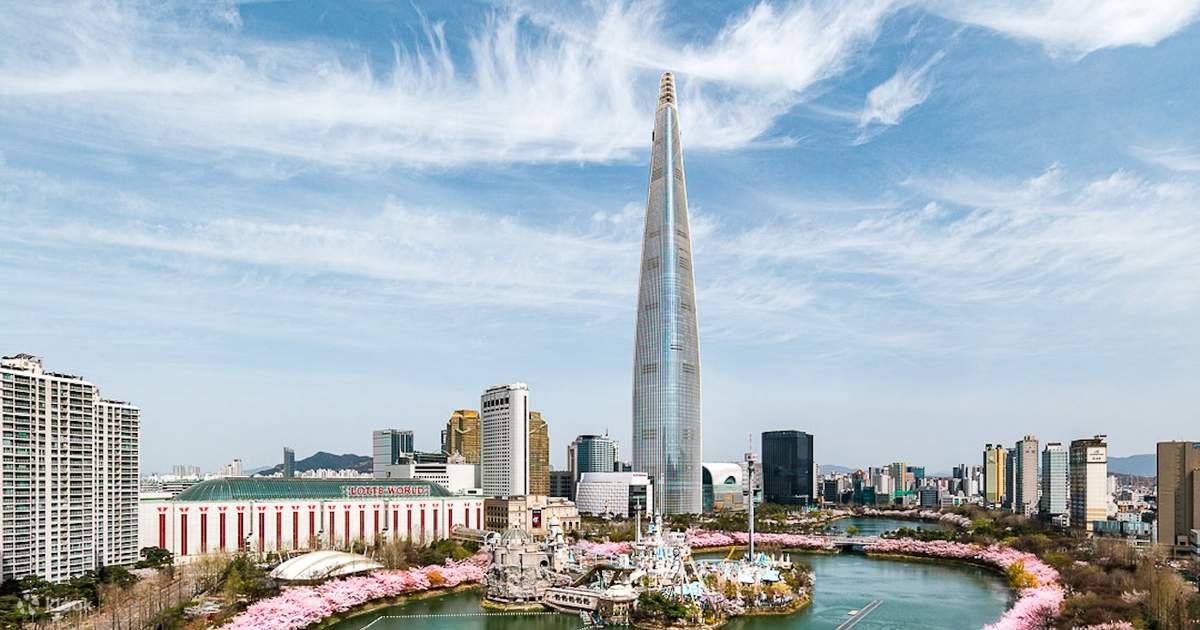
Lotte World Tower changes character with distance. From across Seoul, it is a slender point above the city’s broad spread of buildings. Near its base, the smooth curve becomes a glass wall, and the crown seems almost too far away to belong to the same structure.
The tower’s appeal begins with that contrast, but it does not end with height. A visit can involve a fast elevator ride, a transparent floor above the streets, a quiet meal overlooking the city, or an outdoor crossing near the summit. Each experience reveals a different aspect of a building designed to serve many purposes at once.
Understanding those purposes makes the landmark more interesting. It also makes planning easier. Lotte World Tower, the Seoul Sky observatory, Lotte World Mall, and the nearby Lotte World theme park share a location and branding, but they aren't interchangeable attractions under one universal ticket.
What Lotte World Tower is
Lotte World Tower is a 123-story skyscraper in Jamsil, Songpa District, Seoul, South Korea. It is widely described as 555 meters tall and contains a mixture of offices, residential accommodation, a hotel, commercial facilities, and public observation spaces. It opened on April 3, 2017. [1, 2]
There is a small but useful distinction in the height figures. The Skyscraper Centre records an architectural height of 554.5 meters and a tip height of 555.7 meters. The familiar 555-meter figure is the rounded description used by the architect and many official visitor sources. None of those numbers means that a standard visitor stands 555 meters above the pavement. [3]
The tower is South Korea’s tallest building. KPF’s current project page describes it as the world’s sixth tallest, while opening-era material called it fifth. The difference reflects changes in global rankings rather than a change to the tower itself. [1, 2]
Where it stands in Seoul
The address used by Seoul Sky is 300 Olympic-ro, Songpa-gu, Seoul. The surrounding Jamsil area places the tower close to shopping, entertainment, and Seokchon Lake. [9, 15]
This setting gives the building more than one public face. One face is the commercial complex, with indoor circulation and busy entrances; the other is the open landscape around the lake, where visitors can step back and see the tower in its entirety.
For a first visit, it is worth experiencing both. Looking upward from the base emphasizes scale. Viewing the building across water makes its taper easier to read. Going inside then reverses the relationship: the tower becomes the place from which the surrounding city is understood.
The history of the project
Construction began in November 2010, according to a contemporary Korea.net report published before the opening. The same account described an investment of approximately KRW 4.2 trillion. This is best treated as a reported project figure with its original context, rather than converted into a supposedly exact present-day dollar cost. [4]
The official opening followed in April 2017. Kohn Pedersen Fox Associates, usually abbreviated to KPF, designed the tower, with Baum Architects identified as associate architect on KPF’s project page. [1, 2]
Its construction was a substantial technical undertaking, but completion was only one stage in the building’s life. A mixed-use tower must keep office traffic, hotel arrivals, residents, service operations, and sightseeing visitors moving without turning every entrance into a bottleneck.
That continuing operational challenge is part of the story. A skyline landmark succeeds when the systems behind its image work reliably for the people using it every day.
A silhouette influenced by Korean art
The tower’s smooth taper is deliberate. KPF relates its curves to Korean ceramics and calligraphy, with silver-toned glass and fine white metal elements contributing to the exterior’s restrained appearance. [2]
The reference works through proportion and line rather than literal imitation. The building does not reproduce a ceramic vessel at enormous scale. Instead, it borrows a sense of continuity: a broad lower form gradually narrowing into a more delicate upper one.
KPF also describes a seam running up the façade and orienting toward Seoul’s historic centre. Inside, larger gathering spaces mark transitions between the building’s different uses. [1]
These details help explain why the tower appears calm despite its enormous size. Its exterior does not divide the height into a series of strongly projecting tiers. The eye follows a continuous movement upward, while the divided crown provides a recognisable finish.
The design is especially easy to appreciate in a photograph that includes some surrounding buildings. Against an empty sky, height can become abstract. Beside the city, the tower’s unusual proportions become unmistakable.
How different uses fit inside one tower
Offices, residences, hotel accommodation, and observation facilities require different kinds of space. Large workplaces benefit from flexible floor areas. Hotel rooms need repeated room layouts, privacy, and carefully managed circulation. An observatory must handle queues and people moving slowly around windows.
Lotte World Tower accommodates these needs vertically. The broader lower areas and narrower upper sections create a changing set of floor sizes rather than one identical plate repeated from bottom to top. [1]
SIGNIEL Residences is the residential component, while SIGNIEL Seoul is the hotel. The observatory is a separate public attraction. Visitors should follow the entrance and booking instructions for the service they have actually reserved; a ticket to one part of the building is not permission to wander through all the others.
This is one reason the phrase “vertical city” is often used for the development. It captures the range of activity, though the tower still depends on the surrounding streets, transport, utilities, and public spaces. A tall building can concentrate functions without replacing the wider city
The engineering behind the taper
Structural engineer LERA describes a system of eight concrete mega-columns, concrete core walls, outriggers, and belt trusses. These elements work together to carry gravity loads and resist lateral forces. [5]
In simple terms, the core forms a strong central spine, while connections to large perimeter columns allow the building’s width to contribute to stability. Belt trusses help distribute forces around the structure and transfer loads between sections with different column arrangements.
The taper made the engineering more complex, but LERA notes that the shape was helpful in reducing wind loads. The design team also had to balance structural efficiency with the desire for open interiors. On office and officetel levels, selected long-span elements span up to 24.5 meters between mega-columns. [5]
That balance is easy to overlook from outside. A column placed in the most structurally convenient position might interfere with a room, a view, or a flexible office layout. The finished building results from negotiating those competing requirements.
Its elegance therefore depends on more than a pleasing outline. The architectural form, internal uses, and structural system had to be developed together.
Elevators and the journey upward
The Seoul Sky experience begins well before the panorama. Otis supplied a pair of double-deck Sky Shuttle elevators designed to travel at 10 meters per second and make the express journey in about one minute. [6]
A double-deck elevator uses two cabins stacked one above the other, increasing the number of passengers a single shaft can carry. Speed is only part of its value. Capacity, boarding arrangements, and waiting-area management also shape the visitor experience.
The tower contains other elevator systems for its everyday occupants. Mitsubishi Electric describes installations serving offices, residences, and the hotel, including double-deck office elevators linked to a destination-allocation system and access control. [7]
For a visitor, the practical lesson is simple: use the correct entrance and elevator route. The building’s different lift systems serve different destinations.
Also allow more time than the advertised ride duration. A one-minute ascent does not include ticket checks, waiting, boarding, or the descent queue at the end of the visit.
Sustainability and environmental design
KPF recorded the project's LEED Gold certification. Its building-services design includes measures to manage the large energy and water demands of a supertall development. [1, 8]
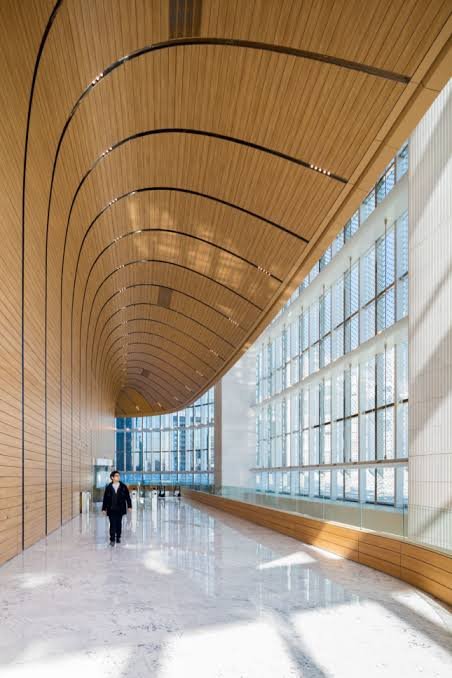
Syska Hennessy identifies energy recovery, variable-speed equipment, power monitoring, low-flow fixtures, and greywater reuse among its design features. It also describes radiant heating and cooling and displacement air for the large atrium lobby. [8]
These are practical responses to how people occupy space. Conditioning a huge volume of air uniformly is not always the most efficient approach. Controls, zoning, and recovering otherwise wasted energy can matter as much as a highly visible renewable installation.
The contractor’s environmental account also describes geothermal heat exchange, insulating glass, efficient lighting, and solar thermal collectors. [17]
Certification and installed technology should still be read carefully. A building designed for efficiency is not a building with no environmental footprint. Published design expectations are also different from independently verified operating results. Lotte World Tower’s environmental interest lies in the coordinated systems supporting a demanding development, rather than a claim that height itself is sustainable.
Seoul Sky and the view over the city
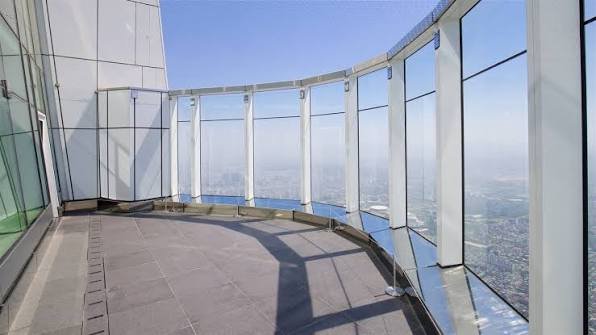
Seoul Sky occupies the tower’s upper observation levels, broadly identified as floors 117 through 123. Its public spaces offer views across Seoul, with the Han River, dense urban neighbourhoods, and distant hills shaping the panorama. Access to particular lounges or special experiences depends on the ticket and operating arrangements. [4, 9]
The most rewarding approach is to walk slowly around the windows. At first, the city may look like a texture of roads and roofs. After a few minutes, larger patterns emerge: the river corridor, groups of tall buildings, open spaces, and changes in terrain.
Visibility determines how much of that wider landscape you can see. Clear weather reveals distance; haze compresses it. Low cloud may obscure the skyline even when conditions at street level seem acceptable.
For that reason, plan the observatory visit with some flexibility. An expensive ticket cannot guarantee a clear horizon, and a sunset reservation is only as good as the weather that accompanies it.
The glass-floor Sky Deck
The Sky Deck on the 118th floor is one of the attraction’s best-known features. Guinness World Records records its glass-floor observation platform at 478 meters, verified in January 2017. [10]
Its effect differs from a normal window view. Looking outward lets your eye travel across the city; looking down puts the distance directly beneath your feet. Roads and vehicles become a measure of height in a way that a distant mountain cannot.
You do not have to enjoy that sensation to enjoy Seoul Sky. Visitors who are uncomfortable with transparent floors can concentrate on the panoramic views and other areas, following the available route and staff guidance.
The glass floor is also a popular photography spot. Give other visitors room, avoid blocking circulation while setting up a picture, and follow the rules for bags and equipment. A brief photo usually captures the experience better than a long performance for the camera.
Sky Terrace and the outdoor Sky Bridge
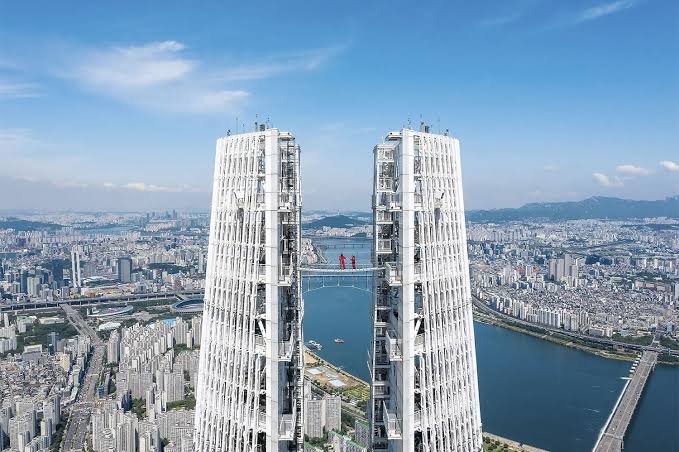
The Sky Terrace is associated with the 120th floor. It should not be confused with the much higher Sky Bridge, which crosses between the tower’s paired crown elements. [4, 11]
KPF describes the Sky Bridge as an 11-meter crossing approximately 541 meters above street level, experienced while wearing a safety harness. The operator presents it as a separate tour, with its own booking and participation conditions. [11, 12]
This is a more specialised activity than visiting the indoor observatory. Check the current requirements concerning height, health, clothing, equipment, and check-in. Seasonal operation and weather can affect availability, so a photograph or an old account of the experience doesn't prove it will run on a particular day.
For a group with different comfort levels, not everyone needs to make the same choice. Some may prefer the exposed rooftop setting; others may find the indoor panorama entirely sufficient. Plan around the experience people actually want rather than treating the highest possible point as compulsory.
SIGNIEL Seoul and staying above the city
SIGNIEL Seoul occupies floors 76 through 101 of Lotte World Tower. Songpa District’s official tourism information lists 235 rooms, along with restaurants, a bar and lounge, spa and fitness facilities, and a swimming pool. [13]
A hotel stay provides a different relationship with the skyline from an observation ticket. Instead of seeing the city during one short visit, guests can watch changes in daylight, weather, and nighttime illumination from their accommodation.
The exact experience depends on room category and orientation. If a particular river view, bathtub setting, lounge benefit, or dining reservation matters, confirm it directly when booking. Hotel photographs may represent several room types rather than the one selected.
A room reservation should not be assumed to include Seoul Sky or the Sky Bridge. Likewise, an observatory ticket does not provide access to hotel facilities. Any combined benefit should be stated clearly in the booking terms.
The hotel is worth considering as hospitality in its own right, rather than merely as a way to gain height. Service, room layout, location, and budget still matter.
The mall and nearby entertainment
Lotte World Mall provides shopping, dining, and entertainment beside the tower. The wider development also includes a concert hall, with connections between commercial spaces and outdoor gathering areas. [1, 3]
The nearby Lotte World Adventure is a theme park, a separate attraction at 240 Olympic-ro. Its admission arrangements differ from Seoul Sky's. [14]
This distinction matters when comparing online packages. A product labelled “Lotte World” may refer to the theme park rather than the tower. Read the actual included attractions before paying, especially if the observatory is your main reason for visiting.
There is plenty to do in the area, but trying to fit every attraction into one day can make the visit feel hurried. Choose a main activity and one or two complementary stops. A tower visit followed by a meal and a lake walk gives a very different day from a full theme-park outing.
Seokchon Lake and seeing the tower from outside
Seokchon Lake offers a useful counterpoint to the indoor observation experience. Seoul’s official tourism material highlights its walking areas and views of the illuminated tower at night. [15]
The lake provides space to see the building’s full form. Reflections can add interest when the water and light cooperate, while the surrounding trees create a softer foreground than the commercial streets.
This is also where the tower becomes part of an everyday urban landscape. People walk, meet, rest, and take photographs around a building often presented as a record or an engineering achievement.
Leave some time for that ordinary view. A photograph taken from the observatory cannot include the building you are standing in. A walk outside completes the visual story.
Tickets and opening hours
In October 2026, Seoul Sky’s official ticket listing showed general adult admission at KRW 33,000 for visitors aged 13 and above. Promotions and other ticket categories can differ, and this should be treated as a dated reference rather than a permanent price. [16]
The Korea Tourism Organisation listed regular hours as 10:30 to 22:00 Sunday through Thursday and 10:30 to 23:00 on Friday and Saturday, with last admission one hour before closing. Confirm the operator’s schedule for the actual date, especially around holidays or special events. [9]
Check what a ticket includes: ordinary observatory access, a faster admission option, a special experience, or a combination with another attraction. Read cancellation and redemption conditions as carefully as the headline price.
Keep your booking confirmation available offline if possible. Allow time to find the Seoul Sky entrance and pass through the required checks. Arriving at the address of the tower is not the same as being ready to board an elevator.
Getting there
Jamsil Station is served by Seoul Subway Lines 2 and 8, making rail a practical approach to the tower complex. Follow the station signs for the tower and mall, then the signs for your booked destination. [13]
For navigation, use “Seoul Sky” if you are visiting the observatory and “SIGNIEL Seoul” if you are checking into the hotel. The correct destination can save time in a large development with several entrances.
A taxi may be convenient for travellers with luggage or for a group, but allow for traffic. If you are combining the visit with another part of Seoul, check the journey time from that actual location rather than relying on a general estimate for the city.
Visitors who need step-free access or other assistance should confirm the appropriate route with the operator before arrival. Indoor observatory access and participation in an outdoor harnessed activity involve different requirements.
When to visit and how long to stay
Allow approximately one and a half to two hours for an unhurried observatory visit, including some waiting time. This is a planning estimate, not an official required duration. Add more time for dining, shopping, or the Sky Bridge tour.
Daylight makes it easier to identify the river and the city's structure. After dark, illuminated buildings and roads become the main subject. A late-afternoon arrival may allow both, but sunset periods can attract visitors with exactly the same plan.
Look at visibility as well as the weather forecast. A bright sky does not always mean a distant, clear horizon. If skyline photography is the priority, leave room in the itinerary to choose the better day.
For a simple half-day outing, begin with a walk near Seokchon Lake, visit the observatory, and finish with dinner in the surrounding complex or neighbourhood. Reverse that order if evening views matter more to you.
Photography tips
Through observatory windows, reflections are often more troublesome than the view itself. Turn off flash, move close to the glass without leaning against it, and adjust your position to avoid bright interior lights appearing in the image.
A dark top can help reduce your own reflection. At night, try several exposures rather than immediately assuming the brightest image is the best. Too much brightness can erase the contrast that makes a cityscape interesting.
Outside, give the tower some context. A lake edge, a line of trees, or a smaller building helps communicate scale. Take a detail of the façade or crown as well as the full-height picture.
Equipment rules differ between ordinary indoor viewing areas and the Sky Bridge. Check the rules for the experience booked, and do not assume that a tripod or handheld accessory permitted in one space is permitted in another.
What makes the tower significant
Lotte World Tower brings together several ambitious ideas: a distinctive skyline form, a complex mix of uses, and public access to exceptional height. Its design shows how a contemporary skyscraper can refer to local artistic traditions without copying a historic building.
Its value should also be judged at ground level. Connections, entrances, public spaces, and relationships with nearby streets matter as much as the view from the summit. A landmark can be visually successful yet still ask difficult questions about energy use, access, and the concentration of activity.
The most rewarding visit keeps both scales in mind. Enjoy the panorama, but also notice how the tower meets the lake, the mall, and the people moving around its base. That is where an extraordinary structure becomes part of Seoul.
Frequently Asked Questions
Where is Lotte World Tower
It is in Jamsil, Songpa District, Seoul, South Korea. Seoul Sky uses the address 300 Olympic-ro. Jamsil Station on Lines 2 and 8 provides a convenient subway approach. [9, 13]
How tall is Lotte World Tower
It is commonly described as 555 meters tall and has 123 above-ground stories. The Skyscraper Center records 554.5 meters to the architectural top and 555.7 meters to the tip. [3]
When did Lotte World Tower open?
The tower officially opened on April 3, 2017. Construction began in November 2010, according to government reports at the time. [2, 4]
Who designed the building?
Kohn Pedersen Fox Associates designed it, with Baum Architects as associate architect. LERA developed the structural engineering system. [1, 5]
Is Seoul Sky the same as Lotte World Tower?
Seoul Sky is the observation attraction within the tower. The building also includes offices, residences, and SIGNIEL Seoul. Admission to the observatory does not open every part of the tower to visitors.
What is special about the glass floor?
The Sky Deck lets visitors look down through transparent flooring from a height of 478 meters. Guinness World Records verified its glass-floor observation-deck record in January 2017. [10]
Is the Sky Bridge included in ordinary admission?
It should be treated as a separate tour unless a booking explicitly includes it. The outdoor crossing requires safety equipment and compliance with the operator’s participation and weather conditions. [11, 12]
Can you stay overnight inside the tower?
Yes. SIGNIEL Seoul is the hotel within the tower, occupying floors 76 through 101. Check the selected room package for inclusions; observatory access should not be assumed. [13]
Does a tower ticket include the Lotte World theme park?
Not automatically. Lotte World Adventure and Seoul Sky are separate attractions. A combination package must clearly list both if you want admission to both. [14, 16]
Is Lotte World Tower worth visiting in poor weather?
The building, elevator experience, and indoor facilities can still be interesting, but distant views may be obscured. Outdoor experiences can be affected more directly. If the panorama is your main goal, check visibility and booking conditions before choosing a time.
Sources and editorial notes
Prepared October 14, 2026. Ticket prices, schedules, floor access, and outdoor-tour availability can change. Practical pacing and photography advice are editorial guidance. Older project pages may retain opening-era global rankings or promotional hotel star labels; the article avoids treating these as current official classifications. Meta keywords are supplied as requested and do not guarantee search rankings.
[1] KPF — Lotte World Tower, architecture, uses, project team, and certification.
https://www.kpf.com/project/lotte-world-tower
[2] KPF — Lotte World Tower Opens in Seoul, April 2017.
https://www.kpf.com/news/lotte-world-tower-opens-in-seoul
[3] The Skyscraper Center — Lotte World Tower, height measurements and building classification.
https://www.skyscrapercenter.com/building/lotte-world-tower/88
[4] Korea.net — Seoul’s vertical metropolis awaits grand opening, March 21, 2017. Used for construction history and original floor arrangements.
https://www.korea.net/NewsFocus/Society/view?articleId=144868
[5] LERA Consulting Structural Engineers — Lotte World Tower structural system.
https://www.lera.com/lotte-world-tower
[6] Otis — Lotte World Tower Sky Shuttle project.
https://www.otis.com/en/uk/our-company/global-projects/project-showcase/lotte-world-tower
[7] Mitsubishi Electric Building Solutions — Lotte World Tower elevator installations.
https://www.mebs.com/resources/projects/018/index.html
[8] Syska Hennessy — Lotte World Tower building-services and environmental design.
https://syska.com/projects/lotte-world-tower-seoul-south-korea/
[9] Korea Tourism Organization — Lotte World Tower Seoul Sky, address and regular visiting hours. Its displayed admission prices differ from the operator’s current listing; reference [16] is used for price.
https://english.visitkorea.or.kr/svc/whereToGo/locIntrdn/rgnContentsView.do?vcontsId=65854
[10] Guinness World Records — Highest glass-floor observation deck, verified January 23, 2017.
https://www.guinnessworldrecords.com/world-records/456735-highest-glass-floor-observation-deck
[11] KPF — Sky Bridge Opens at Lotte World Tower, March 4, 2021; bridge dimensions and setting.
https://www.kpf.com/news/sky-bridge-opens-at-lotte-world-tower-541-meters-above-seoul
[12] Seoul Sky — Official Sky Bridge tour information.
https://seoulsky.lotteworld.com/enjoy/skyBridge
[13] Songpa District — SIGNIEL Seoul hotel information and subway connections.
https://www.songpa.go.kr/culture/detailInfo.do?cpn=2&key=3845&rcpp=6&resrceCd=TR0230-1007471&sc1=TR0230
[14] Lotte World Adventure — Official theme-park website and address.
https://adventure.lotteworld.com/eng/main/index.do
[15] Visit Seoul — Seokchon Lake at Night.
https://english.visitseoul.net/nature/Seokchon-Lake-at-Night/ENP016328
[16] Seoul Sky — Official ticket information. Check the date-specific price and product before purchase.
https://seoulsky.lotteworld.com/price/info/ticket
[17] Lotte Engineering and Construction — Environmental design features.
https://www.lottecon.co.kr/Medias/tower_intro_eco