Jama Masjid rises above Old Delhi as one of the most recognisable buildings commissioned by Shah Jahan. Its broad courtyard and marble domes reflect the history of the Mughal capital, but it remains central to daily prayer and the life of the surrounding neighbourhood. This detailed guide explains the mosque’s construction, architecture, colonial history, religious importance, and connection with Shahjahanabad. It also covers visitor hours, published entry fees, respectful photography, clothing, transport, nearby places, and ten frequently asked questions to help readers plan an informed visit.
Jama Masjid Delhi History Architecture and a Guide to Visiting
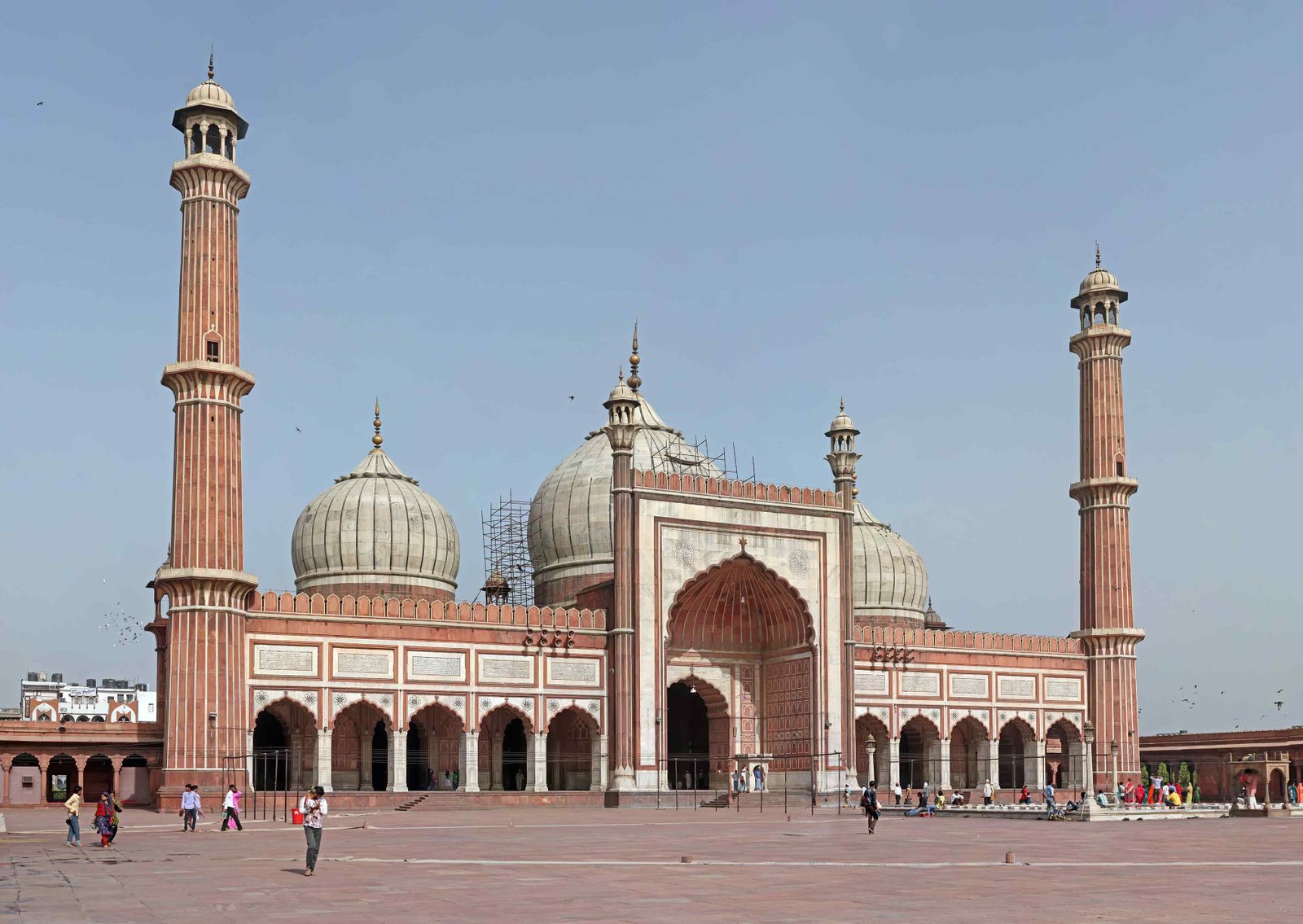
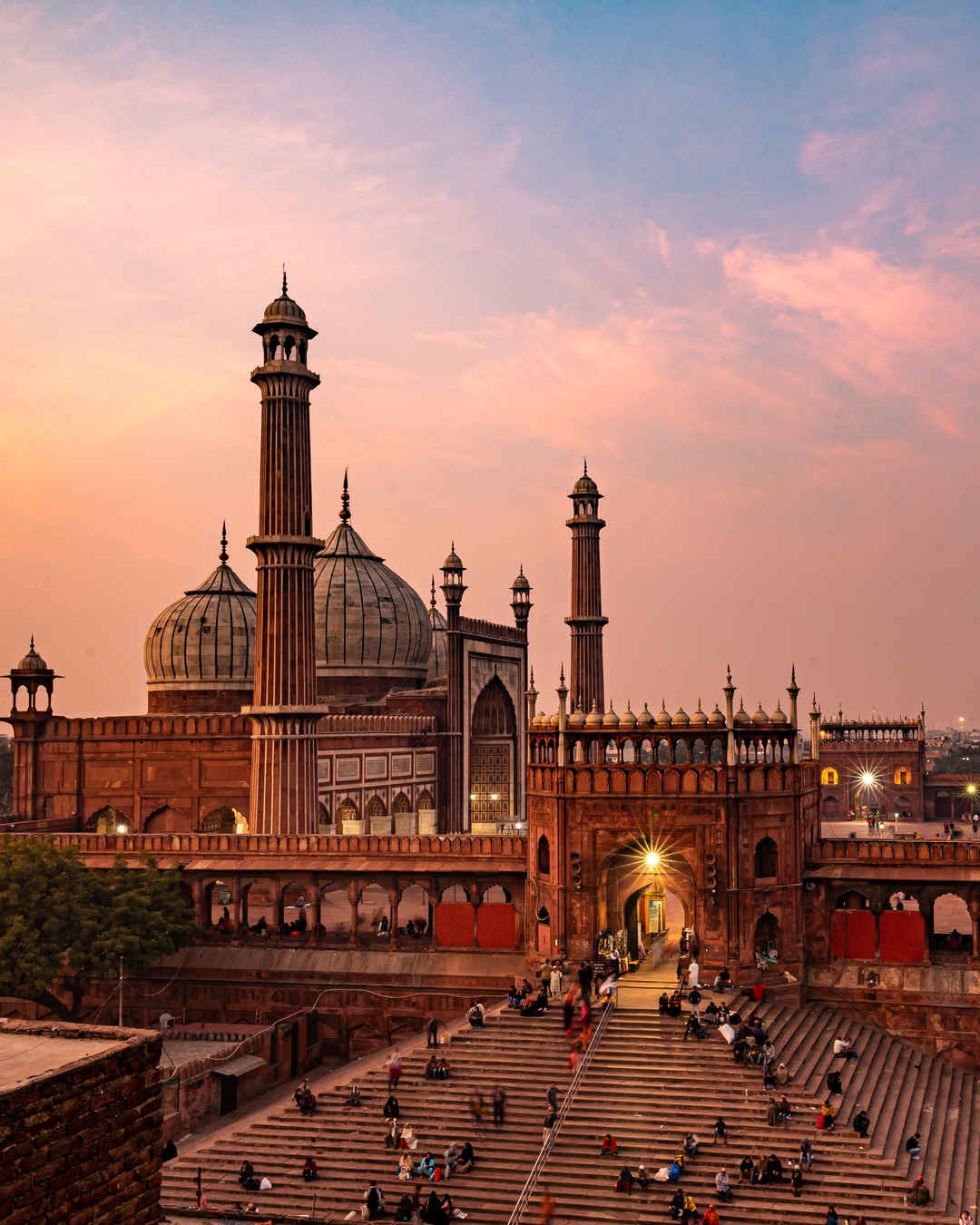
A photograph of Jama Masjid usually begins with its skyline: pale domes between tall minarets, rising above the roofs of Old Delhi. At street level, the experience begins with a climb. The steps lift you out of the lanes, and the courtyard gives you enough distance to see the mosque as a whole.
That change of scale is one of the building’s great pleasures. Details that seemed crowded together from below become clear. The central entrance to the prayer hall commands attention; the domes rise behind it; people crossing the courtyard provide a measure of the space.
Shah Jahan commissioned Jama Masjid as the congregational mosque of his new capital, Shahjahanabad. It remains a working place of worship, so understanding its daily purpose matters as much as recognising its architectural features. A thoughtful visit allows time for both. [1, 2]
Where Jama Masjid stands in Delhi
Jama Masjid sits in Old Delhi, near the Red Fort and the markets of Shahjahanabad. Delhi Tourism places it off Netaji Subhash Marg, west of the fort. It sits in an inhabited neighbourhood, with businesses, homes, religious buildings, and traffic lining the approaches. [3]
That setting affects how you should plan a visit. A route that looks short on a map may involve a busy crossing, a crowded lane, and a flight of steps. Leave some flexibility between appointments rather than treating the mosque as a quick stop between distant attractions.
Many mosques across India are called Jama Masjid. When arranging transport or searching for directions, specify Jama Masjid in Old Delhi. This article concerns the seventeenth-century mosque Shah Jahan commissioned, not another mosque with the same name.
What the name means
Jama Masjid describes a congregational mosque, especially associated with Friday prayer. Its more formal name, Masjid-i-Jahan-Numa, is often rendered as a mosque commanding a view of the world. English spellings vary because the name is transliterated from Persian and Urdu. [4, 5]
The names offer two ways of understanding the building. One points to the congregation that gives the mosque its purpose. The other evokes the elevated site and the view across the city. Both help us look beyond the familiar façade in photographs.
For a visitor, the first meaning has a practical consequence. Sightseeing access must fit around worship, even when the building appears on the same itinerary as a fort or museum.
Shah Jahan and the construction of the mosque
The construction period most commonly used in architectural and government heritage accounts is 1650–1656. Shahjahanabad Redevelopment Corporation records the foundation in October 1650, while Texas Tech University’s architectural collection dates the mosque to approximately 1650–1656. Some tourism accounts give an earlier starting date, including 1644. Acknowledge the difference rather than hide it behind a falsely precise timeline. [1, 6]
Shah Jahan was the patron who ordered and financed major building projects. Calling him the builder does not mean he personally designed every arch or supervised every stage of construction. A project of this size depended on administrators, builders, stoneworkers, and many other craftspeople.
Incredible India gives a workforce estimate of about 5,000 people over six years. Such figures convey the scale of the undertaking, although historical summaries do not all agree on the exact number. The enduring evidence is the building itself: its consistent proportions and the careful meeting of different materials. [2]
The mosque also helps explain why a Mughal capital required more than a palace. A royal residence housed the court, but a city needed places for its people to gather. Jama Masjid gave Shahjahanabad a major setting for collective prayer, closely connected with the capital’s public life.
Jama Masjid in the world of Shahjahanabad
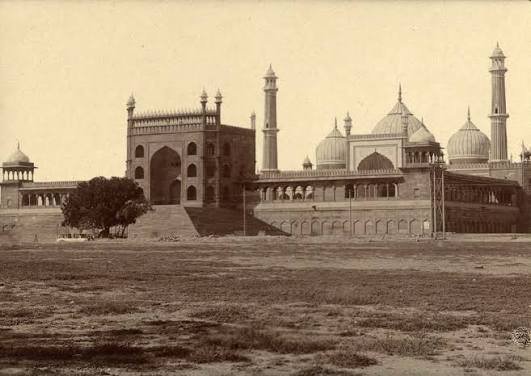
Shahjahanabad brought the imperial court and a substantial urban population into a planned capital. The mosque’s position on a ridge near the palace-fort made it an important part of that city’s appearance. Its raised platform established a clear relationship between the monumental building and the streets below. [1]
Looking at the mosque and the Red Fort together makes their different functions easier to understand. One was organised around a congregation; the other around the residence and business of a ruling household. The routes between them belonged to a city of trade, employment, and ordinary domestic life.
Today, much of the interest lies in noticing where these scales meet. A gateway may dominate a view, but the approach also contains deliveries, shopfronts, and people going about their day. A visitor who pays attention to the neighbourhood will understand more than one who isolates the mosque from everything around it.
The connection with the Taj Mahal
Jama Masjid and the Taj Mahal share Shah Jahan’s patronage, but they served different purposes. The Taj Mahal in Agra is a mausoleum complex associated with Mumtaz Mahal. Delhi’s Jama Masjid was created for congregational worship. The Red Fort was another major commission of the same emperor. [3]
The comparison helps explain how architectural choices respond to use. A tomb complex directs attention toward commemoration and a burial place. A congregational mosque must accommodate people gathering, preparing for prayer, and standing together. Its open space is part of how the building works.
You don't need to choose which monument is more beautiful to appreciate these differences. Seeing several commissions by the same ruler can sharpen your understanding of how material, scale, and arrangement were adapted to different tasks.
The raised platform and three approaches
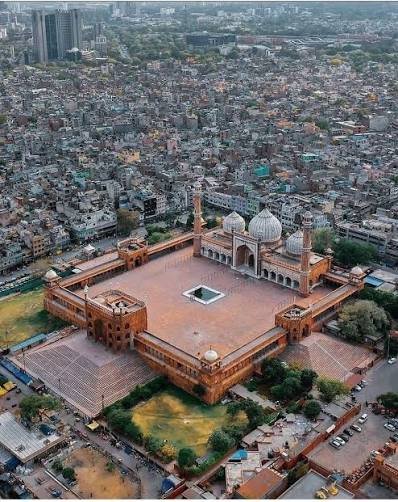
Flights of steps approach the mosque from the north, east, and south. The platform increases its prominence, while the gateways mark the transition into the courtyard. The prayer hall occupies the western side. [1, 4]
Before entering, take a moment to look back toward the street, provided you can do so without obstructing people. The height becomes easier to judge from the stairs than from a tightly cropped photograph. The approach also explains why an apparently simple visit can be demanding for someone who finds steps difficult.
Use the entrance directed by staff on the day. Historic descriptions of gateways explain the original plan; they do not establish which route will be operating for every visitor today. Keep the steps clear, particularly when people are arriving or leaving together.
Red sandstone and marble
Red sandstone and white marble give Jama Masjid its distinctive appearance. The broad areas of warm stone create visual weight, while lighter surfaces draw attention to the domes and selected details. Black stone adds definition in parts of the decorative scheme. [1, 4]
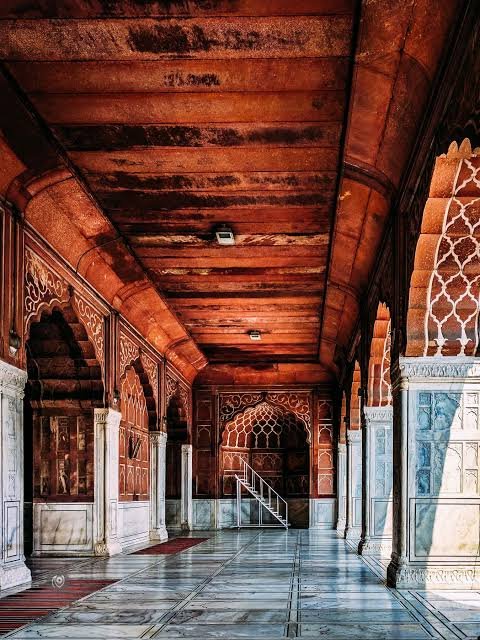
Try viewing the building first from across the courtyard and then from a permitted closer position. At a distance, the colours organise the whole composition. Closer up, the interest shifts to joints, edges, carved surfaces, and the depth of the arches.
Sunlight changes what is easiest to see. Strong light can flatten pale surfaces while deepening the shade beneath an arch. Softer light may make small differences in stone colour more apparent. This is a useful reason to slow down rather than take a single photograph and move on.
The courtyard and ablution pool
The courtyard can accommodate a large congregation. Official tourism descriptions commonly quote a capacity of around 25,000 worshippers. Treat that as a widely cited estimate of scale, not a guarantee about present-day crowd limits or access. [2]
At its centre is a pool associated with wudu, the ritual washing undertaken before prayer. This gives the water a practical religious purpose. It should not be treated as a decorative pond or a convenient place for visitors to pose. [4]
The open area also makes the architecture legible. You can step back far enough to see the domes, prayer hall, and towers together. From the edge, you can compare their proportions without needing an elevated viewpoint.
Give people using the ablution area privacy and room to move. If you want to photograph the water or reflections, choose an angle that does not intrude on someone preparing for worship. The best composition is not worth making another person uncomfortable.
The prayer hall and its direction
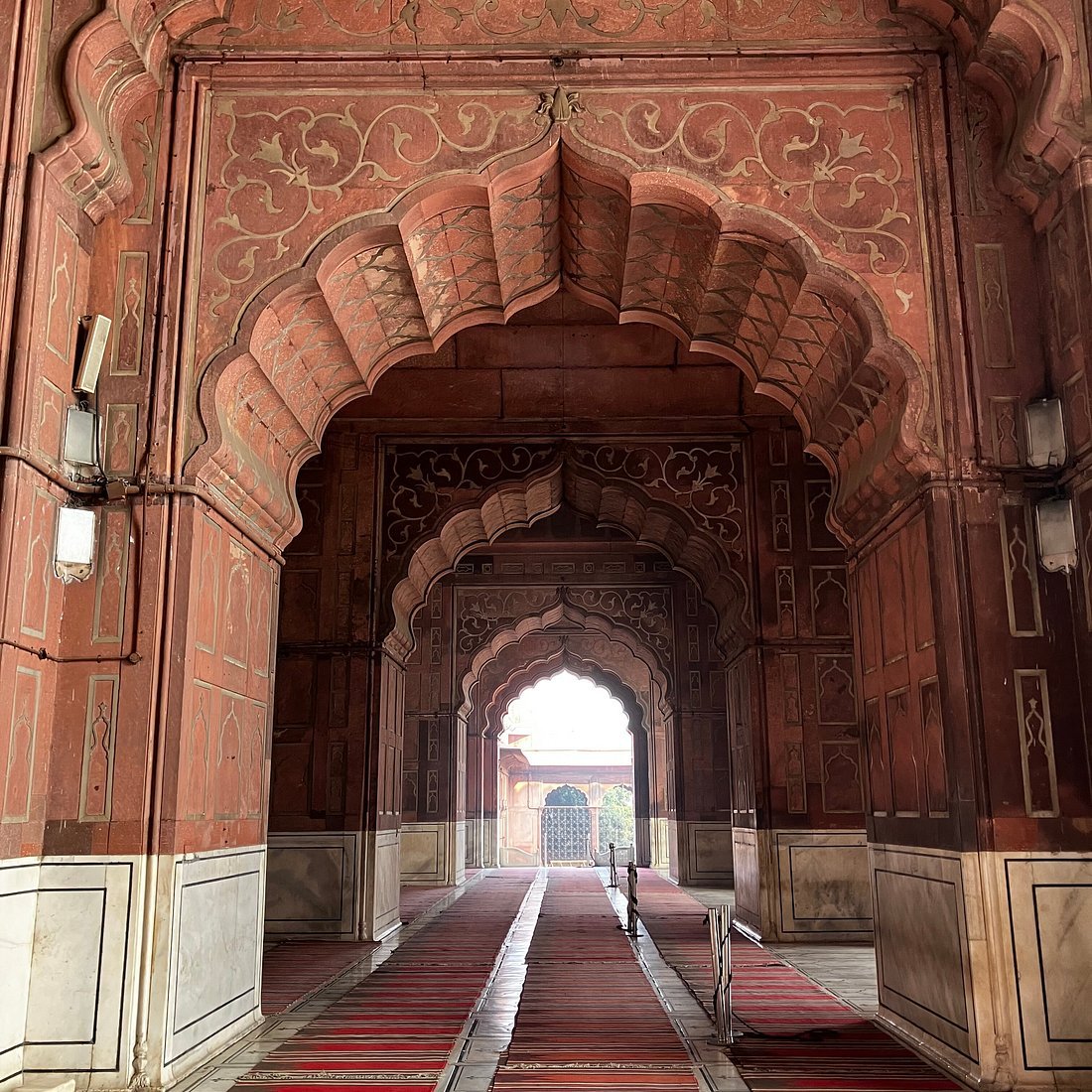
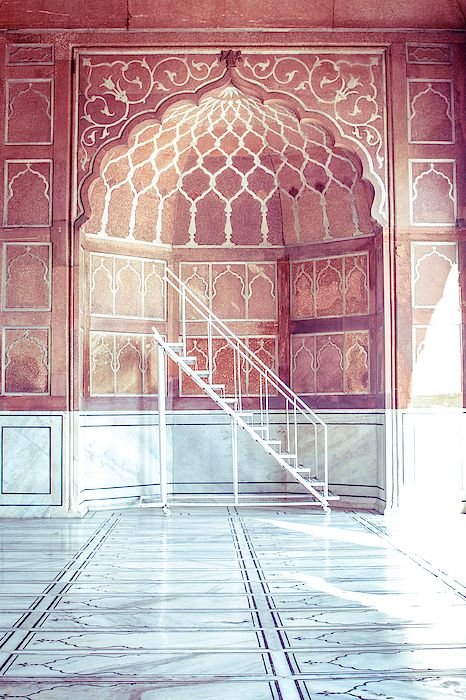
The prayer hall occupies the western side of the courtyard. To understand its interior, it helps to know a few architectural terms. The qibla is the direction of prayer toward the Kaaba in Mecca. A mihrab is a niche indicating that direction, while a minbar is the pulpit used for the sermon. These are functional elements of mosque architecture, not interchangeable decorations. [4, 7]
Knowing the vocabulary changes what you notice. The interior orientation guides worshippers. Its arrangement supports shared movement and attention, whereas a visitor unfamiliar with the space may initially see only a sequence of arches.
Observe from the areas open to visitors and follow any instructions about entering the prayer hall. Avoid crossing directly in front of someone praying. If a group is assembling, move aside before being asked; space that was available a few minutes earlier may soon be needed.
The domes and minarets
Three bulbous marble domes rise above the prayer hall. They form the building's central skyline, with tall minarets framing it. Architectural descriptions emphasise the prominent central portal beneath them. [1]
The two principal minarets are generally described as about 40 metres high. Alternating sandstone and marble bands make their height easier to read, dividing the towers into visible sections. [8]
A useful way to study the design is to compare the vertical towers with the long frontage of the hall. The minarets pull the eye upward, while the repeated arches carry it across the building. The open courtyard lets you see these movements together.
You do not need to identify every architectural term to enjoy this arrangement. Start with simple questions: where does your eye settle, what appears balanced, and which detail changes most as you move? Those observations are often more memorable than a list of measurements.
Calligraphy and details worth noticing
Rana Safvi’s account describes inscriptions above the prayer hall’s arches, including writing connected with the mosque’s construction and royal patronage. Calligraphy is part of the building’s visual and historical language. It should not be reduced to a general statement that every inscription says the same thing. [4]
If reading the inscriptions is important to your visit, choose a guide who can distinguish a documented translation from a popular explanation. Ask which panel is being discussed and what source supports the interpretation. An honest partial answer is more useful than an elaborate story without evidence.
Look beyond the largest features too. The framing of an opening, the underside of a sheltered space, or the edge where marble meets sandstone can reveal decisions that disappear in a wide photograph. Observe from accessible areas and leave historic surfaces untouched.
Sacred relics and devotional traditions
Incredible India describes relics traditionally associated with the Prophet Muhammad, along with a Quran manuscript on animal skin. Their religious significance should be presented respectfully, with a distinction between devotional attribution and independently established provenance. [2]
For worshippers, such objects may carry meanings that architectural history alone cannot explain. For visitors, listen carefully and avoid treating devotional practices as entertainment.
Do not assume that relics are displayed continuously or included in ordinary sightseeing access. Ask authorised staff about any arrangements, and follow the rules governing viewing and photography. A reference in a guidebook is not a promise that an object will be available during your visit.
The upheaval of 1857 and the return to worship
The 1857 uprising changed the mosque’s relationship with political authority. After British forces retook Delhi, Jama Masjid was confiscated and religious use was halted. Sadia Aziz’s study, drawing on colonial records, examines its military occupation and efforts to return it to the community. [5]
The return took place in November 1862 under conditions governing management and conduct. It did not simply erase the disruption. The negotiations show how control of a religious building could become a means of controlling public life. [5]
This history gives the present-day congregation added significance. A surviving building can appear continuous even when access to it has been violently interrupted. Remembering that interruption prevents the mosque’s story from becoming a smooth sequence of construction dates and architectural praise.
Jama Masjid and the memory of 1947
The mosque also appears in Partition's history. In October 1947, Maulana Abul Kalam Azad addressed Delhi’s Muslims at Jama Masjid during a period of fear and migration. Government accounts recall his appeal for confidence in their place in India. [9]
That episode belongs to a different political world from Shah Jahan’s court, yet the location mattered because people already recognised the mosque as a place of collective importance. Its meaning continued to develop long after the empire that commissioned it had ended.
A heritage visit becomes more rewarding when you consider these later chapters. The same structure can reflect imperial ambition, colonial control, and the choices facing people in a newly independent country.
Prayer Ramadan and Eid
Jama Masjid remains an active mosque. The distinction between worship and sightseeing should shape every visit, from arrival time to where you stand with a camera. Tourist access may pause around prayers, and the congregation takes priority. [8]
During Ramadan, also called Ramzan in South Asia, the area is particularly associated with iftar, the meal that breaks the daily fast after sunset. Incredible India describes people gathering in the courtyard and the surrounding food streets as part of this experience. [10]
If you hope to visit during Ramadan or Eid, check arrangements for the particular day. A meaningful time for worshippers may be crowded or unsuitable for an unhurried architectural tour. Don't assume that an organised iftar visit guarantees unrestricted evening entry for tourists.
If invited to join a meal, ask where to sit and how to help. Respect those who are fasting and the space you share. Clear away your litter, and avoid photographing families at close range without permission.
Tourist hours and published entry fees
Visitor information checked on 12 October 2026: Delhi Tourism lists the mosque as open daily, with foreign tourist access from 8 am until sunset and Indian tourist access from 11 am until sunset. It lists admission at ₹400 for foreign tourists and free for Indian tourists, with photography marked as free. The page distinguishes tourist hours from devotee access for Isha and Fajr prayers. [3]
These are published details, not a guarantee against changes at the gate. Prayer schedules, special occasions, maintenance, and local instructions can affect access. Check the current notice before travelling, particularly if your itinerary depends on an early arrival.
Older guides may describe a different camera charge or universal free entry. Ask staff what applies to your visit, what a payment covers, and whether any optional activity has a separate charge. Keep a receipt when one is issued.
Clothing, footwear, and respectful conduct
Choose loose, modest clothing that covers your shoulders and legs. Carry a scarf or other suitable covering and follow the requirements explained by mosque staff. Remove footwear where directed. Delhi Tourism notes robe hire, but arriving suitably dressed is the simplest preparation. [3]
Before handing over shoes, establish where they will be kept and whether a charge applies. Keep any collection token secure. On a hot day, consider how you will cross exposed paving after removing your footwear, and use permitted mats or routes when provided.
Keep your voice low near worshippers and silence unnecessary phone alerts. Ask before entering an area whose access is unclear. Courtesy is often a matter of noticing what is happening around you rather than memorising a long list of rules.
Photography and the minaret view
For an architectural photograph, begin with the relationship between the courtyard and the façade. A wider view can explain the building better than a tightly cropped shot of a dome. From a side position, repeated arches and the pattern of light may become the main subject.
Ask permission before photographing identifiable people closely, especially children or anyone engaged in prayer. Permission to take photographs of the monument does not remove the need to respect personal privacy. For commercial work, tripods, or a planned shoot, establish the requirements in advance.
Incredible India promotes a view from the southern minaret. Treat this as a possible extra and confirm whether climbing is permitted that day, along with any charges and restrictions. [2]
If you are uncomfortable with heights, enclosed stairs, or a demanding climb, enjoy the mosque from the courtyard. An elevated photograph is optional. Allow enough time to descend without rushing if access is available and you choose to go up.
Getting there and choosing a comfortable time
Jama Masjid station is on Delhi Metro’s Violet Line. Use the official journey planner to choose your route and check the exit appropriate for your approach. Leave time for the walk between the station and the mosque rather than treating arrival at the platform as arrival at the entrance. [11]
A taxi or auto-rickshaw may be useful for part of the journey, but confirm the practical drop-off and pickup points. If travelling as a group, agree on a meeting place that you can identify easily without blocking a gateway or shop entrance.
The cooler months, broadly October to March, are commonly recommended for exploring Delhi. Still, choose your day using the actual weather forecast and air-quality information. Comfortable temperatures do not guarantee clear views. [12]
Allow roughly one to two hours for a considered first visit, with extra time if access, prayer pauses, or an optional climb require it. This is a planning suggestion, not an official visit duration. Travellers with limited mobility should ask about current step-free options and assistance before setting out; don't assume the historic approaches will suit everyone.
Exploring Old Delhi around the mosque
Jama Masjid fits naturally into a longer walk through Shahjahanabad. The city’s redevelopment corporation describes heritage routes through streets such as Dariba and Kinari Bazaar that connect with the mosque precinct. These routes help place the monument among the neighbourhood’s other buildings and commercial spaces. [13]
Choose a manageable extension instead of trying to cover every market at once. You might combine the mosque with time in the lanes, a meal, and one further landmark. If the Red Fort is also on your list, allow a separate block of time for its entrance procedures and palace grounds.
Around Matia Mahal, food is an important part of many visits. Choose what suits your preferences and dietary needs, ask about ingredients when needed, and check preparation and cleanliness before ordering. A famous location does not make every stall equally suitable for every traveller.
A local guide can help if you want to understand the street's history or navigate a particular route. Agree on the duration, fee, and inclusions first. For a family visit, fewer stops and a comfortable pace usually leave more room for curiosity than a tightly packed checklist.
Visiting a historic building that is still in use
Jama Masjid asks visitors to hold two thoughts together: the building deserves close attention, and the people using it deserve space. Those aims are compatible when the visit is planned with care.
Avoid leaning on carved surfaces, climbing onto features for photographs, or leaving rubbish in the courtyard. Follow temporary barriers even when they interrupt a preferred angle. A repair area is part of the work of keeping an old building usable.
Before leaving, pause at a permitted edge of the courtyard and look across it once more. By then, the pool has a purpose, the prayer hall has a direction, and the steps connect the monument to the city below. Knowing how those parts work gives the view more depth than its skyline alone.
Frequently Asked Questions
Who built Jama Masjid in Delhi?
Mughal emperor Shah Jahan commissioned the mosque for his capital, Shahjahanabad. He was its royal patron; administrators, builders, and craftspeople carried out the construction. [1, 6]
When was Jama Masjid built?
The principal construction period is commonly dated to 1650–1656. Some tourism descriptions give 1644 as the starting year, so published accounts are not fully consistent. The 1650–1656 dating is supported by architectural and government heritage sources. [1, 6]
Why is it called Jama Masjid?
The name refers to a congregational mosque, particularly associated with Friday prayer. Its formal name, Masjid-i-Jahan-Numa, is commonly interpreted as a mosque commanding a view of the world. [4, 5]
Can non-Muslim visitors enter Jama Masjid?
Tourists can generally visit during permitted sightseeing hours, subject to mosque rules. Access must accommodate prayer, and visitors should follow staff instructions about which areas are open. [8]
What is the entry fee?
The Delhi Tourism page checked for this article lists free entry for Indian tourists and ₹400 for foreign tourists. Confirm the current charge and any optional extras before entering. [3]
What should I wear?
Wear modest clothing that covers your shoulders and legs, carry a suitable covering, and follow the entrance requirements. Remove footwear where directed. Arriving prepared makes entry easier.
Which metro station should I use?
Jama Masjid station on the Violet Line is a direct option. Check the official Delhi Metro journey planner for your starting point and allow time to walk from the station to the mosque. [11]
Can I climb a minaret?
The southern minaret is described as a visitor viewpoint by Incredible India. Access is conditional, so check whether it is open, whether a separate charge applies, and whether the climb suits you. [2]
Is Jama Masjid the largest mosque in India?
It is safer to describe it as one of India’s largest and most prominent mosques. Rankings depend on the measure used, such as site area or capacity, and tourism descriptions are inconsistent. Its importance does not depend on claiming a single record. [1, 2]
How much time should I spend there?
Plan around one to two hours for an unhurried visit. Add time for waiting, prayer restrictions, an optional minaret climb, or a walk through Old Delhi. Your pace and the areas open on the day will determine the actual duration.
Sources and editorial notes
Research checked on 12 October 2026. Numbered references support factual passages. Architectural observations, suggested visit durations, photography advice, and itinerary choices are editorial guidance. Recheck visitor arrangements before publication or travel. Historical sources differ on the construction start date and some numerical estimates; the article preserves those distinctions. Meta keywords are supplied as requested, without any ranking guarantee.
[1] Texas Tech University Libraries. Arch Design Images. Jama Masjid. Construction dating, materials, elevated site, approaches, prayer chamber, and domes.
https://exhibits.lib.ttu.edu/s/archlib/item/14522
[2] Incredible India. Visit the Jama Masjid Delhi. Capacity estimate, workforce estimate, devotional relics, and southern minaret viewpoint.
https://www.incredibleindia.gov.in/en/delhi/delhi/jama-masjid
[3] Delhi Tourism. Jama Masjid. Location and published tourist entry arrangements, checked 12 October 2026. Its historical start date differs from sources 1 and 6.
https://delhitourism.gov.in/tourist_place/jama_masjid.html
[4] Rana Safvi. Glorious history of Delhi’s Jama Masjid — the mosque that promised a view of the world. Name, architectural details, inscriptions, and ablution pool.
https://ranasafvi.com/glorious-history-of-delhis-jama-masjid-the-mosque-that-promised-a-view-of-the-world-2/
[5] Sadia Aziz. Mosque, Memory and State: A Case Study of Jama Masjid (India) and the Colonial State c. 1857. The Polish Journal of Aesthetics, 47, 2017, pages 13–29. DOI 10.19205/47.17.1. Colonial occupation and return to worship.
https://doaj.org/article/1b586a112b644f7db72fd8399b520966
[6] Shahjahanabad Redevelopment Corporation. 1600–1700. Jama Masjid foundation chronology and historical context.
https://srdc.delhi.gov.in/en/srdc/1600-1700
[7] Metropolitan Museum of Art. The Mosque. General explanations of qibla, mihrab, and minbar.
https://www.metmuseum.org/it/learn/educators/curriculum-resources/art-of-the-islamic-world/unit-one/the-mosque
[8] Incredible India. Jama Masjid, legacy destination page. Minaret height and prayer-related tourist restrictions. Its older fee information is not used as current guidance.
https://prod.incredibleindia.gov.in/content/incredible-india-v2/en/destinations/delhi/jama-masjid.html
[9] Press Information Bureau. Maulana Abul Kalam Azad: Educationist and Scholar Extraordinary. Account of the October 1947 address at Jama Masjid.
https://www.pib.gov.in/newsite/erelcontent.aspx?lang=2®=48&relid=44652
[10] Incredible India. Iftar at Jama Masjid, Delhi. Ramadan setting and an organised visitor experience, not a guarantee of general evening access.
https://www.incredibleindia.gov.in/en/delhi/delhi/iftar-at-jama-masjid-delhi
[11] Delhi Metro Rail Corporation. Operational Network map, March 2026. Jama Masjid station and network context.
https://delhimetrorail.com/static/media/DMRC-Network-Map_Jan2026_Hindi-English-13.03.2026.147097c4.pdf
[12] Incredible India. Delhi. Broad seasonal travel guidance.
https://www.incredibleindia.gov.in/en/delhi
[13] Shahjahanabad Redevelopment Corporation. Delhi Heritage Walks. Neighbourhood route context.
https://srdc.delhi.gov.in/en/srdc/delhi-heritage-walks