Humayun’s Tomb is one of Delhi’s most rewarding historic sites. Built for the second Mughal emperor during his son Akbar's reign, it established a grand architectural language that later generations would develop in monuments such as the Taj Mahal. This detailed guide explores the people behind the tomb, its garden design, double dome, sandstone and marble craftsmanship, neighbouring monuments, conservation, and visitor experience. It also explains the new museum and offers practical advice for planning an unhurried visit.
Humayun’s Tomb in Delhi and the Making of Mughal Garden Architecture
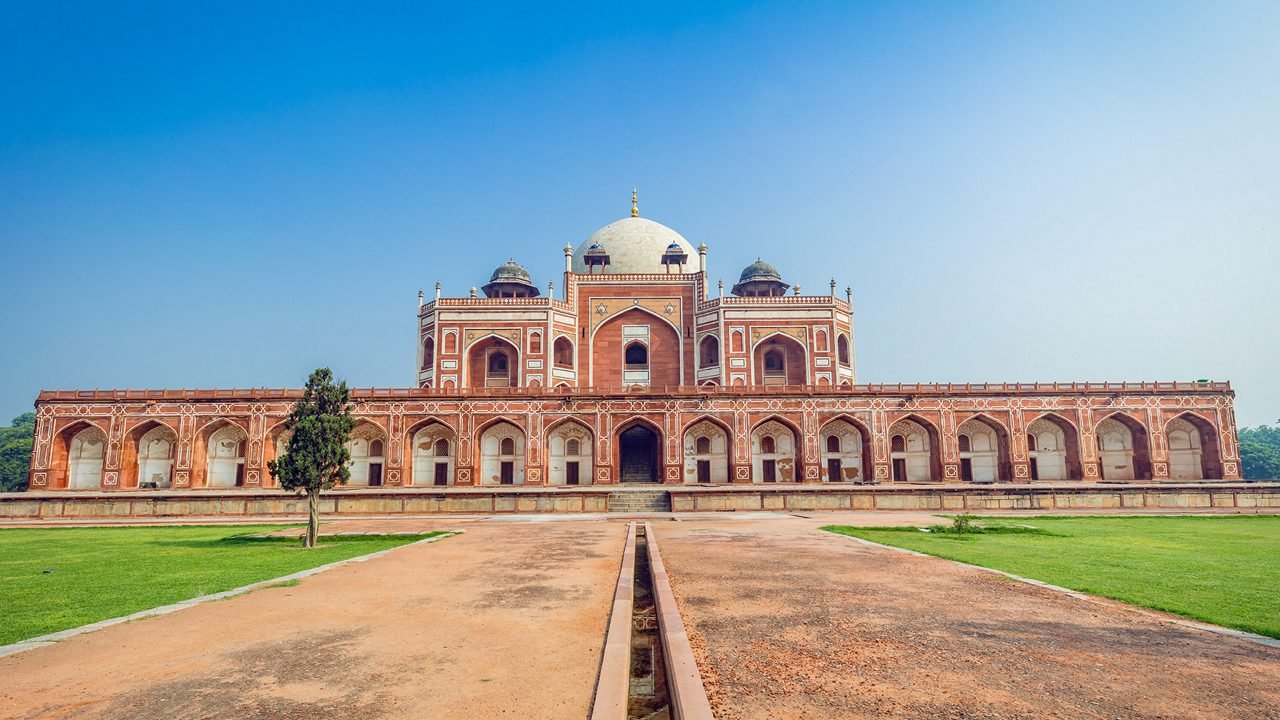
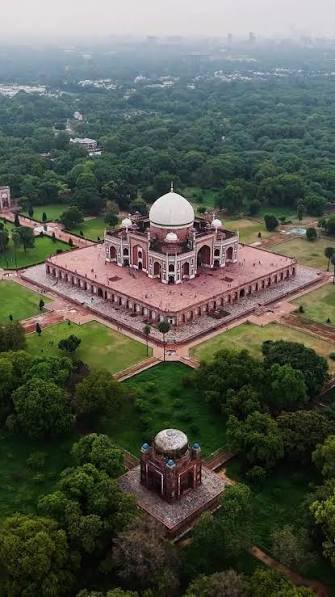
The first view of Humayun’s Tomb is carefully composed. A gateway opens onto long paths, garden divisions, and a broad platform. Above them rises a red sandstone building crowned by a pale dome. The distance matters: the approach gives the eye time to understand the symmetry before the details become visible.
This is one of the pleasures of visiting the monument. You can appreciate it immediately, without knowing the names of its arches or the dates of its dynasty. Yet the longer you look, the more questions it raises. Why was this site chosen? Who commissioned so ambitious a memorial? How does the dome work? And why is a sixteenth-century tomb in Delhi so often discussed alongside the Taj Mahal in Agra?
The answers reveal a building shaped by royal patronage, cross-cultural craftsmanship, and a landscape designed to carry meaning. They also reveal a historic place that has changed over time, survived periods of upheaval, and benefited from painstaking conservation.
Where Humayun’s Tomb stands
Humayun’s Tomb sits in Delhi's Nizamuddin area, near the junction of Mathura Road and Lodhi Road. It belongs to a wider historic neighbourhood rather than an isolated archaeological site. The tomb, Sunder Nursery, and the settlement around the shrine of Hazrat Nizamuddin Auliya form distinct but closely related places. [1, 2]
That setting helps explain the concentration of funerary monuments here. Nizamuddin Auliya was a revered fourteenth-century Sufi saint, and burial near his shrine carried spiritual significance. UNESCO identifies this sacred landscape as essential to understanding the tomb’s surroundings. [1]
For visitors, the distinction between these places is both practical and historical. The royal tomb is a protected monument; the museum has its own opening arrangements; Sunder Nursery is a separate destination; and the dargah is a living religious space. Plan for each accordingly.
The emperor behind the monument
Humayun was the second Mughal emperor, the son of Babur and the father of Akbar. His rule in northern India came in two periods, from 1530 to 1540 and again from 1555 to 1556. The interruption was decisive. Defeat forced him from power, and years of displacement followed before he recovered his position. [3]
His life also brought him into contact with the Persian world. That history gives useful context to the cultural exchanges visible in early Mughal art and architecture. The dynasty’s visual culture developed through travel, patronage, and the movement of skilled people across political boundaries.
Humayun died in 1556 after a fall on a stone staircase in Delhi. He therefore never saw the great mausoleum that now bears his name. [3]
The tomb presents a composed, enduring image of an emperor whose actual career was unsettled. That difference is revealing. Royal monuments tell us about the intentions of those who built them as much as about the people they commemorate. Here, remembrance became part of the public expression of a dynasty continuing under Akbar.
Bega Begum and the building of the tomb
Humayun’s senior widow, Bega Begum, also known as Haji Begum, is associated with commissioning the mausoleum. She should not be confused with Hamida Banu Begum, Humayun’s wife and Akbar’s mother. The Persian architect Mirak Mirza Ghiyas is credited with the design. [4, 5]
The construction chronology needs a little care. UNESCO uses 1570 in its introductory description, while the Ministry of Tourism’s account on Google Arts & Culture gives a building period of 1565 to 1572. A clear way to describe the monument is that it was constructed in the later 1560s and early 1570s, during Akbar’s reign. The differing dates should not be concealed behind an artificially precise claim. [1, 4]
Bega Begum’s role deserves attention in its own right. Discussions of Mughal architecture often concentrate on emperors, leaving the women who commissioned major works at the edge of the story. This tomb provides a strong reason to broaden that view.
Its creation also required much more than one patron and one architect. A project of this scale depended on masons, stonecutters, plasterers, garden workers, and specialists coordinating their work. The finished structure gives these contributions a common order, even where individual names have not survived.
What made its architecture important
Humayun’s Tomb occupies a central place in the development of Mughal imperial architecture. Its importance lies in the relationship between the elevated mausoleum, the formal garden, and the controlled approach. The building and its setting were conceived as a single ensemble.
UNESCO inscribed the site on the World Heritage List in 1993, recognizing its architectural influence and the exceptional ensemble of garden tombs. The listed property covers 27.04 hectares, a figure that refers to the World Heritage property rather than the main mausoleum alone. [1]
It is frequently called India’s first garden tomb. That familiar description needs qualification: earlier tombs had garden settings, and the Delhi government’s heritage account specifically points to Sikandar Lodi’s tomb as an earlier example. Humayun’s Tomb’s distinction is its development of the monumental Mughal dynastic garden mausoleum. [5]
This is more interesting than a simple race to be first. Architectural history rarely begins with a completely unprecedented object. Designers adapt established ideas, change their scale, and combine them in ways that create new possibilities. Humayun’s Tomb is a particularly powerful example of that process.
Reading the exterior
Sandstone and marble
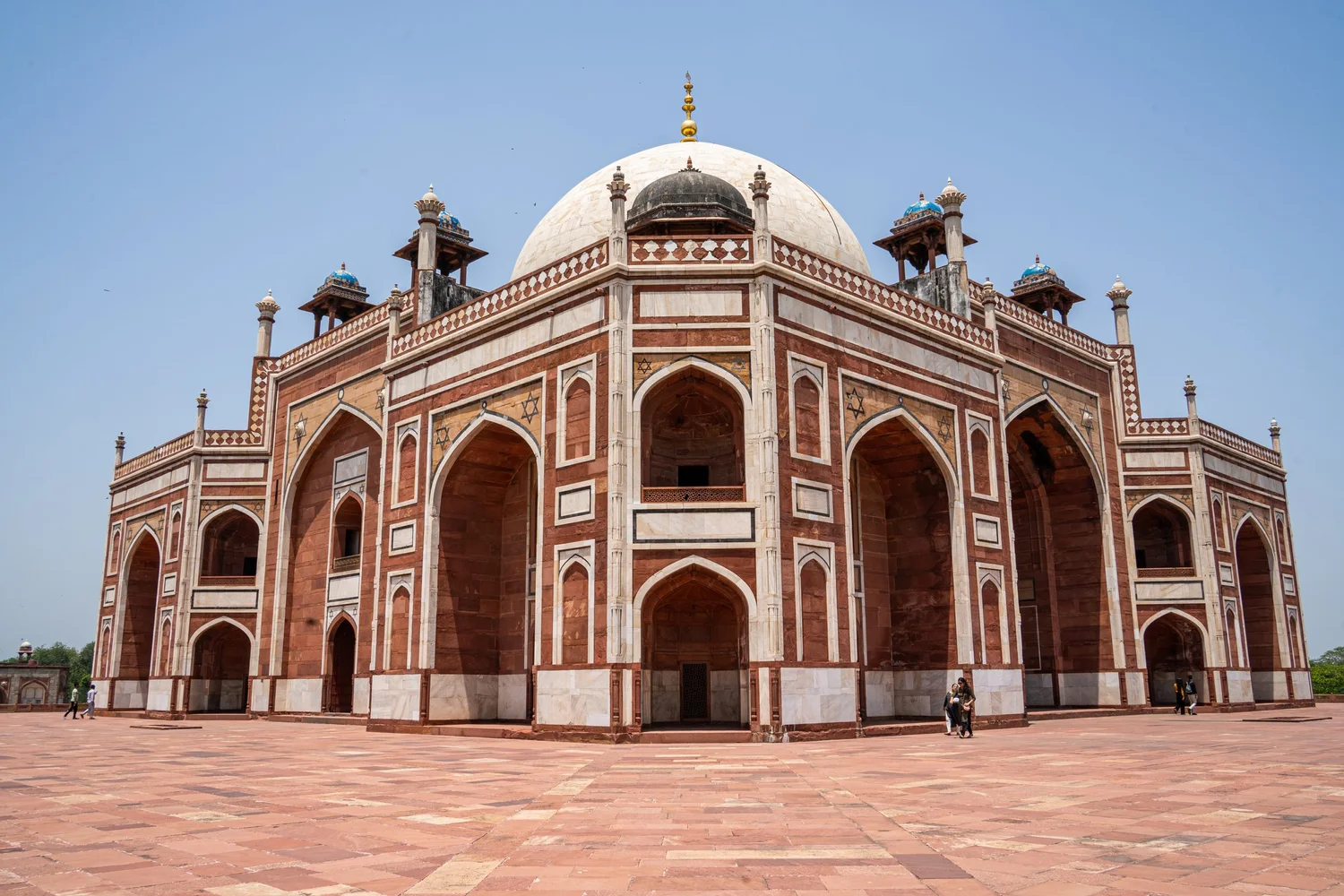
The contrast between the red exterior and pale marble detailing is one of the building’s strongest visual features. Marble borders emphasize openings and surfaces, while the dome gathers attention above the main mass. The structure includes dressed stone, red sandstone facing, and white and black marble detailing. [1]
From far away, the effect is graphic: broad areas of color, strong outlines, and a clear silhouette. Close up, the interest shifts to joints, carved edges, and variations in surface. Both distances are worth allowing for. A single photograph from the garden cannot show how the building is assembled.
The platform and recessed arches
The raised platform gives the mausoleum a commanding position. Its height changes the relationship between a visitor and the façade: the building remains above the line of approach, while the terrace offers a different understanding of the gardens.
Deep arched recesses create shade and depth. They prevent the exterior from reading as a flat wall, and their repeated arrangement helps organize a large building into parts the eye can follow. Pillared roof pavilions, or chhatris, add smaller elements around the main dome. The government’s architectural account describes the combination of Persian forms and Indian building traditions. [5]
To look more closely, choose one side and follow its sequence from the central opening to the corners. Notice how the smaller elements repeat the logic of the larger composition without having identical dimensions.
New section heading
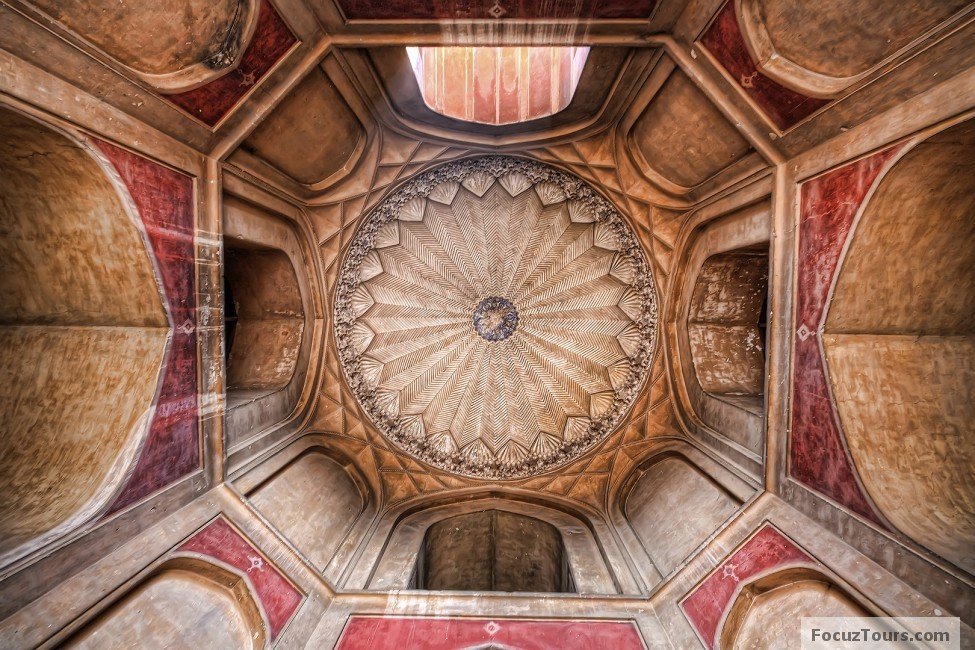
A double dome has two shells with space between them. The outer shell establishes the lofty form seen from outside, while the inner shell shapes the ceiling experienced within. At Humayun’s Tomb, this arrangement let the designers relate the interior’s proportions to the central chamber without sacrificing the exterior’s commanding height. [6]
The gap is a real construction space, not simply a descriptive label. Dome conservation involved work on surfaces ordinary visitors cannot see. Specialists removed inappropriate cement from marble joints, repaired them with lime-based materials, and reinstated protective plaster on the inner face of the outer shell. [6]
Understanding this changes the experience of looking upward. The visible ceiling and the familiar skyline dome belong to the same system, but they are not the same surface. A photograph of the exterior tells only part of the structural story.
The interior and the emperor’s memorial
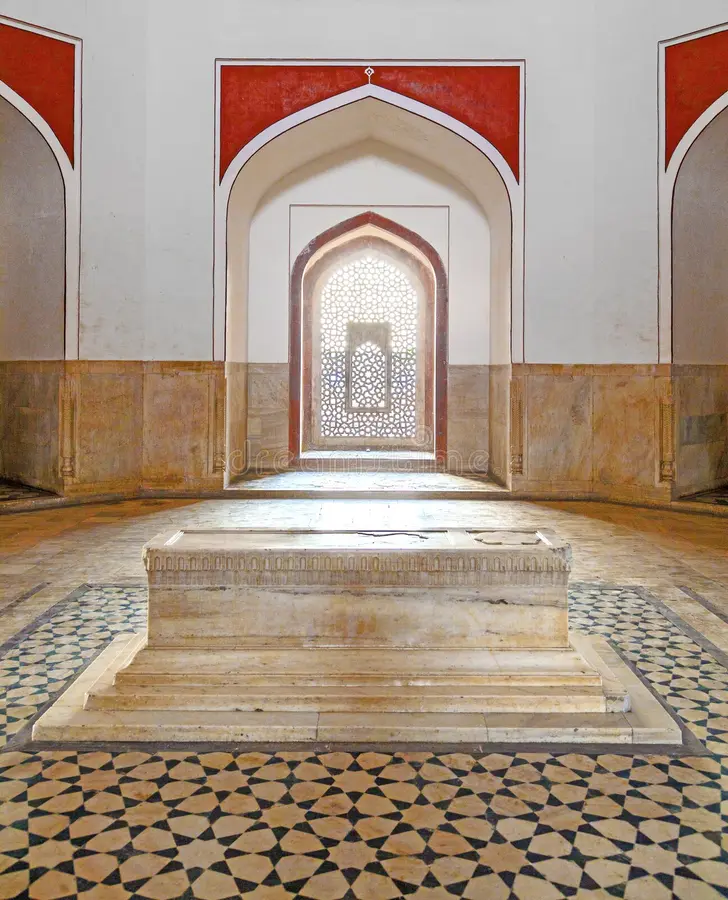
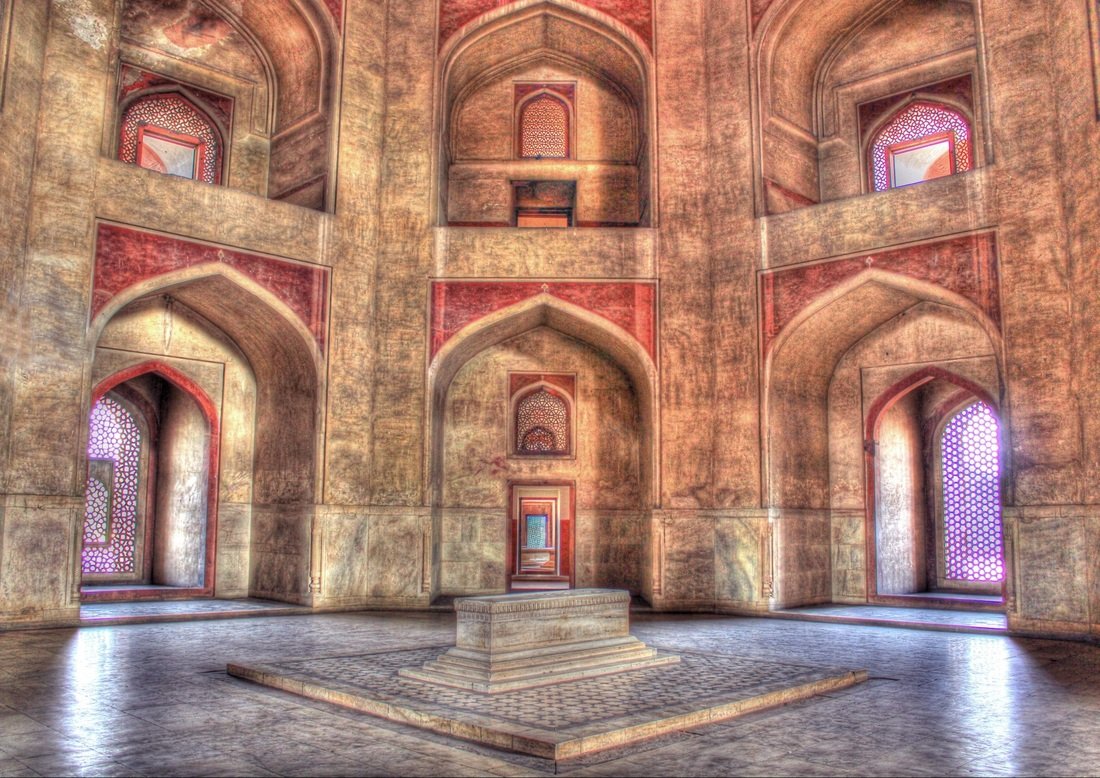
The central space is organized around Humayun’s cenotaph. A cenotaph is a commemorative marker: the actual burial lies below it. An Archaeological Survey of India guide describes this vertical relationship between the central hall and the burial beneath. [7]
Inside, allow your eyes a moment to adjust. The experience is different from the bright garden approach. Openings, screens, and the arrangement of surrounding spaces control how light and views pass through the building.
The chamber rewards quiet attention. Look at the transition from walls to the domed ceiling, then turn toward the openings and consider how the central marker relates to the room. The architecture directs attention without requiring a crowded display of objects.
Treat the chamber as a funerary space. Keep your voice low, avoid blocking narrow routes, and do not touch or sit on grave markers. A respectful visit also makes it easier for everyone to experience the room without competing noise or interruption.
The charbagh garden
The term charbagh refers to a four-part garden. At Humayun’s Tomb, pathways and water channels organize the landscape into large divisions and smaller sections. The Ministry of Tourism describes a total of 36 subdivisions. [4]
The garden makes the mausoleum legible from a distance. Its long lines pull the eye toward the building; intersections offer places to pause; and the measured spacing lets the central monument remain the focus even when trees and smaller structures enter the view.
Water is part of the design, not an optional finishing touch. Channels and pools reinforce the garden’s association with paradise and give its geometry physical form. UNESCO records the importance of the historic water system and its restoration. [1]
Walk at least one side route after taking the central approach. From there, the same building takes on a different balance. Corners become more prominent, the platform’s depth is easier to read, and the garden begins to feel like a place to move through rather than a foreground for a photograph.
The appearance of planted areas and the operation of water features can vary with maintenance and season. Enjoy whatis there on the day rather than expecting every pool to match a promotional image.
Other monuments worth noticing
Isa Khan’s tomb and mosque
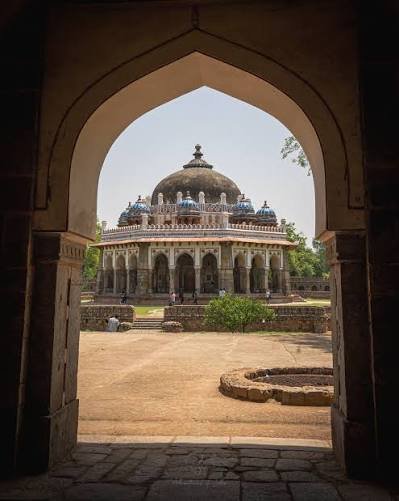
Isa Khan’s enclosure is one of the most rewarding parts of the visit. His tomb dates to 1547–1548 and predates Humayun’s mausoleum. Isa Khan was an Afghan noble associated with the courts of Sher Shah Suri and Islam Shah. [8]
The octagonal tomb, surrounding veranda, and nearby mosque offer a useful comparison with the later imperial monument. Take time to notice the smaller building’s roofline, openings, and decoration before approaching Humayun’s Tomb.
Conservation revealed the historic sunken character of Isa Khan’s garden and highlighted its glazed tiles, plasterwork, and stone craftsmanship. The restoration team used traditional materials and techniques, guided by surviving evidence. [9]
Visiting the two enclosures together helps prevent a common misunderstanding: Delhi’s architecture did not progress through neatly separated styles with nothing between them. Different patrons and political traditions worked within a shared landscape, adapting forms already familiar to local craftspeople.
Smaller tombs and gateways
The wider heritage ensemble includes monuments known as Bu Halima’s Tomb, Afsarwala’s Tomb, the Barber’s Tomb, Nila Gumbad, and Arab Serai. [1]
Their names can inspire confident stories, but a familiar name does not always prove who a buried there. Treat colorful anecdotes as traditions unless an inscription, site interpretation, or reliable historical account supports them.
Use the site map to decide which areas are accessible during your visit. A monument’s inclusion in the wider heritage ensemble does not guarantee that you can enter every enclosure from the same route or with identical access arrangements.
These smaller structures deserve more than a hurried glance. Comparing their scale and ornament with the imperial mausoleum helps explain how rank, function, and patronage could affect architectural choices.
A burial place for a dynasty
Humayun’s Tomb became a burial place for many members of the Mughal family. UNESCO records more than 150 family burials, which is why the site's commonly described as a resting place for the dynasty. [1]
The monument's larger historical significance is that it continued to gather meaning after its original construction. Later burials linked successive generations to an earlier emperor and gave the site a role extending beyond a single act of commemoration.
It also entered the history of the dynasty’s end. In 1857, the last Mughal emperor, Bahadur Shah Zafar, took refuge here before the British captured him. Delhi Tourism records the event as part of the tomb’s history. [2]
A place created during Mughal consolidation thus became associated with the collapse of Mughal political authority. That connection adds gravity to the setting, even though the architecture itself appears exceptionally composed.
Humayun’s Tomb and the Taj Mahal
The connection with the Taj Mahal is architectural and historical. Both monuments belong to the Mughal tradition of combining a royal mausoleum with an ordered landscape, carefully controlled views, and monumental symmetry.
Shah Jahan commissioned the Taj Mahal for Mumtaz Mahal in Agra. UNESCO dates construction from 1632, with the principal mausoleum completed in 1648 and the wider complex completed in 1653. Its main tomb stands at the river end of the garden, while Humayun’s mausoleum occupies a central position within the garden. [10]
The materials also create different impressions. Humayun’s Tomb depends on the contrast of red sandstone and pale marble; the Taj Mahal’s main mausoleum is dominated by white marble. The later building develops its own proportions, decorative treatment, and riverfront composition.
Calling Humayun’s Tomb a “copy of the Taj Mahal” reverses the chronology. Calling it merely a rehearsal also understates its achievement. It already offers a complete architectural experience, with its own balance of mass, colour, and garden space.
A rewarding comparison asks how a shared architectural tradition changed between the two commissions. What happens when the tomb moves to the garden's edge? How does a different material palette affect the silhouette? Those questions reveal more than deciding which monument is more beautiful.
Conservation and the work behind the view
The tomb’s present appearance reflects sustained conservation. The Archaeological Survey of India and the Aga Khan Trust for Culture worked together on the monument and its setting, with the major tomb restoration inaugurated on 18 September 2013. [11]
The work included removing damaging or inappropriate modern materials, repairing stonework, and recovering details obscured by earlier interventions. The project account records removing roughly a million kilograms of concrete from the roof, along with extensive repairs to lime plaster, sandstone paving, and tilework. Research and documentation preceded the interventions. [11]
These details explain why conservation is a specialist discipline. A material that seems strong or convenient in a modern building may perform poorly in an older construction system. Repair requires understanding how the original building manages moisture, weight, and movement.
The work also depended on skilled hands. Cutting stone, preparing compatible mortar, and finishing plaster cannot be reduced to choosing a colour that looks old. Keeping these skills in use preserves knowledge and the physical fabric.
The surrounding urban renewal initiative has linked conservation to community facilities, education, health, and livelihoods in Nizamuddin. [11] That broader approach recognises that historic places remain part of inhabited neighbourhoods. Their future depends partly on the people who live around them.
The Humayun World Heritage Site Museum
The museum inaugurated on 29 July 2024 adds a valuable layer to the visit. Developed by the Aga Khan Trust for Culture with the Archaeological Survey of India, its sunken design connects the interpretation of Humayun’s Tomb with the wider Nizamuddin landscape and Sunder Nursery. [12]
The museum’s official website describes collections including manuscripts, coins, miniature paintings, astronomical instruments, and architectural material. These objects help place a monumental building within a wider world of learning, craftsmanship, and cultural exchange. [13]
Consider visiting the museum before the gardens if you prefer historical context first. Alternatively, see the tomb in cooler outdoor conditions and use the museum afterwards to explore questions raised by the walk. Either order works; the best choice depends on the weather, opening times, and how much time you have.
Avoid treating the museum as a quick corridor between attractions. Choose a few objects or themes to examine closely. A carefully read label and a few minutes with one object can be more memorable than rushing past every display.
Planning your visit
Opening times and admission
Check the monument and museum separately. Delhi Tourism’s pages list different monument schedules: one says sunrise to sunset, while another says sunrise to 7:30 pm. Because these listings conflict, verify the current entry and closing times through the official booking channel or site staff before planning a late visit. [2, 14]
The museum's official website, checked in October 2026, listed 10 am to 9 pm, last entry at 8 pm, and closure on Mondays and national holidays. Published museum tickets were ₹50 for Indian and SAARC citizens, ₹25 for children aged 5–12, and ₹300 for other nationalities. These are museum prices, not a statement of combined admission to the tomb and Sunder Nursery. [13]
For monument tickets, use the current ASI booking information rather than an old price copied from a travel blog. Check the visitor category, entry date, inclusions, and any identification requirement before payment. Keep your booking available on your phone.
Getting there
Navigate to the visitor entrance for Humayun’s Tomb, not simply to a pin somewhere inside the grounds. Delhi Tourism identifies JLN Stadium as a Metro access option; the final connection still needs planning. [2]
Compare the full journey from your starting point, including the last stretch on foot or by local transport. A railway station or Metro stop described as nearby may not have a direct walking route to the entrance you need.
If arriving by taxi, allow extra time for traffic and security checks. For a group, agree on a meeting point outside the entrance before people become separated.
Choosing a season and time of day
Cooler weather generally makes a long outdoor heritage walk more comfortable. In hot conditions, prioritize an early visit, carry drinking water where permitted, and build in breaks. After rain, watch for slippery surfaces and puddles around paths and steps.
For photography, low-angle morning or late-afternoon light can bring out the relief of arches and stonework. Check visibility as well as sunshine: haze can soften distant views even when the sky appears bright.
There is no single ideal time for every visitor. Someone interested in museum collections may organize the day differently from a photographer or a family with young children. Plan around your main interest rather than trying to satisfy every suggested itinerary.
How much time to allow
Allow roughly two hours for an unhurried look at the main tomb, gardens, and selected neighboring monuments. Add another hour or more for the museum, depending on your interest. These are planning estimates, not official visit durations.
A simple sequence is to start with Isa Khan’s enclosure, pass through the main gateway, approach the mausoleum, explore its accessible interior, and return via a different garden path. Add the museum before or after, depending on its schedule.
Visitors with mobility needs should ask about the current step-free route and access to individual levels. A broadly accessible site can still have steep historic stairs or areas that require a alternative route.
Photography and respectful visiting
Start with the central view, then move away from it. A diagonal angle makes the building’s depth clearer. An archway can provide a frame, while a closer image of stone or plaster records details lost in a wide photograph.
Keep the camera level when possible to reduce the impression that vertical walls are leaning. In strong light, check that the marble retains detail rather than turning into a featureless white patch. Take a second image with a slightly darker exposure if needed.
Give other visitors space to pass, especially near stairs and doorways. Ask before photographing identifiable people at close range. Follow posted restrictions on equipment, filming, and access; do not assume a casual photography allowance covers commercial work or drones.
Keep to permitted routes and avoid climbing parapets or touching delicate surfaces. The best photograph is one taken without damaging the place or interrupting someone else’s experience.
Why this monument stays with visitors
Humayun’s Tomb is unusually rewarding because its design becomes clearer as you move. The distant composition leads to the façade, the façade to the chamber, and the chamber back to an understanding of the garden outside. Each part helps explain another.
Its history is equally layered. A widow’s commission became a dynastic burial ground; a setting of imperial remembrance witnessed the capture of the last Mughal emperor; and a major conservation effort has made historic craftsmanship visible again.
Before leaving, pause once more at the garden’s edge. The view may be familiar by then, but the building will carry more meaning than it did on arrival. Its beauty is easier to appreciate when you can also see the people, materials, and decisions behind it.
Frequently Asked Questions
Where is Humayun’s Tomb?
It is in the Nizamuddin area of Delhi, near Mathura Road and Lodhi Road. Use the visitor entrance as your navigation destination, and check the final connection from public transport. [2]
Who commissioned Humayun’s Tomb?
Humayun’s widow Bega Begum, also known as Haji Begum, is credited with commissioning it. The mausoleum was built during the reign of his son Akbar. [4, 5]
When was Humayun’s Tomb built?
Construction belongs to the later 1560s and early 1570s. UNESCO uses 1570, while the Ministry of Tourism’s published account gives 1565–1572. [1, 4]
Who designed the tomb?
The design is credited to the Persian architect Mirak Mirza Ghiyas. Its architecture brings Persian forms into a building tradition also shaped by Indian craftsmanship and features such as chhatris. [5]
Is Humayun’s Tomb a UNESCO World Heritage Site?
Yes. It was inscribed in 1993. The designation recognizes the mausoleum and its wider historic ensemble, rather than only the central building. [1]
What is special about its double dome?
It has separate inner and outer shells. This allows the exterior dome and the interior ceiling to have different proportions, supporting both the skyline silhouette and the central chamber’s spatial character. [6]
How is it connected with the Taj Mahal?
It is an important earlier monument in the Mughal garden-tomb tradition. The Taj Mahal later developed related ideas of symmetry, royal commemoration, and landscape design in a different riverfront arrangement and material palette. [10]
Is the museum open every day?
No. In October 2026, its official website listed Monday and national-holiday closures, with opening hours of 10 am to 9 pm and last admission at 8 pm. Verify the schedule before travelling. [13]
Does one ticket cover the tomb museum and Sunder Nursery?
Do not assume so. Check precisely which attractions a ticket or combination package includes. The museum publishes its own admission categories, and neighboring attractions have their own arrangements. [13]
Is Humayun’s Tomb worth visiting if I have already seen the Taj Mahal?
Yes, particularly if you enjoy architecture or Mughal history. Its sandstone façades, central garden arrangement, surrounding tombs, and museum offer a different experience. Seeing both makes their similarities and individual qualities easier to understand.
Sources and editorial notes
Prepared October 14, 2026. Visitor information is dated and should be rechecked before travel or republication. Sources disagree on some construction dates and monument opening hours; those differences are identified in the article. Visit durations and photography suggestions are editorial guidance. Meta keywords are supplied as requested; they are not a guarantee of search visibility.
[1] UNESCO World Heritage Centre — Humayun’s Tomb, Delhi. Designation, garden, architecture, ensemble, and historical context.
https://whc.unesco.org/en/list/232/
[2] Delhi Tourism — Humayun’s Tomb. Location, access information, visitor listing, and the events of 1857.
https://www.delhitourism.gov.in/tourist_place/humayun_tomb.html
[3] Encyclopaedia Iranica — Homāyun Pādešāh. Reign, biography, and circumstances of death.
https://www.iranicaonline.org/articles/homayun-padesah/
[4] Incredible India, Ministry of Tourism — The First Garden Tomb of India, on Google Arts & Culture. Patronage, dates, and garden layout.
https://artsandculture.google.com/story/WAXRc-W_SrOKIw
[5] Shahjahanabad Redevelopment Corporation, Government of Delhi — Humayun Tomb. Architect, architectural traditions, and earlier garden-tomb precedent.
https://srdc.delhi.gov.in/en/srdc/humayun-tomb
[6] Nizamuddin Urban Renewal Initiative — Restoring the Marble Dome 2009–11. Double-dome construction and conservation.
https://www.nizamuddinrenewal.org/conservation/humayun-tomb/data/dome.php
[7] Archaeological Survey of India guide — Humayun’s Tomb and adjacent monuments, hosted by MughalArch. Cenotaph and burial chamber.
https://s3.us-east-2.amazonaws.com/mughalarch.com/articles/2002-humayuns-tomb-adjacent-monuments-naqvi.pdf
[8] Archaeological Survey of India monument record, hosted by IGNCA — Tomb of Isa Khan.
https://ignca.gov.in/Asi_data/87960.pdf
[9] Nizamuddin Urban Renewal Initiative — Isa Khan’s Tomb Garden. Conservation and landscape findings.
https://www.nizamuddinrenewal.org/conservation/isa-khan/
[10] UNESCO World Heritage Centre — Taj Mahal. Patronage, chronology, and riverfront composition.
https://whc.unesco.org/en/list/252/
[11] Aga Khan Development Network — Humayun’s Tomb restoration inaugurated by Indian Prime Minister and Aga Khan, September 2013.
https://the.akdn/en/resources-media/whats-new/news-release/humayuns-tomb-restoration-inaugurated-indian-prime-minister-and-aga-khan
[12] Aga Khan Development Network — New museum celebrates the rich cultural heritage of Delhi, July 2024.
https://the.akdn/en/news-release/new-museum-celebrates-the-rich-cultural-heritage-of-delhi
[13] Humayun’s Tomb World Heritage Site Museum — Official website. Collections, museum hours, closures, and museum admission categories.
https://www.htmuseum.org/
[14] Delhi Tourism — Humayun’s Tomb, Explore the City listing. Alternative published closing time.
https://www.delhitourism.gov.in/dt/explore_the_city/humayuns_tomb.html