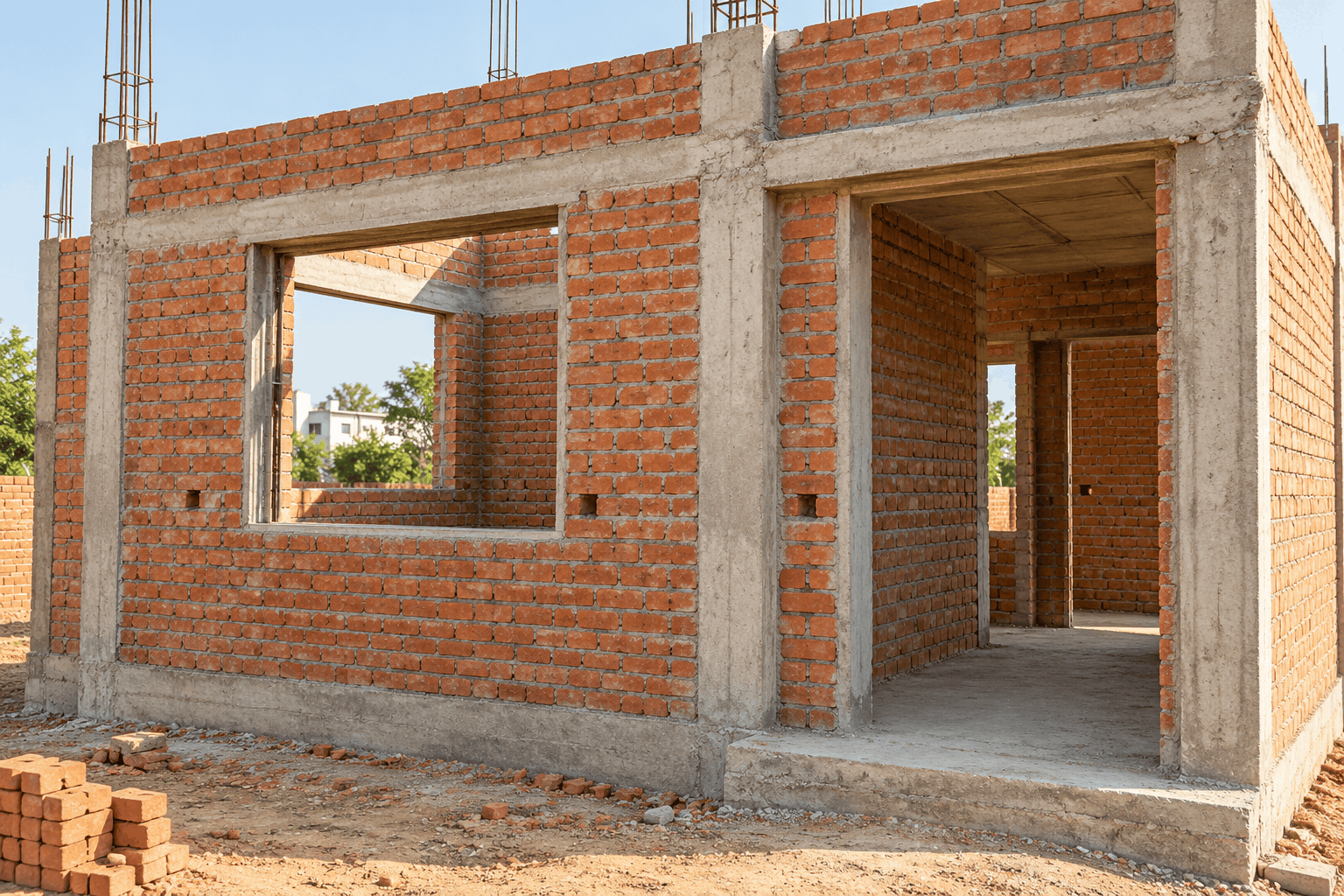
Introduction: The question to ask before you order materials
A new house takes shape one delivery at a time. A truck of sand arrives, cement bags are stacked in a dry corner, and the mason asks for another load of stone chips. It can all look routine until the bills start piling up. Order too little, and workers may lose a day waiting for supplies. Order too much, and you pay for storage, handling, and materials you might never use.
A better way to start: measure the work first, then calculate the material requirement. You don't need an advanced engineering degree to understand the basic arithmetic. You do, however, need to know what is being measured, which type of mixture is involved and where a rough estimate ends and structural design begins.
This guide is written for homeowners, site supervisors, students and first-time builders in India. It shows the arithmetic behind common construction estimates in metres, cubic metres, square feet, cubic feet and 50 kg cement bags. More importantly, it explains why an online calculator's neat answer may still differ from a contractor's actual requirement.
IMPORTANT: The formulas below are for preliminary quantity estimation and checking purchases. They do not specify safe concrete grades, footing dimensions, slab thickness or structural mix designs. For reinforced concrete, follow the drawings, exposure requirements and approved mix proportions provided by a qualified structural engineer or concrete technologist.
Know the difference: cement, sand and aggregate
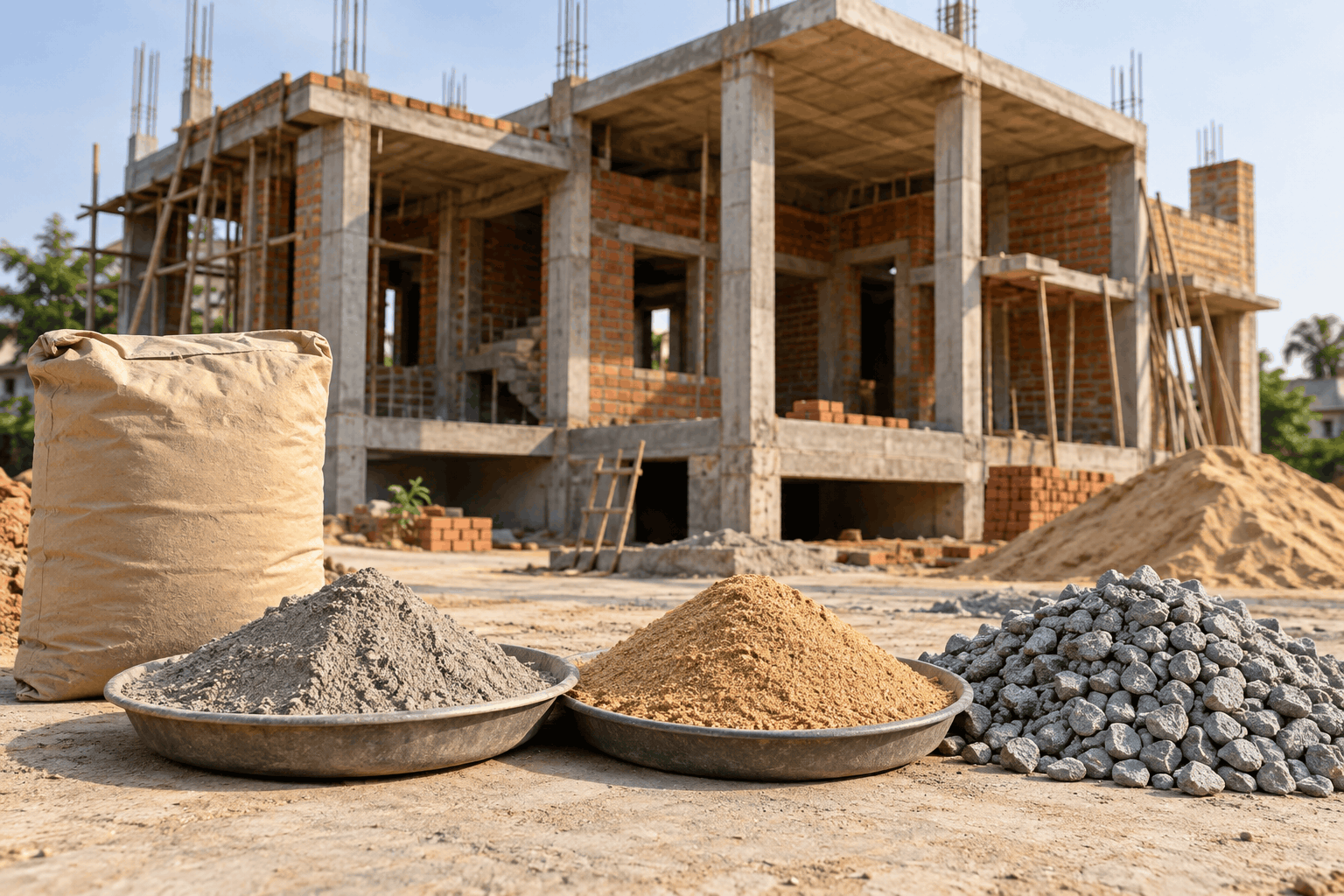
Cement is the binder. When mixed with water, it hydrates and helps bind sand and stone into a hardened mass. In India, cement is commonly sold in 50 kg bags, but check packaging and supply arrangements rather than assuming them.
Fine aggregate, commonly called sand, fills smaller spaces and contributes to the workability and structure of mortar and concrete. Natural sand and properly graded manufactured sand (M-sand) can both be considered where suitable for the intended use. They are not automatically interchangeable without checking grading, moisture and specifications.
Coarse aggregate generally means crushed stone or gravel of an appropriate size and grading. It is used in concrete, but ordinarily not in conventional cement-sand plaster or brick-laying mortar. Homeowners often call it gitti, bajri or stone chips, depending on the region.
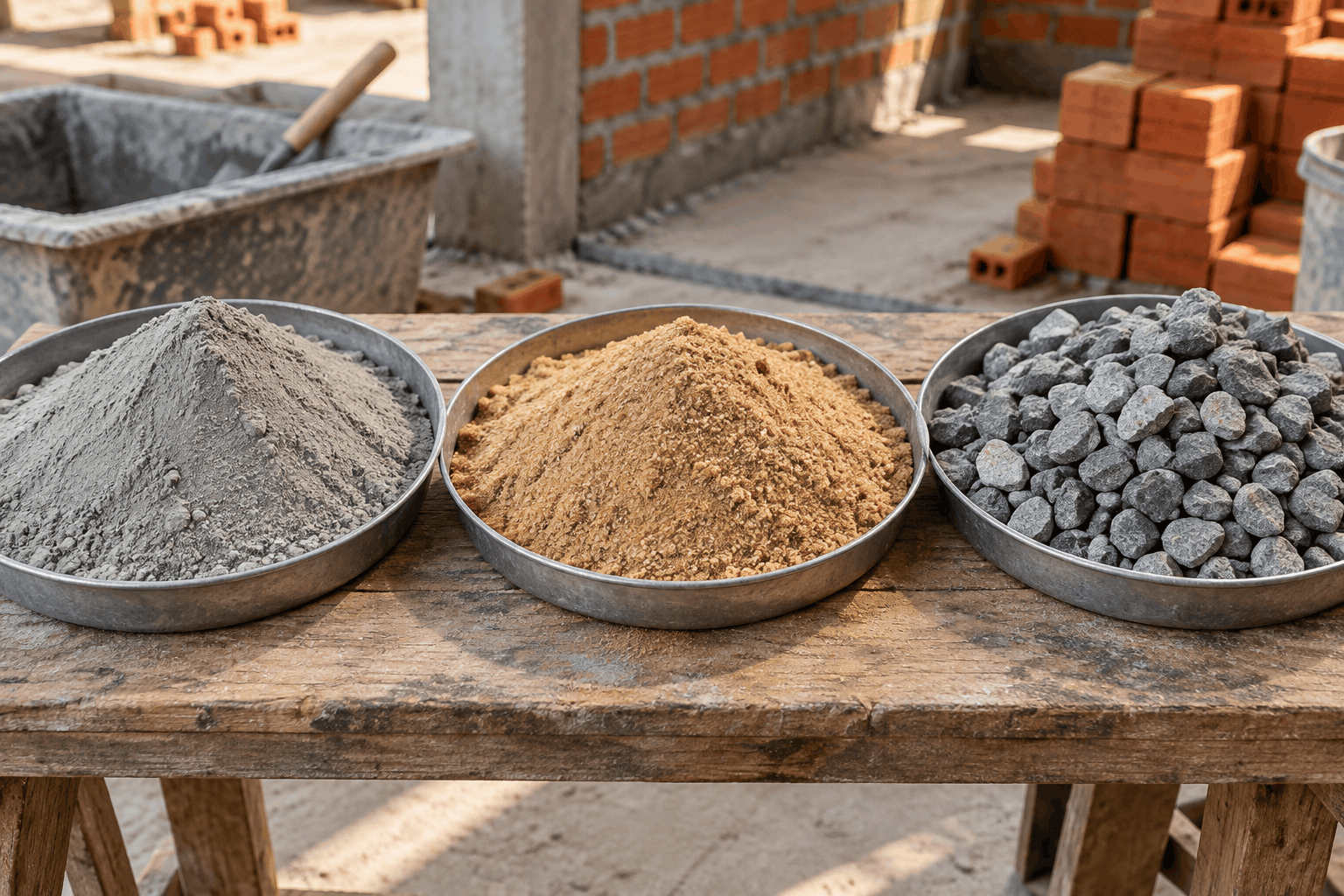
Three combinations appear repeatedly in house construction: concrete (cement + fine aggregate + coarse aggregate + water), mortar (cement + fine aggregate + water, possibly other specified constituents), and plaster (a mortar applied in a comparatively thin layer). Each must be calculated differently.
The units every homeowner should understand
Most errors begin with unit conversion. Contractors may discuss square feet for floors and walls, cubic feet for sand deliveries and cubic metres for ready-mix concrete. A bag of cement is counted by mass, not by its visible size.
The 1,440 kg/m³ figure is a convenient loose bulk-density assumption, not cement's true particle density. Actual bulk density varies. Use the bag's labelled mass for purchases and the approved mix's mass-based quantities for designed concrete.
EXAMPLE: A sand delivery of 100 cft contains about 100 ÷ 35.3147 = 2.83 m³ of measured loose sand. That does not mean it will make 2.83 m³ of finished mortar, because empty spaces between grains, moisture and compaction change the volume relationship
Reference table
| Quantity | Useful conversion |
|---|---|
| 1 metre | 3.28084 feet |
| 1 square metre | 10.7639 square feet |
| 1 cubic metre (m³) | 35.3147 cubic feet (cft) |
| 1 cubic foot (cft) | 0.0283168 m³ |
| 1 cement bag (common) | 50 kg |
| Assumed loose bulk density of cement | About 1,440 kg/m³, for preliminary volume calculations |
| Volume equivalent of one 50 kg cement bag | 50 ÷ 1,440 = 0.0347 m³, or about 1.23 cft |
First formula: calculate the volume of work
Before splitting any mix into materials, calculate the volume of concrete or mortar required by the drawings.
FORMULA: Volume (m³) = Length (m) × Width (m) × Thickness or depth (m)
For a concrete slab, length and width describe the plan dimensions while thickness is the designed slab depth. For a rectangular PCC bed, they describe its overall geometry. For long beams and columns, calculate each member separately, accounting for overlaps to avoid double counting.
If the measurements are in feet, calculate volume in cubic feet first and then divide by 35.3147 to obtain cubic metres. Do not multiply dimensions expressed in feet by thickness in millimetres without converting one set of units.
FORMULA: Volume (m³) = Volume (cft) ÷ 35.3147
EXAMPLE: A 12 ft × 10 ft slab with an assumed, illustrative thickness of 125 mm has a volume of (12 × 0.3048) × (10 × 0.3048) × 0.125 = 1.394 m³. Its actual thickness must be determined by structural design, not by this example.
Why calculated concrete volume is not the same as dry material volume
If you measure a loose heap of sand, a heap of stone and a quantity of cement, their combined loose volume is not the volume of finished concrete. Fine particles occupy spaces between larger particles, and mixing, water and compaction alter the total volume.
For a rough, volume-based nominal concrete estimate, a widely used planning shortcut is to multiply the target volume of finished concrete by about 1.54. It is an estimating convention, not a constant specified for every mix and not a substitute for a tested concrete mix design.
FORMULA: Estimated dry ingredients volume for nominal concrete = Finished concrete volume × 1.54
EXAMPLE: For 1.00 m³ of finished nominal concrete, the illustrative dry ingredients volume is 1.00 × 1.54 = 1.54 m³.
Mortar is different. A convenient rule of thumb for ordinary cement-sand mortar quantities is a dry-volume multiplier around 1.33. The real relationship can vary with sand grading, proportion and measuring method.
FORMULA: Estimated dry ingredients volume for mortar = Wet mortar volume × 1.33
Do not confuse these two factors. Neither factor is appropriate for reverse-engineering a supplier's certified ready-mix concrete recipe. A properly designed concrete mix is usually specified by mass quantities per cubic metre, moisture corrections and other controlled parameters.
Understanding mix ratios without misusing them
You may hear a mason request “one part cement, two parts sand and four parts gitti.” That is shorthand for a 1:2:4 volume proportion, not an automatic guarantee of compressive strength. The ratio totals seven parts: one for cement, two for sand and four for coarse aggregate.
Reference table
| Familiar nominal ratio | Cement : sand : coarse aggregate | How to read it |
|---|---|---|
| 1:3:6 | 1 : 3 : 6 | A lean nominal proportion sometimes used in specified plain concrete work |
| 1:2:4 | 1 : 2 : 4 | A traditional nominal proportion often associated with M15-style teaching examples |
| 1:1.5:3 | 1 : 1.5 : 3 | A traditional nominal proportion often associated with M20-style teaching examples |
| Design mix | Varies by tested design | Materials are proportioned for required strength, durability and workability |
A crucial distinction: M15 and M20 denote characteristic compressive strength at 28 days, not a universal recipe printed on every cement bag. IS 456:2000 expresses its permitted nominal mixes on a mass basis, with adjustments for material grading. It permits nominal mixing only up to M20 under its provisions and prefers design mix. For structural RCC, the grade, mix and placement requirements must follow professional design and quality controls. In particular, do not assume that a fixed 1:1.5:3 site ratio will automatically produce compliant structural M20 concrete.
For calculation lessons below, the traditional volume ratios are used only as transparent arithmetic examples. Your project's approved mix may use very different quantities, including chemical admixtures or supplementary cementitious materials.
Core calculation: cement, sand and aggregate for 1 m³ of nominal concrete
Suppose you need an illustrative 1 m³ of finished concrete and want to estimate traditional 1:2:4 batching quantities.
First calculate the dry-volume allowance: 1 × 1.54 = 1.54 m³. The total ratio parts are 1 + 2 + 4 = 7.
FORMULA: Cement volume = Dry volume × Cement part ÷ Total parts
FORMULA: Sand volume = Dry volume × Sand part ÷ Total parts
FORMULA: Coarse aggregate volume = Dry volume × Aggregate part ÷ Total parts
FORMULA: Cement bags = Cement volume (m³) × 1,440 (kg/m³) ÷ 50 (kg/bag)
For the 1:2:4 example, cement occupies 1.54 × 1/7 = 0.220 m³, or approximately 6.34 bags (317 kg). Sand occupies 1.54 × 2/7 = 0.440 m³ (15.54 cft), and coarse aggregate occupies 1.54 × 4/7 = 0.880 m³ (31.08 cft).
Reference table
| For 1 m³ of finished nominal concrete | 1:3:6 | 1:2:4 | 1:1.5:3 |
|---|---|---|---|
| Cement, 50 kg bags (approx.) | 4.44 | 6.34 | 8.06 |
| Sand, loose dry volume (m³) | 0.462 | 0.440 | 0.420 |
| Coarse aggregate, loose dry volume (m³) | 0.924 | 0.880 | 0.840 |
NOTE: This quick-reference table uses the 1.54 multiplier, a cement loose bulk density of 1,440 kg/m³ and simplified volumetric proportions. It is not a compliant structural mix-design schedule; measured results vary with the actual materials.
Worked example: cement, sand and aggregate for a concrete slab
A slab calculation should begin with the actual structural drawings. Consider a hypothetical 12 ft × 10 ft slab, 125 mm thick, with no openings or deductions. Its volume is 1.394 m³. We will apply the illustrative 1:1.5:3 batching shortcut simply to demonstrate the process.
Step 1. Finished concrete volume = 3.6576 × 3.048 × 0.125 = 1.394 m³.
Step 2. Estimated dry volume = 1.394 × 1.54 = 2.146 m³.
Step 3. Ratio total = 1 + 1.5 + 3 = 5.5.
Step 4. Cement = (2.146 ÷ 5.5) × 1,440 ÷ 50 = about 11.24 bags.
Step 5. Sand = 2.146 × (1.5 ÷ 5.5) = about 0.585 m³, or 20.7 cft.
Step 6. Coarse aggregate = 2.146 × (3 ÷ 5.5) = about 1.171 m³, or 41.4 cft.
For procurement planning you might round cement upward and discuss delivery tolerance with the supplier, but do not add arbitrary quantities to the actual design mix. Additional considerations include slab reinforcement, openings, beam intersections, pump losses, and approved wastage. Do not select slab thickness, mix grade or reinforcement from this calculation.
Worked example: plain cement concrete below a floor or foundation
Lean plain cement concrete (PCC) is often used as a blinding or levelling layer where specified. Consider a rectangular PCC bed 4 m long × 1 m wide × 100 mm thick, giving 4 × 1 × 0.10 = 0.40 m³ of finished concrete.
Assume, for illustration, a traditional 1:3:6 nominal ratio. Dry volume = 0.40 × 1.54 = 0.616 m³. The total parts are ten.
Cement = 0.616 ÷ 10 × 1,440 ÷ 50 = 1.77 bags. Sand = 0.616 × 3/10 = 0.185 m³ (about 6.53 cft). Coarse aggregate = 0.616 × 6/10 = 0.370 m³ (about 13.06 cft).
The point is not that all PCC requires a 1:3:6 ratio. The specified grade and proportion depend on the drawing and site requirements. The purpose is to show how the same method scales from one cubic metre to a real measured quantity.
How to calculate cement and sand for brickwork mortar
Brickwork uses cement-sand mortar, not ordinary coarse-aggregate concrete. First calculate the net volume of brick masonry by deducting door and window openings. Then estimate how much of that masonry volume will be occupied by mortar joints.
The mortar percentage depends on brick or block dimensions, joint thickness, bond and workmanship. For a simple traditional brickwork estimate, using 25% of the net masonry volume as an illustrative wet-mortar allowance can be a starting point. It is not a universal standard for all bricks, blocks or wall types.
EXAMPLE: A wall is 10 m long, 3 m high and 230 mm thick. It has one 1 m × 2.1 m door opening. Gross brickwork volume = 10 × 3 × 0.23 = 6.90 m³. Opening volume = 1 × 2.1 × 0.23 = 0.483 m³. Net masonry volume = 6.417 m³.
At an assumed mortar fraction of 25%, wet mortar = 6.417 × 0.25 = 1.604 m³. Dry mortar materials = 1.604 × 1.33 = 2.134 m³.
For an illustrative 1:6 cement-to-sand mortar (seven parts), cement = 2.134 ÷ 7 × 1,440 ÷ 50 = 8.78 bags. Sand = 2.134 × 6/7 = 1.829 m³ (about 64.6 cft).
Remember that openings, junction deductions, blocks of different sizes and required mortar mix specifications can all change the answer. Estimate internal and external walls separately when they have different thicknesses or materials.
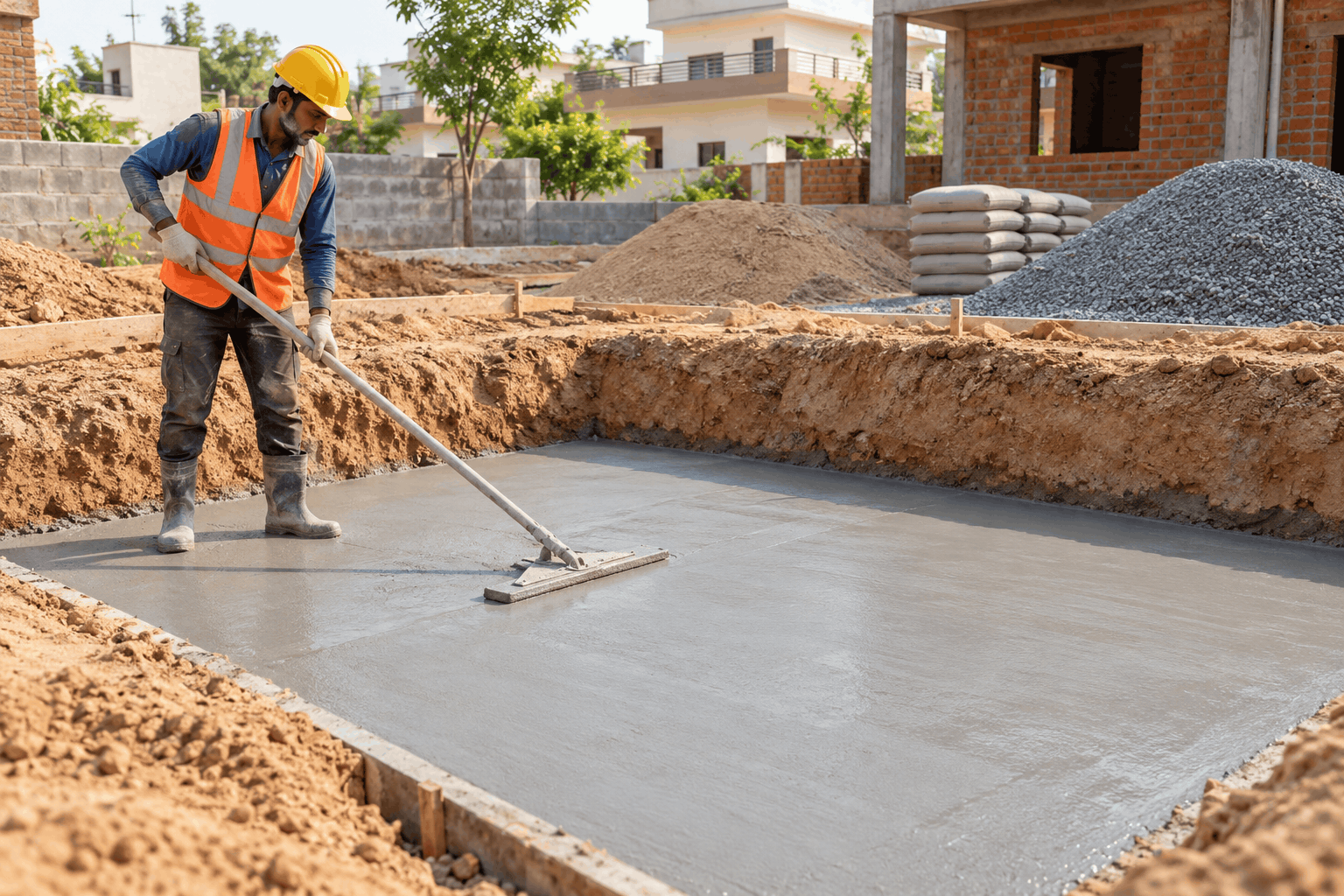
How to calculate cement and sand for wall plaster
Calculate plaster from its net surface area, average applied thickness, and specified cement-sand proportion. The thickness may differ between internal walls, external surfaces and areas needing correction. Measure them independently.
FORMULA: Wet plaster volume (m³) = Net plaster area (m²) × Plaster thickness (m)
Suppose a house has 100 m² of wall surface to be plastered at an illustrative average thickness of 12 mm. Wet volume = 100 × 0.012 = 1.20 m³. Using the 1.33 mortar factor, estimated dry materials volume = 1.20 × 1.33 = 1.596 m³.
For a specified illustrative 1:4 cement-sand mortar, total parts = 5. Cement = 1.596 ÷ 5 × 1,440 ÷ 50 = 9.19 bags. Sand = 1.596 × 4/5 = 1.277 m³, or 45.1 cft.
To account for reasonable handling losses, a planner might allow around 5% in an early purchase budget: about 9.65 bags of cement and 1.34 m³ of sand. These are not instructions to change the mix proportions. They are procurement allowances that should be checked against site conditions.
Ceilings, rough masonry, two-coat plaster and unusually uneven substrates can change material demand. Also remember to deduct large openings and apply the measurement rules specified in your contract rather than subtracting every tiny opening inconsistently.
Floor screed and bedding mortar: another common requirement
A house may need a mortar screed or bedding layer below a floor finish, as specified by its design. Unlike concrete slabs, these layers are often estimated as cement-sand mortar with no coarse aggregate in the stated mix.
EXAMPLE: For 80 m² of floor area and a specified 40 mm average mortar layer, wet volume = 80 × 0.04 = 3.20 m³. Dry volume = 3.20 × 1.33 = 4.256 m³.
With an illustrative 1:4 cement-sand mix, cement = 4.256 ÷ 5 × 1,440 ÷ 50 = 24.51 bags; sand = 4.256 × 4/5 = 3.405 m³ (about 120.3 cft).
Do not confuse a mortar screed with a structural concrete floor slab. They serve different functions, and you should not substitute one for the other without an approved design.
What if the concrete is a designed mix or ready-mix concrete?
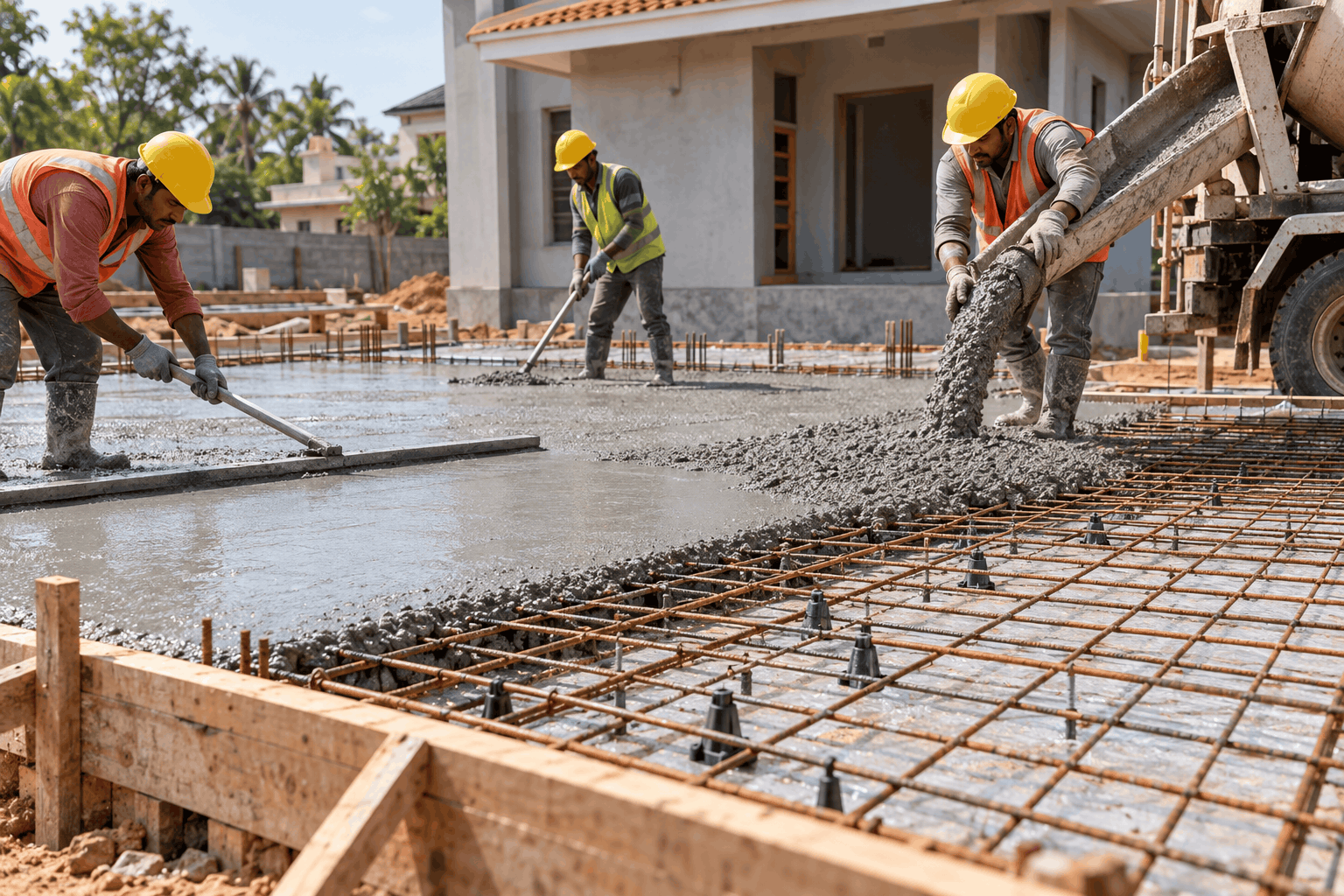
For reinforced concrete footings, beams, columns and slabs, a design mix is usually the dependable approach. In a designed mix, material quantities are established through calculations, trials and testing with the actual cement, fine aggregate, coarse aggregate, water and admixtures that will be used.
IS 456:2000 provides the code framework for plain and reinforced concrete, while IS 10262:2019 provides guidance on proportioning concrete mixes. IS 383:2016 covers specification requirements for coarse and fine aggregates. The project may also require relevant amendments and additional applicable standards.
A mix design is commonly presented in kilograms per cubic metre, for example, quantities of cementitious binder, fine aggregate, coarse aggregate and water. Those masses cannot safely be obtained by simply applying a universal 1.54 volume multiplier to an RCC slab.
EXAMPLE: If an approved design mix sheet specifies 350 kg of cement per cubic metre and the measured concrete requirement is 18 m³, the cement corresponding to that sheet is 18 × 350 = 6,300 kg, equal to 126 bags of 50 kg. This is a multiplication example only: 350 kg/m³ is not a recommended universal cement dosage. An actual mix may contain other cementitious materials and admixtures, and must satisfy the engineer's specification.
When ordering ready-mix concrete (RMC), the homeowner normally buys the required volume of concrete, not separate loose sand and aggregate for that volume. Ask the supplier about the specified grade, placement method, transit time, testing documentation, delivery unit, pump charges and the allowable order tolerance.
The overlooked issue: damp sand, bulking and moisture correction
Wet sand can appear to occupy more space than dry sand because a film of moisture separates the grains. This phenomenon is called sand bulking. It matters especially when workers use volume boxes or buckets to batch materials.
Imagine you need 2.00 m³ of sand measured on a particular dry-loose basis. If field measurement shows a 20% bulking correction for the moist sand, you would need about 2.40 m³ of that moist loose sand by volume to represent the same underlying sand quantity in this simplified example.
FORMULA: Moist loose sand volume = Required dry loose sand volume × (1 + measured bulking fraction)
Bulking is not a fixed 20% for all sand. It varies with grading and moisture content and should be measured using a suitable field or laboratory method when volume batching is used. The proper correction depends on what exactly is being compared.
In a designed concrete mix, moisture also affects the water added at the mixer. Aggregates may bring free surface moisture into the mix or absorb some water. Both affect workability and the effective water-to-cementitious-material ratio.
A common mistake is to pour in extra water until stiff concrete becomes easier to place. Additional water can weaken the intended mix and affect durability. The quantity of water, moisture adjustments and any use of admixtures should follow the approved mix and site quality-control procedure.
What does the water-cement ratio actually mean?
The water-cement ratio is a mass ratio, not a bucket-volume ratio. For a simple illustrative example, a water-cement ratio of 0.50 means 0.50 kg of water per 1 kg of cement, before considering the particulars of the mix and moisture corrections.
FORMULA: Water mass (kg) = Specified water-cement ratio × Cement mass (kg)
EXAMPLE: At a purely hypothetical ratio of 0.50, 50 kg of cement corresponds to 25 kg of water, approximately 25 litres at ordinary temperatures. This is not a recommended instruction for every 50 kg bag used on site. The correct limit and total water requirement depend on the concrete grade, exposure, workability, aggregate moisture, admixtures and design.
For mortar, workability is managed differently and needs to follow the application and mortar specification. Do not apply a concrete water-cement ratio blindly to plaster or masonry mortar.
The complete sample estimate: a 1,000 sq. ft. house
A common search is “How many cement bags for a 1,000 sq. ft. house?” Floor area alone cannot answer that. Two houses with identical built-up areas may have different foundations, numbers of floors, wall lengths, slab systems, plaster areas and finishing specifications.
The following is a deliberately hypothetical material take-off to show how a proper estimate is assembled. It is not a standard material requirement for every 1,000 sq. ft. home.
Assume the measured and specified activities are: 3.00 m³ of PCC calculated with a nominal 1:3:6 classroom ratio; 28.00 m³ of net conventional brick masonry with an illustrative 25% mortar fraction using 1:6 mortar; 250 m² of 12 mm plaster using 1:4 mortar; 80 m² of 40 mm bedding/screed using 1:4 mortar; and 18.00 m³ of structurally designed RMC, ordered separately.
Reference table
| Activity | Site cement (50 kg bags) | Site sand (m³) | Site coarse aggregate (m³) |
|---|---|---|---|
| 3 m³ PCC, illustrative 1:3:6 | 13.31 | 1.386 | 2.772 |
| 28 m³ net brickwork, mortar assumptions above | 38.30 | 7.980 | 0 |
| 250 m² plaster, 12 mm, 1:4 | 22.98 | 3.192 | 0 |
| 80 m² screed, 40 mm, 1:4 | 24.51 | 3.405 | 0 |
| Subtotal for these site-mixed activities | 99.11 | 15.963 | 2.772 |
Separate RMC order: 18.00 m³ of approved, structurally designed concrete. Its cement, sand, and aggregate are not included in the site-mixed subtotals because RMC supplies them. This prevents double-counting.
For an illustrative 5% purchase allowance on the listed site-mixed materials, the budget would be roughly 105 cement bags, 16.76 m³ of sand and 2.91 m³ of coarse aggregate. Actual allowance should be confirmed with the supplier and contractor. Do not assume the 5% automatically applies to RMC orders or engineered mix proportions.
What is missing? Other possible PCC locations, staircase or terrace treatments, repairs, alternate mortar areas, waterproofing systems, cementitious adhesives and project-specific details. A full building BOQ must account for every measured item on the approved drawings.
A simple quantity worksheet you can copy
The most useful construction estimate is one that another person can verify. Create a spreadsheet or notebook with each measurable activity on its own line.
Reference table
| Work item | Dimensions or area | Finished/wet volume | Mix basis | Materials | Remark |
|---|---|---|---|---|---|
| PCC | L × W × T | m³ | Specified nominal/design | Cement, sand, aggregate | Check grade and drawing |
| RCC | Member schedule | m³ | Approved design mix | Usually RMC or mass-based batching | No generic ratio |
| Masonry | Gross wall − openings | m³ | Specified mortar, estimated joints | Cement and sand for mortar | Check block size |
| Plaster | Net wall/ceiling area × thickness | m³ | Specified mortar | Cement and sand | Use average thickness |
| Screed | Floor area × specified thickness | m³ | Specified mortar | Cement and sand | Exclude slab |
A second sheet should record opening and closing stock: material received, quantity issued, quantity returned, wastage, balance and supplier invoice number. This turns an early estimate into a practical site-management tool.
Converting the result into a buying budget
Once you have quantities, request delivered rates from local suppliers. A sand price quoted per cft and another quoted per tonne cannot be compared until the actual measuring basis and verified bulk density are understood. Likewise, a stone price that excludes unloading may not be cheaper in the end.
FORMULA: Estimated material cost = Cement bags × Delivered price per bag + Sand quantity × Delivered rate per unit + Aggregate quantity × Delivered rate per unit
EXAMPLE: Suppose a purely illustrative site-material budget uses 105 bags of cement at ₹390 per bag, 16.76 m³ sand at ₹1,500 per m³ and 2.91 m³ aggregate at ₹1,300 per m³. Cement would cost ₹40,950; sand, ₹25,140; and aggregate, approximately ₹3,783. The illustrative total is about ₹69,873 for these three site-purchased materials only.
That amount is not the price of building a 1,000 sq. ft. house. It excludes the separate RMC order, bricks, steel, labour, transport not already included, taxes where applicable, shuttering, waterproofing and many other items. Rates here are made-up teaching inputs, not verified current 2026 local market quotations.
Why two contractors can produce different estimates
An estimate is only as clear as the assumptions underneath it. One contractor may use actual brick dimensions and joint thickness; another may assume a blanket mortar percentage. One may quote sand in loose cft; another may use compacted volume or weight. One may exclude openings from plaster; another may charge according to a formal schedule of measurement.
Check these issues before comparing totals:
• Is the concrete quantity taken from approved member dimensions, with overlaps handled consistently?
• Are RCC materials included separately or already contained in an RMC quotation?
• Is the mortar mix expressed by volume, by mass or by an approved specification?
• Has the estimator used the correct dry-volume assumption for the specific task?
• Are sand moisture and bulking treated sensibly rather than ignored?
• Are plaster thicknesses and net areas measured independently?
• Does the quotation show delivery, unloading, taxes and reasonable wastage clearly?
• Are the same activities and material specifications included in every bid?
If a contractor cannot explain the assumptions, ask for a line-by-line quantity sheet before committing money.
Material quality: the numbers are only half the story
A precise quantity of poor material is still poor construction. Cement should be appropriate for the specified work, within usable shelf life and stored away from moisture. Sand should be free from harmful contamination and suitably graded. Coarse aggregate must be appropriate for the member, reinforcement spacing and project specifications.
The Bureau of Indian Standards identifies IS 383:2016 as the specification for coarse and fine aggregates for concrete. This matters because a label such as “river sand” or “20 mm gitti” alone does not establish compliance with all quality requirements.
Testing and supervision deserve attention. Site practices can affect concrete quality as much as the original materials: incorrect batching, excessive water, segregation, inadequate compaction and poor curing all matter. For structural concrete, require the testing and inspection provisions called for in the project documents.
Ten common mistakes in cement, sand and aggregate calculations
Mixing square feet and cubic metres. Area does not become volume until a thickness is applied. Always show the units in the equation.
Using a concrete ratio for plaster. Conventional plaster mortar needs cement and sand, not the coarse aggregate allowance from a 1:2:4 concrete example.
Applying the 1.54 factor twice. Once you have converted finished nominal concrete volume to an illustrative dry-material volume, do not repeat the factor after calculating each component.
Treating 1:1.5:3 as a guaranteed RCC recipe. Traditional ratios are educational shortcuts; structural concrete must follow approved mix specifications.
Measuring damp sand as if it were dry. Moisture can change the loose measured volume and the mix water balance.
Forgetting openings. Doors and windows alter masonry and plaster quantities. Apply the contractual deduction method consistently.
Ignoring thickness. Changing a plaster layer from 12 mm to 15 mm increases its theoretical wet volume by 25% for the same surface area.
Double-counting RMC ingredients. If the supplier provides 18 m³ of RMC, its constituent cement and aggregates are part of that delivered product.
Ignoring waste and supply units. Bags are whole items; trucks, tonnes and cubic feet may have different rounding conventions. Plan purchases according to verified delivery units.
Assuming built-up area gives a complete bill of quantities. A 1,000 sq. ft. plan is a useful starting point, not a substitute for measuring the building's actual elements.
Smart purchasing and storage practices for Indian house sites
Order in stages aligned with the work programme, especially when storage space is limited. Protect cement from rain, standing water and damp floors. Stack bags according to suitable site-storage practices and use older stock first where appropriate. Do not keep cement indefinitely and assume it will perform like fresh material.
Keep sand and coarse aggregates on clean, separate surfaces. Mud from the ground and debris from nearby work can contaminate material. Where possible, inspect delivered quantities before unloading is complete and record the delivery date, supplier, vehicle details and measured or weighed quantity.
Use the same measurement convention throughout a job. If sand is ordered by cft, write the converted m³ alongside it. If aggregate is billed by tonne, record the supplier's weight slip rather than estimating mass from an unsupported “one truck equals X tonnes” claim.
Small controls prevent surprisingly large disputes. They also make the next month's purchase order easier to prepare.
Where online building calculators help—and where they cannot
An online cement, sand, and aggregate calculator helps check calculations and explore how material quantities change with dimensions. It can quickly show the effect of a larger slab, different plaster thickness or a revised hypothetical volume proportion.
But a calculator cannot discover poor soil beneath a site, determine a safe slab thickness, inspect aggregate grading, or approve a structural concrete mix. Qualified professionals, drawings, and tests drive those decisions.
At My Home Jankaari (www.myhomejankaari.com), use home-planning and measurement calculators as a way to understand quantities before requesting a BOQ or supplier quotation. Enter dimensions carefully, check each unit, and confirm which inputs are assumptions. Good calculators make a conversation with your contractor more informed; they do not replace it
Final checklist before cement, sand or aggregate arrives
Before placing an order, write down the measured item, the approved specification, the required quantity and the delivery unit. Ask whether taxes, transport, unloading and testing are covered. Check that storage is ready and that the material will actually be needed in the construction sequence.
Keep a separate column for design-approved concrete in m³ and for site-mixed mortar ingredients. This alone avoids one of the most common estimating mistakes: buying sand and aggregate for concrete that a ready-mix supplier has already priced as a complete product.
The best building-material calculation is not the one with the most decimal places. It is the one that clearly states its basis, can be checked against drawings and can be updated when real measurements and supplier information become available.
Reference table
| Heading 1 | Heading 2 |
|---|---|
| Value 1 | Value 2 |
| Value 3 | Value 4 |
Frequently Asked Questions
How much cement, sand and aggregate are needed for 1 m³ of concrete?
It depends on the mix. Using a traditional 1:2:4 volume ratio and a 1.54 dry-volume allowance, you get about 6.34 bags of 50 kg cement, 0.44 m³ of sand, and 0.88 m³ of coarse aggregate for an illustrative 1 m³ of finished nominal concrete. This is an estimation exercise, not an approved RCC mix design.
How many bags of cement make 1 m³ of M20 concrete?
There is no single universal bag count for all compliant M20 concrete. An educational 1:1.5:3 volume-ratio example gives about 8.06 bags per m³, but actual M20 concrete depends on an approved mix design or the code's permitted nominal-mix provisions, aggregate grading, moisture and specifications. Never use the classroom result as an automatic structural purchase specification.
What is the formula for calculating cement bags?
For a simple volumetric estimate, first find the estimated dry-ingredient volume. Then calculate cement bags = [dry volume × cement part ÷ total ratio parts] × 1,440 ÷ 50. For a design mix, use cement bags = concrete volume × approved cement dosage (kg/m³) ÷ 50. Keep these two methods separate.
Why is 1.54 used in concrete calculations?
The factor 1.54 is a common estimating allowance that converts a volume of finished nominal concrete into a larger approximate combined loose dry-material volume. It accounts broadly for voids and volume change during mixing and compaction. It is not a constant prescribed for every type of concrete or a substitute for laboratory-tested design proportions.
Why is 1.33 used for mortar calculations?
A factor around 1.33 is a common planning shortcut for estimating dry cement and sand quantities from the wet volume of conventional mortar. The appropriate factor varies with material and batching assumptions. It should not be applied indiscriminately to designed concrete or every masonry system.
How do I calculate cement and sand for plastering 100 m² of wall?
If the specified plaster is 12 mm thick and the illustrative mix is 1:4, wet mortar volume is 1.20 m³. With a 1.33 dry-volume multiplier, the approximate materials are 9.19 cement bags and 1.277 m³ of sand, before a separately stated handling allowance. Actual thickness and surface conditions can change this quantity.
Is M-sand suitable instead of river sand?
Properly graded manufactured sand may be suitable for certain concrete or mortar applications when it satisfies the project's applicable specifications. Check grading, particle shape, fines, moisture, impurities and performance with the chosen mix. Do not assume that all products sold as M-sand behave identically to natural sand.
How much cement does a 1,000 sq. ft. house require?
There is no reliable single number based on floor area alone. Material quantities depend on the foundations, structural system, number of floors, wall volume, plaster area, floor finishes and whether RCC is supplied as ready-mix. Prepare an itemized take-off from drawings; never use a universal bags-per-square-foot claim as the final purchasing basis.
Should I add 5% or 10% wastage to every material?
No fixed percentage suits all projects and products. A modest allowance may be appropriate for some loose site-mixed materials, but cement bags, concrete delivery, sand bulking, breakage, returns and site conditions each need different treatment. State the allowance separately, verify supplier units and avoid modifying an approved mix proportion.
Can a construction calculator replace a structural engineer?
No. A calculator can check dimensions, volumes, conversions and preliminary material quantities. It cannot design safe columns, slabs or foundations, establish concrete durability requirements, approve aggregate quality or validate a tested mix. Use calculators for planning and independent arithmetic checks, then follow the qualified professionals responsible for structural design and site quality control.

References and Further Reading
The standards below are relevant technical reference points. Verify their latest applicable amendments and your project's specifications before use. The arithmetic shortcuts in this article are identified as illustrative estimating conventions, not as quotations from BIS standards.
• Bureau of Indian Standards, IS 456:2000, Plain and Reinforced Concrete — Code of Practice. BIS Standards Portal: https://www.bis.gov.in/ ; publicly accessible reference text: https://law.resource.org/pub/in/bis/S03/is.456.2000.pdf
• Bureau of Indian Standards, IS 10262:2019, Concrete Mix Proportioning — Guidelines. BIS Standards Portal: https://standards.bis.gov.in/
• Bureau of Indian Standards, IS 383:2016, Coarse and Fine Aggregate for Concrete — Specification. BIS standard information: https://standards.bis.gov.in/
• Bureau of Indian Standards, product manual for IS 383:2016 (aggregate types and quality testing): https://www.bis.gov.in/wp-content/uploads/2020/05/PM-IS-383-MAY-2020-REVISED.pdf
Editorial note: Educational estimates are rounded for readability. Actual procurement must be based on approved drawings, mix designs, measured quantities and current local supplier quotations. No 2026 material rate is represented as a verified market quotation in this article.